
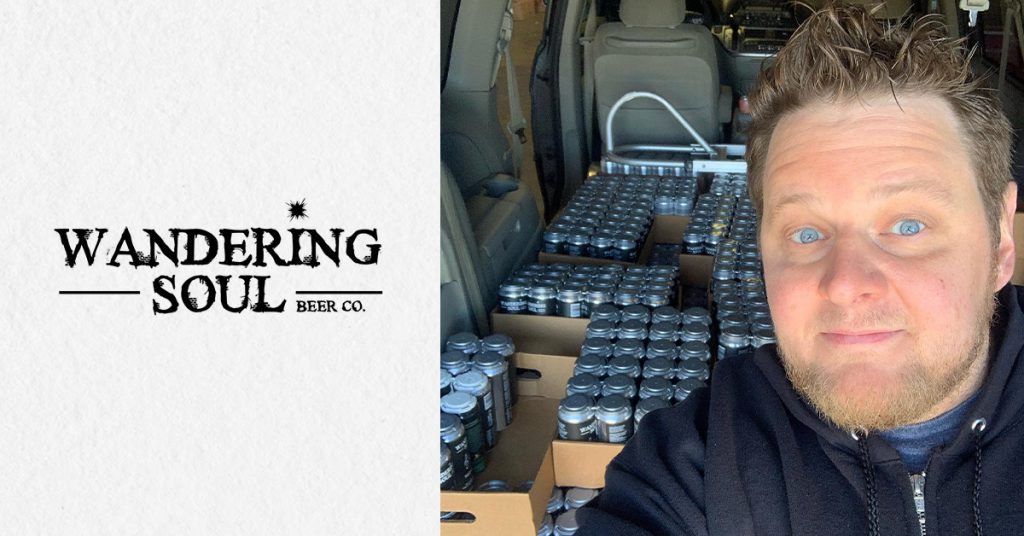
In the latest edition of A Round With – Brewbound’s Insider-exclusive Q&A series with industry leaders – we caught up with Matt Smith, founder of Beverly, Massachusetts-based Wandering Soul Beer Co.
Wandering Soul is a contract-brewed brand concentrated on the North Shore of Massachusetts that homebrewer Matt founded in 2018 as a way to honor the memory of his daughter. Many of the beers in Wandering Soul’s portfolio are infused with Matt’s story. Here, he discusses the challenges of pouring so much of oneself into a business and how to find harmony in contract brewing relationships.
Wandering Soul’s story is so personal – your flagship Melody Maker is named for your stillborn daughter, and many beers in your portfolio take their inspiration from the journey your grief took you on. How does it feel to share so much of yourself through your business?
Matt: I appreciate that you used the word “journey” in terms of this. Wandering Soul has always been a very personal endeavor to me, and each beer has to mean something. Melody Maker was the beer that started Wandering Soul, and it was a crucial part of the healing process for me after she died. I’m going to be honest — sharing such personal details of my life in the context of the craft beer world has not been easy.
At times, I’ve viewed myself as some sort of outsider, even though I’ve been in this industry for a long time. Grief can be an intensely isolating experience. It has been an amazing thing though, to be able to share this experience with others and have them resonate with it.
When I started Wandering Soul, someone close to me said something to the extent of “be careful, you’re going to make everyone sad.” That stuck with me, and it has never been my intention. I want to do something with meaning and I want to keep memories alive. But no, it hasn’t been easy.
Vulnerability and empathy are thoroughly woven through Wandering Soul and it’s clear from comments on the brand’s social media that this resonates with drinkers. How does this shape your business relationships?
Matt: I’ve always worn my heart on my sleeve, going back to when I was a kid. I don’t really know any other way to be, at least at this point in my life. It’s been challenging to treat Wandering Soul as a business, but I obviously have to do that.
My business relationships though … they’ve been “whittled down” to a core group of people who believe in what I’m doing, who I trust, and many of whom are my friends. I’m actually really lucky in that department, and I value those relationships deeply. I’ve made a lot of really good friends throughout this experience.
Wandering Soul donates portions of proceeds from several beers to organizations including Resolve New England, which supports families going through infertility and pregnancy loss. Why was it important to build this into your business model?
Matt: There are some really good people out there, doing really good things. If I believe in a cause or it resonates with me, I’ll try to incorporate it into what I’m doing.
Resolve New England is now called AllPaths Family Building but they’re doing the same type of work, and the executive director, Kate Weldon LeBlanc, was really helpful when my wife and I were in the early stages of grief. Pregnancy loss occurs in many different ways, shapes and forms and it is part of the universal human experience. An organization that can recognize that, and support people as they try to build their families is just amazing, and I’m happy to be connected to them.
You launched Hidden Path sparkling hop water last year as a non-alcoholic alternative. Tell us about the decision to create a separate brand, rather than including it under the Wandering Soul umbrella.
Matt: Hidden Path has had its own journey, and I’m so happy with where it is right now. We just canned a new version of the hop water, this time with Citra and Nelson Sauvin hops. I’m really happy with how it came out.
I wanted to make Hidden Path its own entity as much as possible, because I didn’t want it all tied to my personal story. Of course, it’s always going to be a personal thing, but I really wanted to treat this project differently. It’s more about the actual product, and less about the story behind it. I think it speaks for itself in the world of non-alcoholic beverages. But there’s certainly a story there, and it took me a long time to come up with the recipe since it’s a new beverage category and I had to come up with my own process.
You took a break at the end of 2022 and paused production for a few months. What did you learn about yourself and the brand during that time?
Matt: Yes, it became too much for me. I was overwhelmed. I was tired, and pretty beat up physically. I needed to separate myself from Wandering Soul for a while. There was a feeling of relief because I knew I’d have a break, and I could finally really focus on my mental and physical health. I did that for a bit.
Then, I became restless, especially as I started searching for other jobs. I wasn’t finding anything that had any real meaning, and Wandering Soul means so much to me. In the end, there’s no way to treat this as a business that’s solely focused on making money.
There are many businesses where that’s the only goal. I’ve done all of this from my personal savings, I have no partners or investors, and I try to rely only on myself. When I shut it down, I learned how to pace myself a bit more and look at the reality of the “one-man show” approach, and treat myself with a little more kindness.
Several North Shore breweries serve Hidden Path as an NA option for guests. What were those conversations like?
Matt: Again, they’ve mostly been conversations with friends. Many of the breweries that carry Hidden Path are in Beverly or surrounding towns. And Remnant Brewing in Somerville, as an example, is one where I’m good friends with their head brewer Charlie. Same with the breweries in Beverly, I’m friends with all of them.
So really, it was just approaching them with this new product, which I felt could be a good fit at breweries, for beer customers who were taking a break from it, or who wanted to just pace themselves and hydrate a bit more (because what they’re drinking is basically carbonated water). When I realized I could sell Hidden Path to other breweries, it was such an awesome epiphany.
You ship Hidden Path directly to consumers. What have you learned about your drinkers through opening this avenue?
Matt: I’ve learned a lot. Some of the customers for Hidden Path are in recovery, some are battling serious health conditions… Everyone has their own story. And it has been very moving for me personally, to be able to help people in some way with an alternative to beer (but as close as I can get without using grain in the recipe).
Before striking out on your own, you worked at Clown Shoes. How does this experience inform your entrepreneurial path?
Matt: When I was working with Clown Shoes, it was a small operation. We were constantly pivoting, making decisions on the fly, dealing with problems as they came up, and actually it was very chaotic.
We were all forced to adopt an entrepreneurial mindset back then, because that’s just how the business was running. It was really fun to get involved there and see it grow the way it did. I learned a ton, and a lot of it was trial and error.
Do you have any plans to open a taproom?
Matt: I’m open minded about the form that Wandering Soul Beer takes moving forward.
What advice would you give to fellow brewers entering contract brewing relationships?
Matt: Choose your partners wisely, and trust them. Keep a close eye on the processes as well, and the details of your beer recipes and how they are scaled up. The main thing is trust, though.
I was so scared when we brewed the first batch of Melody Maker at Castle Island Brewing in early 2019. It was an incredible experience, and the folks over there have become like family to me. But they know what they’re doing, and I hate to say it, but there are breweries out there that aren’t as attentive to detail. So just keep a close eye on things, and I think it’s important to come into any contract brewing relationship with a solid understanding of brewing beer.
It sounds like a no-brainer, but the reality is that there are some businesses out there that are more concerned with profit than quality. That’s just the way it is, and you need to know what you’re trying to make, what you’re trying to achieve, and there needs to be something more than money attached to it.