
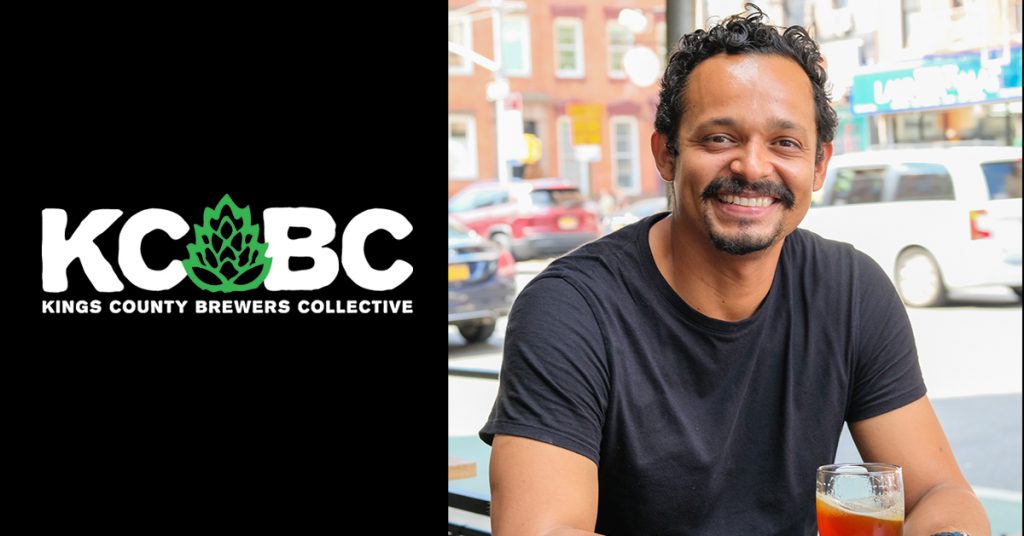
It’s hard to find someone with a more meteoric rise in craft beer than Rafael D’Armas.
In about three years, he went from a production intern to graduating from the World Brewing Academy’s master brewer program.
Now a brewer at New York City’s KCBC (aka Kings County Brewing Company) and a board member of the Michael James Jackson Foundation for Brewing and Distilling (MJF), Rafael shares his thoughts on the evolving craft beer world in the latest installment of Brewbound’s A Round With Q&A.
Your educational background and early career are in political science and international relations, with a focus on democratic backsliding. How did you find your way to beer and what connections do you see between the two?
Rafael: I’ll start with the connections, as they’re surprisingly similar. It might just be because of my academic background that I tend to see the world through that lens, but if you’re interested in political science and international relations, you’re likely drawn to understanding how the world works — how society functions, and how we structure power and social relations. Beer reflects many of these dynamics.
Traditionally, beer was shaped by geography, climate, access to resources, bureaucracy, and power dynamics in the places where it was brewed. Beer is a form of identity because it’s the byproduct of material, geographical, and political circumstances.
For a long time, part of my job as an analyst was to travel across Latin America and the Caribbean, trying to understand the political landscape. That often meant meeting with activists, NGOs, academics, and political parties. Interestingly, some of the best learning moments came not from the formal meetings, but from sitting down with people you’ve built rapport with — over a beer.
You formally entered the industry through a production internship at the Bronx Brewery sponsored by Beer Kulture in 2021. Without that program, where do you think you would be right now – in beer or doing something else?
Rafael: It’s hard to say. In retrospect, a career in beer feels inevitable, given how it intersects with so many things I love. But without the Beer Kulture internship, I don’t think I would have taken the leap.
Before I applied, I didn’t know anyone in the industry, nor did I have any idea how to get started. The fact that Beer Kulture offered a paid entry-level position specifically for people of color — and structured to give real career experience — was incredibly appealing. Going through the application and interview process, and meeting the Beer Kulture team, was a game changer.
In 2022, you enrolled in the Siebel Institute of Technology on the Sir Geoff Palmer Scholarship Award from the MJF. How did this experience change your outlook on brewing?
Rafael: Becoming an MJF awardee was a very happy experience and an honor. When I was doing my internship at the Bronx Brewery, I was fascinated by the first cohort of MJF recipients — their stories, their backgrounds. I admired them and aspired to follow in their footsteps. Thanks to the scholarship, I was able to receive the best technical brewing education available to me.
The program covers a vast amount of material in a relatively short time and exposed me to areas of the beer industry I wouldn’t have experienced otherwise. I learned from great instructors, met some of the best brewers in the world, and got to spend time with smart, talented peers who became friends. It broadened my horizons and set me on the path to becoming the best brewer I can be.
How did it feel to complete the World Brewing Academy’s master brewing course?
Rafael: It was incredibly satisfying. I was grateful for the opportunity to attend a program like the WBA. As exciting, fun, and challenging as it was, it also meant being away from family and not earning an income. So when you finish, there’s a huge sense of accomplishment and anticipation for the future.
The graduation ceremony itself was a major event — it’s held at the Augustiner Keller in Munich, where you graduate alongside your German peers, with much of the Munich brewing community present. And, of course, there was plenty of great lager to go around.
The MJF has created measurable change in the beer industry in an impressively short period of time. What’s the secret to the foundation’s success?
Rafael: Honestly, there’s no secret. It’s a group of talented, hard working people with a track record of excellence in the industry, committed to making a meaningful impact. They focus their efforts on diversity, inclusion, and technical education, digging deep into these areas.
It might sound cliché, but their success really comes down to intentionality, careful planning, and the personal time commitment of every board member. As an awardee, I can say that what sets the MJF apart is their empathy, understanding and guidance.
What has the experience of being an MJF board member meant to you?
Rafael: It’s been exciting and rewarding. It is a privilege to be the first awardee to join the board and it’s also a responsibility that I welcome and intend to honor to the best of my abilities. The MJF is planning for the future and I’m part of that process of growth.
Having gone through my first process of selecting the new cohort of awardees gave me the opportunity to see the inner workings of the board, and have a better understanding and a greater appreciation for the work the MJF does. It was fascinating to see the careful attention to detail that the board pays to each of the applicants, their individual circumstances and how the board’s goal is always to try to find ways to move the applicants forward, recognize and validate their efforts and keep their momentum going.
I’m honored to be part of it and I’m here for it.
How has the New York City (and surrounding area) beer scene changed since you joined the industry?
Rafael: It’s interesting to watch. Some areas of the industry are changing for the better, while others face new challenges. I’m excited to see the growing demand for higher-quality craft beer. The average consumer today has higher expectations for quality, and there’s a lot more beer education out there.
Taproom experiences now demand more attention to detail, which is fantastic. But there are significant challenges too — like creating safe and inclusive work environments, addressing issues of sexism and ableism, and improving HR practices.
There’s often a disconnect between the passion most production workers have for beer-making and the reality of making a sustainable living from it.
What’s your dream unexpected ingredient to brew with?
Rafael: After trying beers brewed with Fonio at Brooklyn Brewery last October, I’ve been intrigued by it. I also have a list of tropical fruits from my childhood that I want to experiment with. Sarapia, or Tonka bean, is one of those ingredients I’m excited to try.