
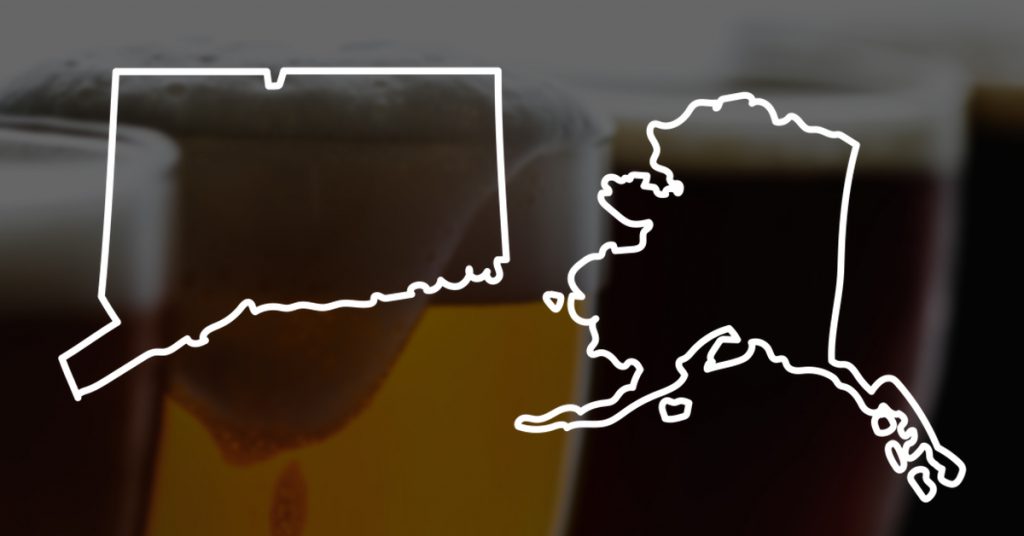
Days after the former U.S. surgeon general called for cancer risk warning labels to be placed on alcoholic beverages, two state Legislatures are considering bills that would expand cancer warnings for bev-alc consumers.
In Connecticut, state Sen. Saud Anwar has filed a bill (Proposed Bill No. 431) that would require bev-alc containers to feature cancer risk warnings, in addition to the federally prescribed health warning labels.
The bill proposes that Connecticut’s liquor control laws “be amended to require alcoholic liquor containers to bear labels warning consumers that alcohol consumption increases the risk of certain cancers.”
Anwar, who is also a medical doctor in addition to serving in the state Senate, filed the bill on January 10, when it was referred to the Joint Committee on General Law. A spokesperson for Anwar told Brewbound the legislation “is a unique bill that hasn’t been presented before” and the office is unaware of anything similar proposed in another state.
In Alaska, state Rep. Andrew Gray proposed House Bill 37 on January 22, which would require bev-alc retailers to display signs warning consumers of alcohol’s cancer risk.
The bill proposes language changes to the two signs that establishments licensed to sell or serve alcoholic beverages are required to display. The first sign, which warns of alcohol’s health risks for pregnant women, would be edited to include, “Alcohol use can cause cancer, including breast and colon cancers.”
The second sign, which warns that anyone who provides alcohol to minors could be fined or imprisoned, would be edited to include, “An unaccompanied person under 21 years of age who enters these premises in violation of law may, under AS 04.16.049(4), be civilly liable for damages up to $1,500.”
Both signs are required to be at least 11 inches by 14 inches with lettering “at least one-half inch high and in contrasting colors.” The first sign must be visible “to a person who will be purchasing or consuming alcoholic beverages” and the second must be posted at all entrances.
Gray proposed a similar bill in the last legislative session that was rolled into an alcohol omnibus bill with other matters. However, the combined bill was approved by lawmakers several minutes after the session’s deadline, so Gov. Mike Dunleavy vetoed it, the Alaska Beacon reported.
Connecticut’s and Alaska’s bills come as alcohol’s potential impact on health is scrutinized at the national level while the industry awaits updates to the Dietary Guidelines for Americans (DGA), which is reviewed every five years.
For this cycle, the Dietary Guidelines Advisory Committee (DGAC), a joint effort between the U.S. departments of Agriculture (USDA) and Health and Human Services (HHS), commissioned two studies of the consumption of alcohol and its relation to overall health. Both studies have been published.
The first report was published last month by the National Academies of Sciences, Engineering and Medicine (NASEM) and found that moderate drinkers had a 16% lower risk of all-cause mortality (dying from any cause) than non-drinkers, though it called out a connection between alcohol consumption and female breast cancer.
The second report, the Alcohol Intake and Health Study, was spearheaded by the Interagency Coordinating Committee on the Prevention of Underage Drinking (ICCPUD) and drew the ire of bev-alc industry trade groups, who said the process was opaque and duplicative to NASEM’s work. ICCPUD published its report earlier this month.
Sandwiched between the reports was former U.S. surgeon general Vivek Murthy’s advisory calling for cancer risk warning labels on alcoholic beverages.
It is not yet clear how the second Trump Administration’s policies will affect the DGA process.