
Sapporo is the largest Asian import beer brand by U.S. dollar sales by a wide margin, but Sapporo-Stone leadership has its sights on doubling the brand’s share of overall imports in the coming years, executives said during the brand’s virtual annual business plan meeting with wholesalers last week.
“To start, we want to double the size of Sapporo,” Sapporo-Stone CEO Zach Keeling said. “To put that in perspective, in terms of share, Sapporo was 0.9% of the import beer category, just 0.9%. Getting to 1.8% of market share delivers 5 million incremental cases of Sapporo into the market.”
To get there, the company plans to focus on the off-premise trade, particularly convenience stores and chains, where gaining new points of distribution is the “No. 1 priority,” chief revenue officer Tom McReavy said.
Three quarters into 2024, Sapporo has gained share in 45 states, secured more than 10,000 new points of distribution (POD) and increased depletions (sales to retailers) in off-premise chains by more than +25%, Keeling said.
Dollar sales of the Sapporo brand family have increased +12.7% at off-premise retailers tracked by market research firm NIQ, to $49.977 million in the 52-week period that ended September 7. Volume, measured in case sales, has increased +13.9%, according to NIQ.
Geographically, Sapporo’s largest market is California, followed by New York. The brand also sees opportunity in Florida, Texas and Illinois, Keeling told Brewbound.
On the demographic front, Sapporo naturally performs well with Asian American drinkers, but also over-indexes with legal-drinking-age Generation Z consumers, Hispanic consumers and high-income consumers, Keeling said.
“It’s not just the Asian American drinker, but it’s the import drinker,” he said. “It’s the drinker looking for a premium offering in a style that really hits on what’s working in 2024 and 2025, which is easier drinking, sessionability and just a great tasting lager.”
Sapporo has ridden a wave of broader interest in Japanese culture to the minds of consumers, Keeling said.
“Japan is the fastest growing destination for Gen Z and millennial travelers, and as you’ve seen just around you, popular culture is increasing Japanese relevance, from TV, fashion, entertainment all trending up,” Keeling said. “If you’re like me and you watch Shogun or just paid attention to the Emmys, you saw that Shogun cleaned up pretty much every award. This is bigger than us. It’s a macro event that’s happening that’s also propelling this brand forward, so we have those tailwinds as well.”
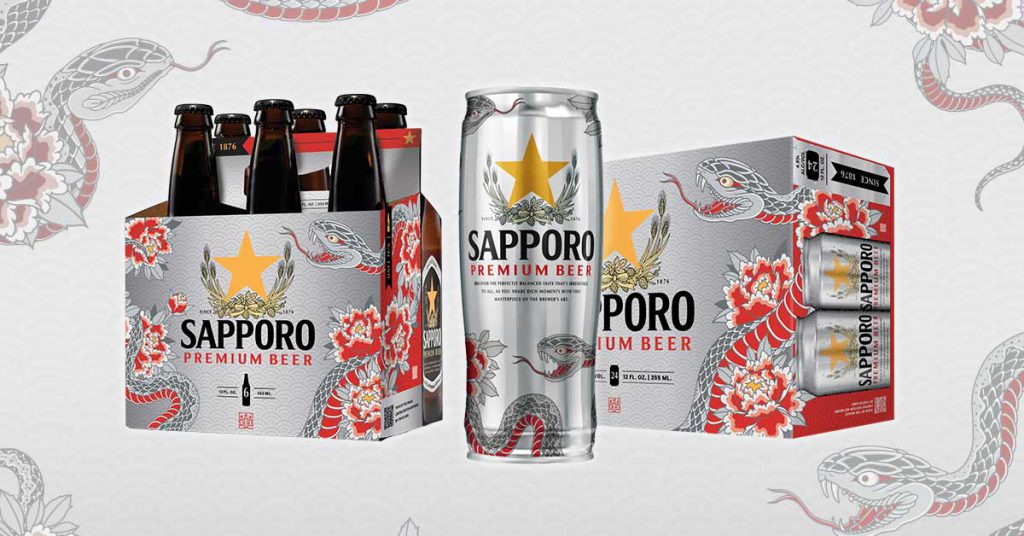
To leverage its roots in Japanese culture, Sapporo is bringing back its collaboration with tattoo artist Tokyo Hiro, who designed Sapporo’s Year of the Dragon 6-pack packaging. For 2025, the artist has created Year of the Snake packaging, which will adorn Sapporo Premium’s full complement of SKUs from November 2024 through April 2025.
“There was a clear, huge, really cool opportunity again to reach new consumers by working with such a well known artist as Tokyo Hiro and bringing that tattoo artistry to life on package,” McReavy said.
Year of the Snake art will appear on 22 oz. cans, wraps for 6-pack cans, 12-pack cans and club-exclusive 24-pack cans, as well as 6-pack bottle carriers and 12-pack bottle cartons.
In the convenience channel, Sapporo trails its competitors in the non-Mexican import segment in PODs by wide margins. Heineken has 109,000 PODs, followed by Anheuser-Busch InBev-owned Stella Artois (95,000 PODs) and Diageo-owned Guinness (47,000 PODs). By comparison, Sapporo has 10,000 and closing even half the gap between its PODs and Guinness’s would translate to an incremental 200,000 case equivalents (CE) nationwide.
“The pure opportunity for growth in this class of trade is impossible to ignore, and it is massive,” McReavy said.
Sapporo’s point of differentiation in the channel is a big one: its 22 oz. single-serve chalice can, which checks several boxes for both imports and c-stores.
“Candidly, there’s nothing else like this out there, and we know that it performs wherever it is placed,” McReavy said. “Additionally, imports have now become the No. 1 beer segment purchased in c-stores, and single-serves make up over 25% of the total import dollars.”
After c-stores, Sapporo’s next priority is expanding 12-pack can distribution in off-premise chains, which McReavy described as a joint effort between the brewery and its wholesaler partners.
“This is a collaboration between you and our chain team, and I’ll put money in on our chain team any day, any week,” he said. “We have an amazing team that is growing, and we’re getting a lot of attention from our retailers, specifically around this brand, because they see the trends too.”
To support chain placements, Sapporo plans to promote the pack at “key marketing and event beats” and ensure appropriate inventory availability during ad periods. Wherever possible, Sapporo wants to billboard 12-pack cans with 6-pack bottles.
“We also know that when we increase the pure family of Sapporo within that retailer – share of shelf – the rate of sale actually goes up across multiple SKUs,” McReavy said. “As an example, we know that when we have our 12-pack can and our 6-pack Sapporo Premium bottle in distribution in the same store, rate of sale actually increases by 14% on our 12-pack cans.”
An expansion of 12-pack can distribution in chains could result in an incremental +750,000 case equivalents (CE), McReavy said.
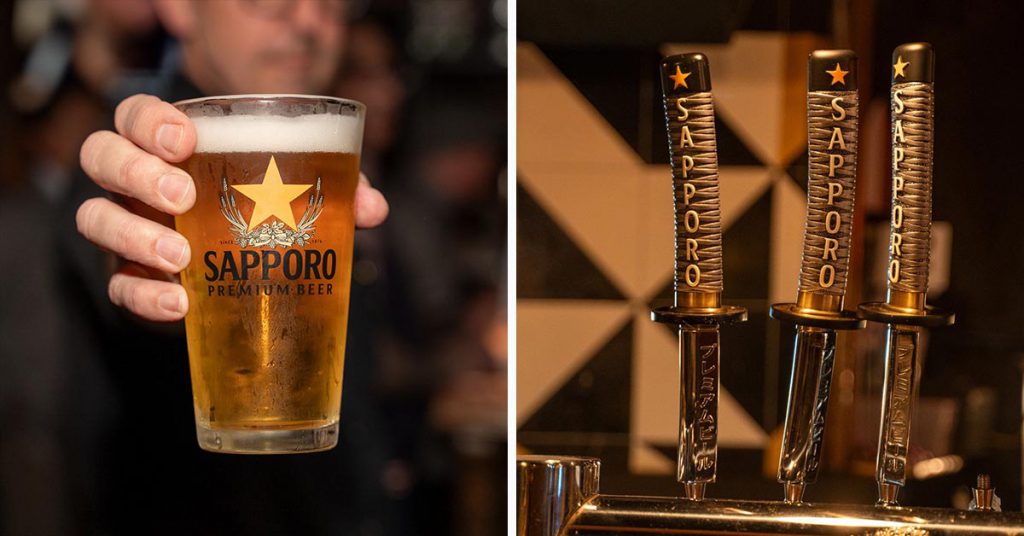
The brand’s third priority for 2025 is the on-premise, which accounts for 40% of Sapporo’s volume – a far greater share than the broader beer category.
Sapporo has deep roots in the sushi channel in the on-premise, which is how many consumers discover the brand.
“We are the No. 1 Asian beer brand, and we are the No. 1 brand in the all-important sushi on-premise restaurants,” McReavy said. “Besides selling a ton of beer, it’s just another way to drive trial with a very important consumer in a very important eating occasion that signals high quality.”
Sapporo’s draft volume has increased +12% and is outpacing many other import brands on draft, as well as domestic premium and super premium offerings, such as Molson Coors’ Miller Lite and Anheuser-Busch InBev’s Michelob Ultra, McReavy said. This broader appeal gives Sapporo license to sell into restaurants that offer other cuisines.
“We also see this as an opportunity to expand to other eating occasions in other on-premise accounts,” McReavy said. “We have a huge opportunity to extend the Sapporo drinking occasion into other eating occasions. Sapporo, candidly, is one of the best pairing beers out there for every occasion.”
The brand aims to support new and existing on-premise placements with “impactful” point-of-sale support and activations.
Among its peer set of non-Mexican import brands, Sapporo is tied with Molson Coors-owned Peroni for third most total distribution points (TDP) in the on-premise. Both brands have about 16,000 PODs, compared to No. 1 Stella Artois (74,000 PODs) and Heineken (68,000 PODs). Nearly doubling Sapporo’s PODs to 30,000 placements would result in +1 million incremental CEs, McReavy said.
Sapporo leads its competitors in CE velocity per TDP in the on-premise, with 75 CEs, followed by Peroni (74), Stella (68) and Heineken (46), according to a slide McReavy shared.
“Simply put, this beer turns and it is sticky, so let’s make sure that we get the distribution in the on-premise and the sales will follow,” he said.
Sapporo’s 2025 marketing calendar leans into both traditional Japanese holidays, American beer occasions, and the brand’s 149th anniversary in August and September. The traditional Japanese campaigns are front-loaded in Q1, when the brand will celebrate Lunar New Year from January through March, and the annual cherry blossom festival from late February through mid-April.
The brand’s Star of the Summer campaign will run from May through September, and its ‘Tis the Season to Shine campaign will launch in October through the end of the year.