
Research from three different studies in the U.S. and Canada shows there may be more interaction between cannabis and alcohol consumption than previously believed, according to analysis of the studies by financial services firm Bernstein.
In Canada, where cannabis has been legal nationwide since 2018, 22.8% of people who use both cannabis and alcohol reported drinking less – a +7.5% increase from 2020, when 15.3% of respondents reported drinking less, according to Health Canada data parsed by Bernstein analyst Nadine Sarwat.
In the U.S., 36% of cannabis users who drink reported drinking less, while 64% said they have “not reduced alcohol consumption,” according to a 2024 survey from market research firm Numerator.
Nearly half (47%) of respondents reported “replacing some of their alcohol consumption” with cannabis, according to data from a 2021 New Frontier survey, Sarwat wrote.
The survey analysis comes with several caveats from Sarwat:
“The consumers may report drinking less alcohol; but it does mean they actually have reduced consumption,” she wrote. “We do not have the control data of what is the equivalent intention for non-cannabis users. Possibly everyone is saying they are reducing alcohol consumption (either in their imagination or in reality).
“Correlation does not necessarily mean causation,” Sarwat continued. “Just because cannabis users are drinking less alcohol doesn’t mean it is because cannabis use is directly cannibalizing alcohol. It could reflect a number of factors, such as an overall trend towards greater health and wellness awareness.”
Furthermore, consumers are unreliable reporters when it comes to surveys about “sin,” Sarwat wrote.
“Given alcohol’s less favorable social perception today, it is possible that this underreporting by young consumers has increased (favoring cannabis),” she wrote. “Put another way, if it’s cool to be sober curious or California Sober, the extent of that sobriety may be overstated.”
Still, nearly two-thirds (64%) of cannabis users who also drink said they prefer beer, compared to 51% of non-cannabis users, according to New Frontier data. Beer had a far higher percentage of cannabis users who prefer it compared to spirits (51%), wine (50%) and hard seltzer (27%). This “expos[es] beer to the greatest risk of cannibalizing,” Sarwat wrote.
Of all bev-alc categories, only wine had a higher percentage of non-cannabis users selecting it as their drink of choice (59%) compared to cannabis users.
Two-in-five (40%) Canadian respondents said they consume cannabis and alcohol simultaneously – a process described as “cross-fading” – at least “sometimes,” while another 23% of respondents said they “rarely” partake in both simultaneously.
Respondents were far more likely to cross-fade with alcohol than any other psychoactive substance, with only one-third (37%) reporting they “never” do. About twice as many (70%) said they never mix cannabis with tobacco or e-cigarettes, while most respondents reported never mixing with stimulants (93%), sedatives (96%) or hallucinogens (91%).
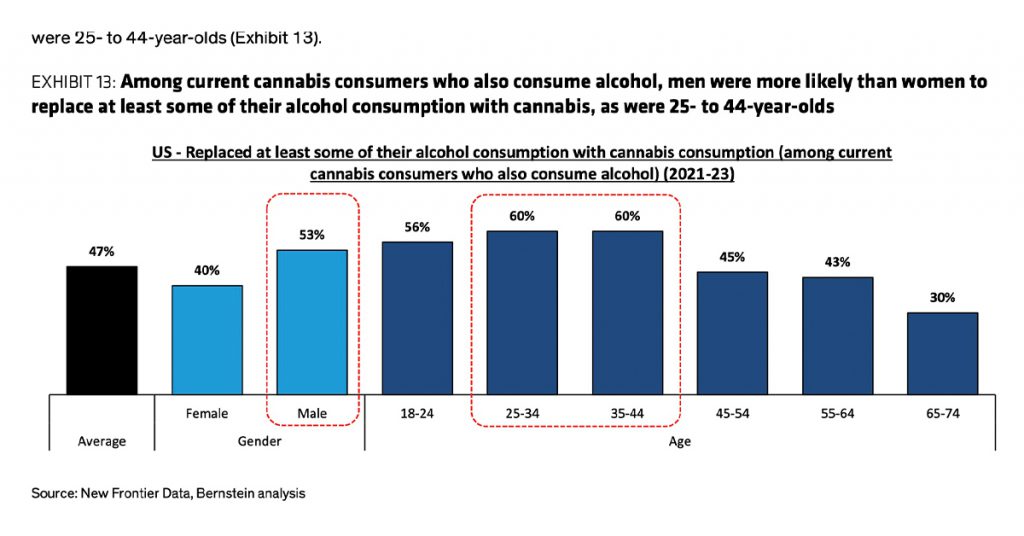
On both sides of the border, men reported drinking less or replacing alcohol with cannabis at higher rates than women, but the gap was wider in the U.S. In the New Frontier survey, a majority (53%) of men said they have “replaced at least some of their alcohol consumption with cannabis consumption,” compared to 40% of women. In Canada, 23.5% of men said they were drinking less since cannabis legalization, compared to 22% of women.
In both countries, respondents in their twenties were more likely to be drinking less or replacing alcohol with cannabis. In Canada, 29.2% of respondents ages 20-24 reported drinking less alcohol, followed by respondents 25 and older (22.1%) and respondents ages 16-19 (19.7%).
In the U.S., 60% of both the 25- to 34-year-old and 35- to 44-year-old brackets said they had swapped “at least some” alcohol for cannabis, followed by 56% of 18- to 24-year-olds. Older age groups reported replacing, but at lower levels, led by 45% of 45- to 54-year olds, 43% of 55- to 64-year-olds and 30% of 65- to 74-year-olds.
In addition to replacing alcohol with cannabis at higher levels, younger survey respondents reported evolving attitudes on the perception of risk from consuming both substances. Between 2015 and 2022, the rate of 18- to 25-year-olds reporting they perceive “great harm” in having four or more drinks once or twice a week increased +1.8%, to 38.7% – which is more than twice the rate of this age group finding “great harm” in smoking cannabis once or twice a week (14.1%).
“This is all against the backdrop of a record proportion [70%] of Americans believing cannabis should be legal,” Sarwat noted.