
Beer Is Art Release A Beer Documentary Film Called Mamogaswa In USA
Title: Mamogaswa, traditional and craft beer film coming to America
Old people villages still believe in Mamogaswa. Mamogaswa is a mermaid or halve snake half human. She lives in rivers, dams and streams. When she is upset, she comes out of the water transforming into a thunderstorm and fly the roof of houses away. One way to upset her is by fishing in places that she lives in. Sometimes the people of the village of Jericho North-western province in South Africa would paint the aluminium roof of their houses to avoid their houses being flown away. There are times whereby Mamogaswa would be moving from one place to the other in the process of moving she would see the aluminium roofs shinning and think that the shinning roofs is water in trying to settle she would fly the rooms away. Painting the roofs it is a safety percussion people used to take.
Women in Jericho village are beer brewers. They brew traditional Setswana tribe beer made from sorghum. This film takes you through the journey, you will get to learn how traditional sorghum beer is made. Six grandmothers from the age of 76 to 93 are interviewed. They get to tell the folktales that they tell their children. Most importantly they tell the story of Mamogaswa. You get the see an array of wild animals, different rivers, dams and exotic plant life villages have. There is nothing that is more fascinating than seeing wild animals not in a cage but in the wild with their normal wild behaviour. Every giraffe and every monkey have a story. You will get to see craft beer being brewed at a local brewery then you will be the judge on who came up with the art of malting, krausening, fermenting and germination in beer brewing is it the Africans or the Europeans.
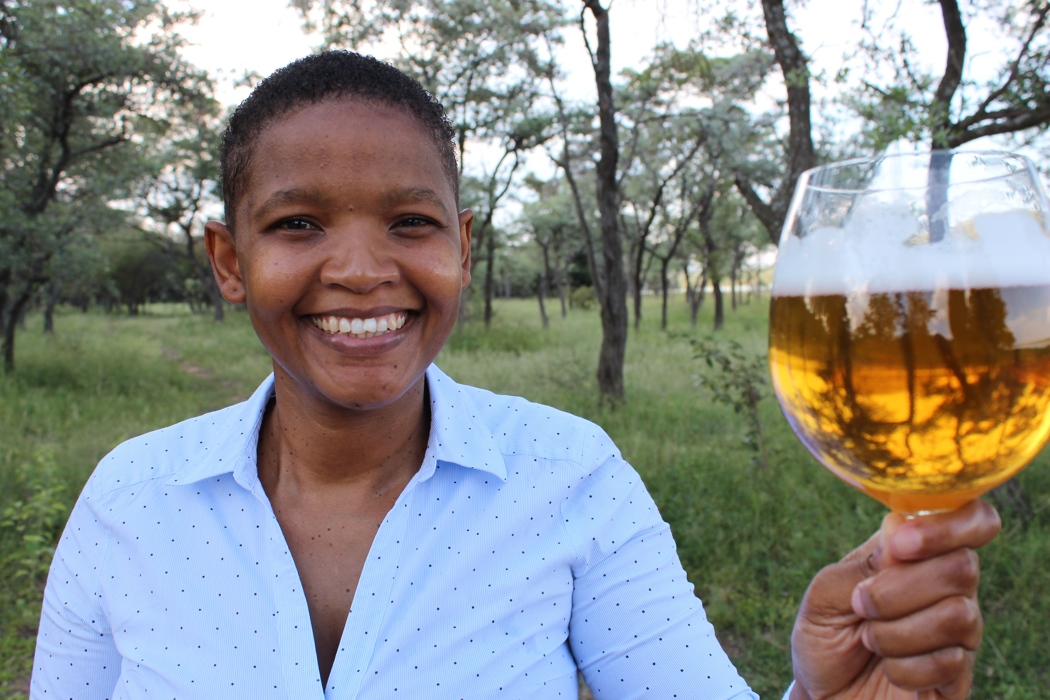
This film is one of a kind. Obakeng Malope watched a lot of beer films and vowed to make hers better. She has a unique skill of filmmaking and beer brewing. After making her name in the film industry she came to the beer industry to implement the art of storytelling in the beer industry that is brewing beers that tell a story.
A wiseman said there is "no one who can say he or she does not like beer" there is a beer for everyone. He can find a beer that can suit everyone. If you have a sweet tooth there are desert beers for you.
When it comes to malted barley the malting process it is an interesting process. High grade barley is selected for the malting process. The barley is soaked in water for 2-4 days until it reaches 40-plus percent water content. This rehydrates the kernel and activates the enzymes within, readying the grain for growth. Then the barley is placed in a cool place and kept well-aerated, as the seed needs oxygen at this point. Rootlets appear at one end, and a shoot called a aerospire grow hidden under the husk. When this sprouting has reached a certain point, the maltster stops the process by applying heat. The process of stopping germination is called kilning. This is the process Obakeng's grandmother was talking about in the beginning of the film. They would soak the sorghum for 2-3 days; When the rootlets appear, they would put it in the sun to dry. Obakeng wondered to herself how did they know this science, who came up with this science of malting first. She went thru her brewing books South Africans are not mentioned in the science of malting.
After malting they would mill the grain by crushing it in the traditional African milling stones. In craft beer brewing you would mill the barley using a miller which is a milling machine. Those are the things that you will get to see in this film. A lot of people do not know the krausening process in beer brewing. In beer brewing, krausening is a technique where actively fermenting wort is added to a batch of beer that has finished fermenting to induce a secondary fermentation and natural carbonisation. Some research says the process of krausening, introduce healthy, new yeast to pick up where the primary yeast, which went dormant due to layering temperature left off. Obakeng has found out that grandmothers have a technique a little bit similar to that in brewing traditional Setswana beer. Her grandmother when finishing cooling the sorghum porridge to send it to ferment she poured fresh milled sorghum a little bit to help with fermentation, that is some sort of krausening because the enzymes in the raw sorghum are still active, they have not gone for primary fermentation and have not been cooked. The beer will ferment whether she pour the sorghum or not, this is to give it a boost
Traditional beer is spiritual to Africans ,beer is brewed and used to celebrate weeding's, childbirths, ceremonies, it is consumed at funerals and also to celebrate the boys who come from initiation. They use it when consulting to their ancestors, they connect with them on a spiritual level. It is like your antenna rising up and now you are able to connect with the frequency. That how come they say that it is spiritual. They feel their energy and presence. This does not happen by drinking traditional beer but by having it be present when they connect to the spirit world and it can put you in a spiritual trance. Their ancestors can hear them and there are some people within them who have the spiritual gift of hearing communication from them. That connection between the people and ancestors cannot happen without their traditional beer.
Obakeng has seen instances whereby it is a funeral of a spiritual healer or traditional healer at the head of a coffin they would put the traditional beer in a clay pot to symbolise that departed person was an important person in the society. Traditional beer is made from sorghum. When it comes to sorghum, they cook milled sorghum and make it into a porridge and consume it for breakfast. The harder version of that can be consumed for lunch and supper be incorporated with vegetables, meat or fish. If you make porridge and make it very watery it becomes a power drink. Fermenting sorghum it is by taking milled sorghum pouring cold water and put it in the sun to ferment, it becomes sour. From that point if you cook hard or soft porridge with it, the porridge will become sour as well. In the olden days sorghum was a staple crop that created a staple food for their forefathers, she said.
If you look at history their forefathers did not get sick, everything they ate they grew it or farmed it themselves. Sorghum gave them energy and strength. If you ask the older generation like their grandparents on why they consume sorghum, they will tell you that it is good for them, their forefathers consumed it, and it was good for them. It has to be good for this generation.
You would think that this statement is just words but if you apply the philosophy of self-responsibility and sustainability you will see that this statement is 100% true. According to 4 Temperaments 6 Lifestyle Factors a book by Dr. Rashid Bhikha, who pioneered the development and spread of Unani-Tibb medicine-a low- cost solution with a philosophy of self-responsibility and sustainability. A temperament is the combination of physical characteristics and mental, emotional and spiritual attributes. Just as a fingerprint cannot be changed, so our fundamental temperament cannot be changed.
There are numerous factors that determine temperament, for example:
Time and place of birth
Conditions in the uterus and diet of the mother during pregnancy ,
and most importantly hereditary factors- parent's temperaments and characteristics.
This proves that because the South Africans have the DNA, the genes and the adaptation techniques of their ancestors, the natural food they got from nature did not harm them. This means that the natural food will not harm them. It is good for them. Not that sorghum is harmful.
The film will be screened in several states in USA

Stay Informed, Stay Competitive
Unlock the articles, expert interviews, and data reports that power the beer and beyond industry. Join our community and stay ahead with exclusive insights from Brewbound.