
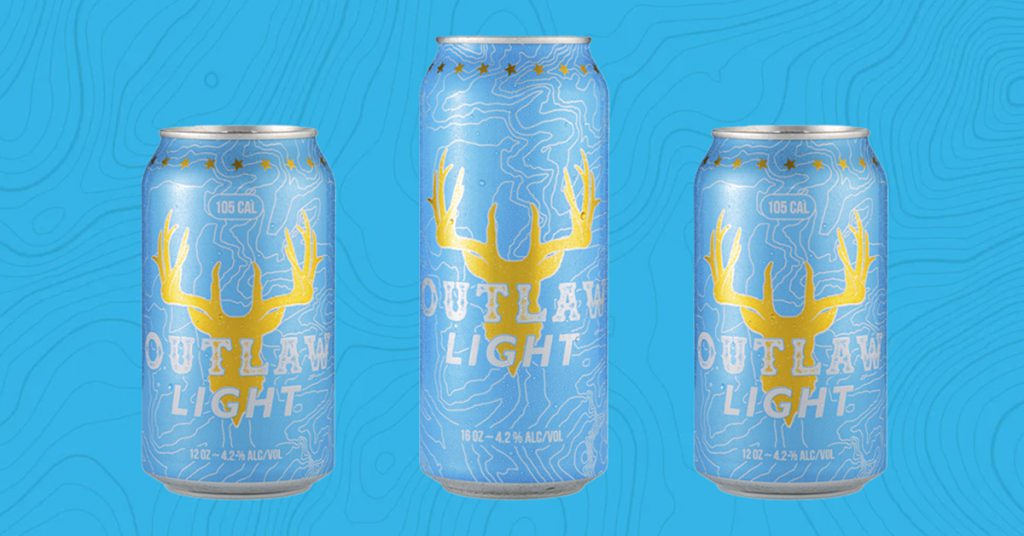
Outlaw Light Beer is aiming to be a disruptor in what its CEO believes is a stale light beer segment.
Ari Opsahl, CEO of Outlaw’s parent company, Tivioli Brewing, is a former Anheuser-Busch InBev (A-B) executive. He has an affinity for light beers from both his former employer and Molson Coors.
“They are great beers,” he told Brewbound. “They’re just tired, and their marketing has gotten all over the place. They’re trying to market to everybody. That’s not working.”
Outlaw, Opsahl believes, has given light beer drinkers “an alternative at the price point that they were accustomed to” paying.
“That consumer wants something in the same price category that has a similar style in sessionability, lightness and ABV, and there hasn’t been one,” he said. “So we’re the crazy ones that are doing it.”
Opsahl emphasized that Outlaw isn’t specifically chasing economy, premium or super premium drinkers, as the lines among those segments have blurred and become less “relevant.” Instead, he believes there is a light beer category that Outlaw, Garage Beer and the macrobrewers are “playing in.”
Thus far, the strategy is working. Outlaw now makes up around 96% of Tivoli’s business. In 2024, Outlaw shipped around 62,000 barrels of beer, Opsahl shared. This year, the company is on track for nearly 109,000 barrels, or 1.5 million case equivalents (CEs) to retail.
The company produces all of its own beer, with a facility capable of cranking out as much as 300,000 barrels, with room for expansion.
“We’re ready to sink our teeth in to support the growth as much as we need,” Opsahl said.
Outlaw’s expansion comes as the company closes in on a national distribution footprint, recently adding Iowa and Northern California to its map.
“In Northern California, our network up there is actually what was the Pabst network at one point in time, which, for me, is perfect,” Opsahl explained. “They know how to execute. They know how to drive beer volume and displays and build the brand. And they’re not as bogged down with what is the priority for Molson Coors? What is the priority for Constellation? What’s the priority for Anheuser-Busch? We get to be the big priority, which is great.”
Opsahl admitted “being a priority brand” in the light beer category “in some of the big houses could be challenging.”
“We want to find the guys that have enough scale to where they can service the market, whether that be chain or independent channel, but at the same time, we can get enough share of mind to really be relevant,” he said.
Outlaw’s approach to its network has been a “best fit” first approach. The expansion has been rapid, growing to 47 states in three years, which Opsahl acknowledges “is pretty dang quick for an independent brewer.”
“I would say we’ve got a nationwide network at this point in time, and now it’s just getting it to be a nationwide availability,” he said.
More states are set to come online. Opsahl shared that Outlaw recently signed distribution contracts with Odom to open Washington and Oregon in “the next couple months.”
There remains holes to fill in West Virginia and South Carolina, as well as Southern California, which the company is actively sorting out.
About 80% of Outlaw’s business is in off-premise channels, Opsahl shared. Outlaw’s home market of Colorado, Philadelphia, Florida and Texas have proven to be the brand’s strongest territories.
In Florida, with limited doors, Outlaw’s “velocity numbers are just incredible with Circle K,” and the brand now accounts for around 7% share of the category in those stores, Opsahl said.
“Texas is becoming a monster” with full distribution in H-E-B, Walmart coming online and going statewide with Buc-ee’s, he added.
In the fall, Outlaw is expected to go statewide in Ohio with major grocery chain Kroger.
More growth is on tap in 2026 with “some really, really big gains in the spring” resets, Opsahl said.
“We have a nationwide footprint,” he said. “We’ve got the results that show this product works. The demand is there, so now it’s time to really scale it.”
Scaling in the on-premise has proven trickier due to chain retailers such as Applebee’s and Buffalo Wild Wings focused on brands with national footprints, Opsahl said.
“The reality is that those guys won’t even talk to you unless you got a national footprint,” he said. “Up until now, we haven’t even been able to have these conversations, because the barriers to entry are real.
“Finally in 2025, going into 2026, we can actually have those conversations, which is great,” he said.
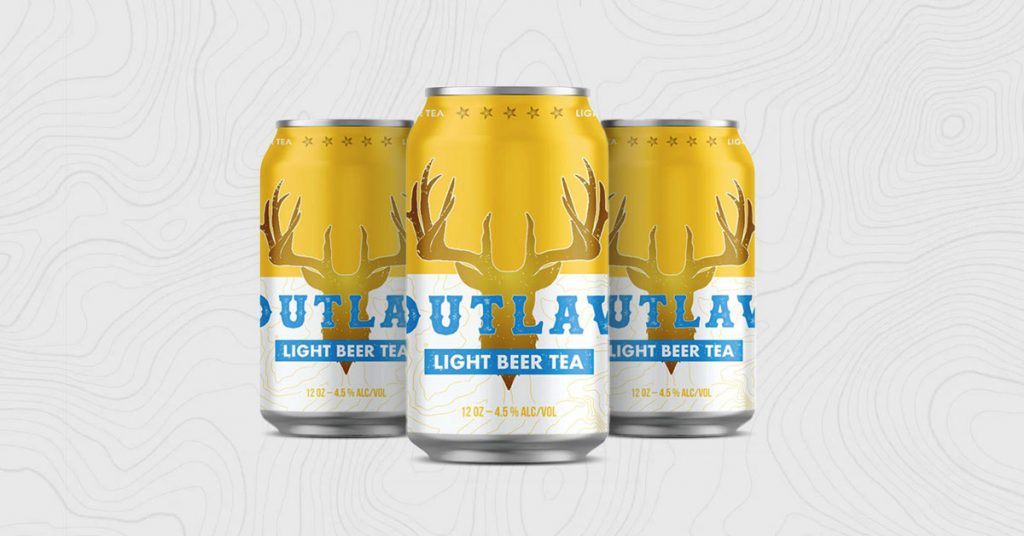
Outlaw Adds ‘Light Beer Tea’
Outlaw is expanding its lineup with the rollout of Light Beer Tea across its home state of Colorado, as well as Atlanta, Pittsburgh and Las Vegas. Supermarket chain H-E-B is picking up the brand in 230 of its Texas stores.
The 4.5% ABV malt beverage blends “sweet lemon and the subtle complexity of black tea,” according to a sell sheet. It’s available year-round in 12-pack cans and draft. 24 oz. single-serve cans and 16 oz. 6-pack cans are expected to follow.