
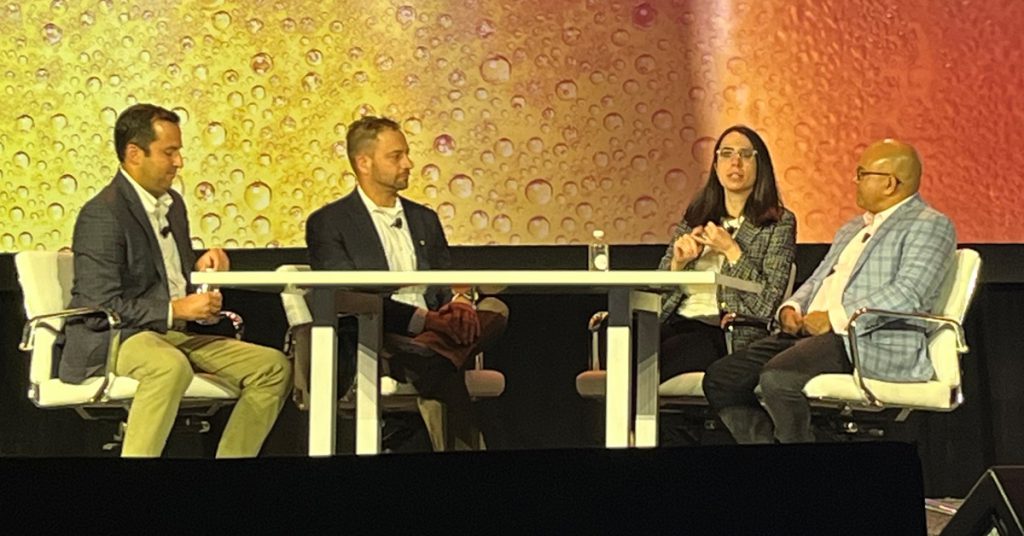
The beverage-alcohol industry has endured an “onslaught of negative news” about health concerns and alcohol consumption in 2025, Bernstein analyst Nadine Sarwat shared during a panel discussion this week at the National Beer Wholesalers Association’s (NBWA) Annual Convention in Las Vegas.
A steady drumbeat began in early 2023 when the World Health Organization (WHO) declared that “no level of alcohol consumption is safe for our health.” Concerns that sentiment would boil over to the U.S. began bubbling in 2024 as the bev-alc industry took issue with a study that was under way as part of the 2025-2030 Dietary Guidelines for Americans (DGA) process.
The former surgeon general called for cancer risk labels on alcoholic beverages in January. In August, the annual Gallup Poll of Americans’ bev-alc behaviors revealed a record low percentage of adults who reported consuming alcohol.
“We’ve had a number of clickbait headlines take over, and then it becomes really difficult to understand what is driving consumer behavior,” Sarwat said.
She participated in a panel discussion about the headwinds facing the category with RBC Capital Markets managing director Nik Modi and Frank Beverage Group beer division CEO Mike Frank, moderated by Maletis Beverage GM of sales Robbie Maletis.
Modi, who covers the beverage and personal care industries, estimated that 60% of the factors dragging down beer volumes are cyclical in nature and may pass with time. Sarwat agreed with this, calling the estimate “spot on,” and urged attendees not to shy away from broader conversations driven by health-related headlines.
“Lean into that conversation, making sure that we are discussing facts, not fearmongering, and that at least the consumers have all the correct facts at their disposal so that at least they’re getting all sides of the conversation,” she said.
“This is where I think beer, wine, spirits – all differences need to be put aside, and really tackling this as an industry together is the best way forward,” Sarwat continued.
With beer volume down 4.5% year-to-date (YTD) through October 5 in Circana-tracked off-premise channels, Modi ticked off other CPG categories that are also in volume decline: salty snacks, refrigerated dough, breakfast foods, baby foods, shaving products and hair care products.
“The reality is that there’s an income issue – 10% of our population is driving over half the consumption,” he said. “And the thing about consumer products in general is that they tend to over-index to middle- and lower-income consumers. And so that’s why, in this part of the world, in economy consumer goods, we’re seeing more weakness than you’re seeing in other parts of the economy. Because you buy these products so frequently, consumers become very sensitive to the price.”
Despite recent trends towards premiumization, Modi called on beer brands to stop pursuing premium-priced products at the expense of other offerings across the value spectrum due to beer’s “bifurcated” consumer base.
“The rich are getting richer, the poor are getting poorer. This has been going on for four decades, and it’s not going to stop, so we have to get out of this obsession of premiumization,” he said.
“I’m not telling you to abandon premiumization. I’m telling you that you have to start thinking about that lower-end consumer, because there are going to be more and more of them over time, and it’s also hurting recruitment of LDA [legal-drinking-age] consumers because they’re currently cash strapped.”
Sarwat pointed to Anheuser-Busch InBev’s (A-B) Busch Light as an example of a sub-premium brand finding success. The Busch brand family is up in both dollar sales (+3.5%) and case volume (+1.3%) YTD through October 5, according to market research firm Circana.
“There is a consumer who wants economy here,” she said. “They are proud to purchase it. They want innovation in that category.”
As beer grapples with ongoing waning consumer interest due to a varied list of culprits that include economic pressures, decreased appetites for alcohol due to GLP-1 drugs or other health concerns and loss of wallet share to legalized gambling, the NBWA has renewed its focus on the Beer First Initiative.
Introduced in 2018, the Beer First Initiative is a brand-agnostic effort to promote beer in the trade by offering channel-specific selling tools and activations. Frank serves as chair of the Beer First Committee, and oversaw a cross-brand meeting of marketing leaders from major suppliers over the summer to address the industry’s sluggishness.
“We can recognize that we’re competitors, but there might be things that we can do collaboratively to address these cyclical and structural challenges,” he said.
Those collaborative efforts may include creative merchandising around consumption-driving occasions such as Halloween and college graduation, Modi said, calling out a Halloween display he recently saw from A-B’s Cutwater Spirits brand promoting its spirits-based ready-to-drink espresso martinis and white Russians.
As suppliers can create point-of-sale support for culturally resonant events, wholesalers need to leverage them in local activation, Modi continued.
“Distributors have to get out of this mentality of, ‘I’m a logistics provider from point A to point B’ – you’re market developers now,” he said. “One thing I see in the industry that hopefully I can at least exploit, is this blame game, ‘Suppliers aren’t giving us the right initiatives or the right products or the right marketing.’ And then the suppliers will say, ‘Well, our distributors are not executing,’ and both are false. I think you have to get alignment.”
Modi called out several drinker-led occasions that beer should wade into, including women’s book clubs and LDA consumers’ gaming, which energy drinks have long tapped into.
“Brands are grown and created on-premise,” he said. “I understand that, but on-premise is now defined in a digital and a physical sense. It is the bars, but it’s also online, on Instagram and Snapchat and Tiktok.
“And so we have to be mindful,” he continued. “We have to create capabilities where we can understand Split the G [the viral challenge of consumers drinking a draft Guinness down to the logo on branded glassware] before it happened, so we can lean into it and take advantage of it, because you’re just leaving cases on the table if you don’t activate.”
Both Modi and Sarwat praised beer’s role as a social conduit in human connections, an oft-repeated theme during the convention.
“Alcohol has been around forever because it brings functionality and something to our life that is not simply black and white,” Sarwat said. “It is a socializing product. Nothing beats that moment when you’re sitting in front of a friend who you haven’t seen, and you have a couple of beers and you’re really connecting.”