
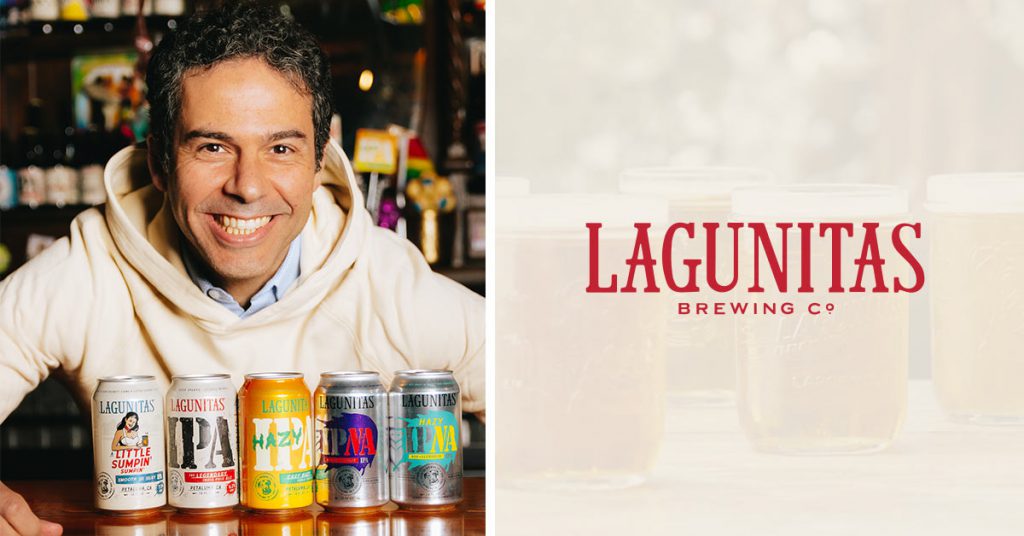
With a leadership team all well under two years on the job, it would be logical to view 2025 as a rebuilding year for Heineken-owned Lagunitas Brewing.
But the Petaluma, California-headquartered brewery took distributor and retailer feedback to heart in the past year-plus, which drove Lagunitas to develop a 2025 plan that’s consistent, focused and hinges on collaboration with its partners.
Newly installed CEO Bernardo Spielmann addressed the brand’s distributors last week at the company’s annual DogPile summit armed with a tidbit of good news. In Q4 2025, Lagunitas hit its highest share of craft (4.51%) since before the COVID-19 pandemic, according to Beer Institute (BA) data.
“We are happy that we’re setting up the basis to grow, and we’re confident that we’re on the right path for 2025 but we can’t stop here,” Spielmann said. “Lagunitas is not happy to just stay recovering a little bit of share.
“We will reignite, and we’ll go back to something that has made us very special, which is the essence of telling stories,” he continued.
Another positive storyline from 2024: Since refreshing packaging for its flagship IPA in June, the brand’s rate of sale (ROS) has increased +4.20%, CMO Hannah Dray shared. The number drew approving chuckles from a crowd well-versed in Lagunitas’ cannabis-tinged lore. IPA 12 oz. can 6-packs have increased sales +18% since June, she added.
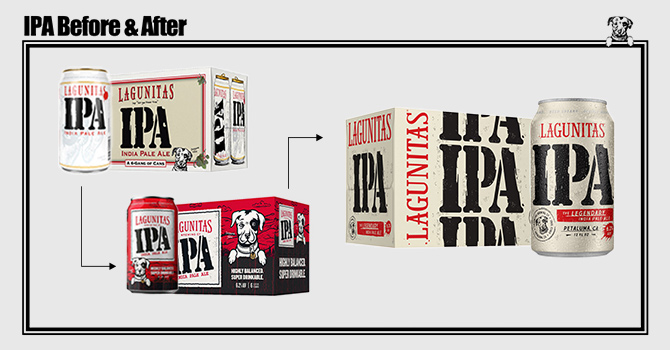
Last year’s redesign was a course correction from a 2022 redesign, the brand’s first global reimagining of its branding that included the entire portfolio.
A Little Sumpin’ Sumpin’ (LSS), Lagunitas’ No. 2 brand, is also sporting new packaging as of October and saw its ROS increase +4%. Millie, its pinup-girl inspired mascot, has returned to LSS, supplanting Lagunitas’ dog mascot, which replaced her in 2022.
Together, IPA and LSS accounted for 67% of Lagunitas’ depletions (sales to retailers) in 2024. Last year, the company put 60% of its marketing investment behind its core, predominantly IPA, Dray said.
“We recognized that consumers across the country, many of them only knew us for IPA, and in fact, some of them can only get their hands on IPA,” she added. “As a result, our national awareness as a brand has increased +20%.”
In 2025, Lagunitas is tripling its media investment, to $6 million, the “vast majority” of which will be spent on “our legendary IPA, with a sprinkling of our innovation in between as well,” brand manager Molly Hagen said. All of Lagunitas’ spend will be on social media due to its “sheer scale,” improved targeting and the fact that 46% of Gen Z consumers say it influences their spending, Hagen added.
Lagunitas’ 2025 innovation slate includes four new products: Hazy IPA (5.5% ABV), Hazicus Maximus (9% ABV), Uncensored Punch (9% ABV) and Hazy IPNA (non-alcoholic). Each product’s go-to-market plan is targeted by format and channel.
“We have been very intentional about the rationale around which product makes sense for which channel and then also which consumer,” Dray told Brewbound.
The new products are spread across craft segments where Lagunitas is already strong, as the No. 3 overall IPA producer, No. 3 non-alcoholic (NA) producer, No. 2 high ABV/flavor-forward producer and No. 1 on-premise IPA, according to NIQ data presented by category development manager William Kellerman.
“We feel that we have the most relevant portfolio in the few pockets of craft that have been showing growth,” Spielmann said.
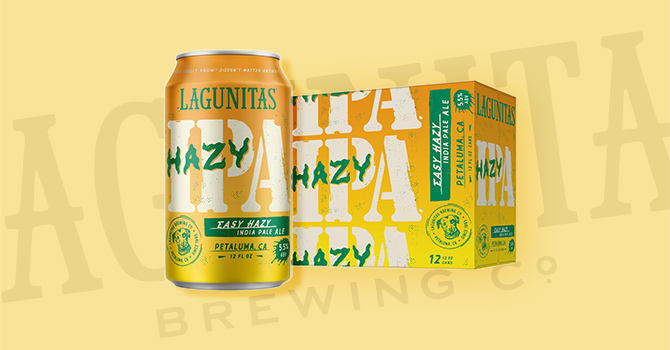
Hazy IPA will be available on draft nationwide as a complement to IPA, the No. 1 IPA on draft nationwide. The move marks Lagunitas’ most significant entrance into the hazy IPA sub-segment, which has carved out a meaningful niche in craft in the past near-decade.
Because it’s positioned as a companion to Lagunitas’ flagship, Hazy IPA, “had to be a damn good beer,” head of sales Peter Green told Brewbound.
“If we’re going to bring something to market, if we’re going to extend IPA, what has to be in the can, or what has to be in the mason jar, has to be a really, really, really good beer,” he added.
The beer’s 5.5% ABV is the result of much internal deliberation – “wars have started over less,” Green said.
“It’s about the extra beer on the check, because it makes it that much more sessionable,” he said. “Then you have to deliver something in the glass that delivers on the flavor, which, as you’re dialing down the ABV, is a little bit harder to do, and that’s where we think that [head brewer] Jeremy [Marshall] has delivered us a little bit of magic with what he’s got in the glass.”
Because the product “could be a very big bet for us” “over a number of years,” Lagunitas is rolling out Hazy IPA in 12 oz. can 6-packs only in its home market of California, Green said.
“The purpose of having it in off-premise in California this year is to give it a chance to build a really strong base,” he continued.
“It’s also giving it the opportunity to benefit from where our equity is the strongest, where we already have quite a broad portfolio for consumers who love our beers to really give us guidance on what success looks like before we expand it across the whole country,” Dray added.
If Hazy IPA’s mission is to give Lagunitas a toehold in the incremental hazy sub-segment, its other innovation products aim to broaden its consumer base and expand their purchasing habits.
The flavor-forward, high-octane offerings (Hazicus Maxmius and Uncensored Punch) are “about bringing younger consumers under 30 into the category,” Green said. New non-alcoholic (NA) offerings are “taking our shoppers and giving them new occasions,” he added.
Kellerman called out common industry caveats to NA’s growth – that it’s off a small base, that craft NA’s growth is driven by one large supplier (Athletic Brewing).
“Nielsen projects that non-alc will be a $1 billion category by the end of this year – not a small base for long,” he said, adding that more than 170 brands increased NA volume in 2024.
Lagunitas has long been a player in craft NA, since it launched its Hoppy Refresher sparkling hop water in 2018 and IPNA in 2020.
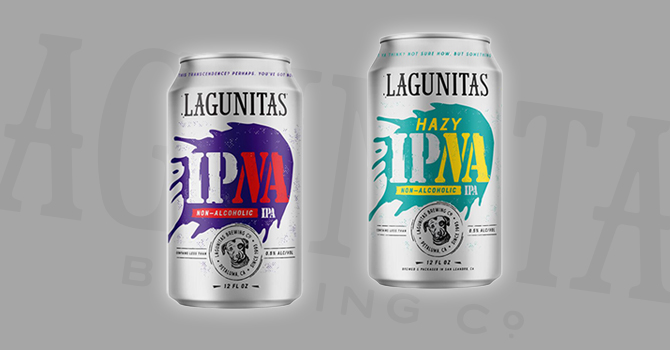
Like its 6.2% ABV sibling flagship IPA, IPNA will also get a hazy companion in 2025 with the launch of Hazy IPNA. Both will be available in 12 oz. 6-pack cans, which marks IPNA’s can debut as it discontinues bottles.
Hoppy Refresher is getting a refresh of its own with new packaging that more plainly calls out the drink’s 0 attributes: 0 calories, 0 carbs, and that it’s alcohol- and gluten-free.
The NA segment of the beer category “is over-indexing with Gen Z, who we know are not engaging with the alcohol category the way that previous generations are,” Kellerman said.
“This becomes a way for us to attract, develop and retain more consumers entering the pipeline over time,” he said.
Both the broader NA segment and Lagunitas’ NA business mimic full-strength beer’s business throughout the year, Kellerman said.
“It has the same exact seasonality, the same exact trend, the same exact peaks and the same exact valleys,” he said. “That’s because an occasion is an occasion. As you go throughout the calendar year, you will sell more non-alc during these holiday weeks than you will during the typical week.”
Dry January – when NA beer is the topic of countless industry conversations – only accounts for 13% of Lagunitas’ NA portfolio’s sales, the company said.
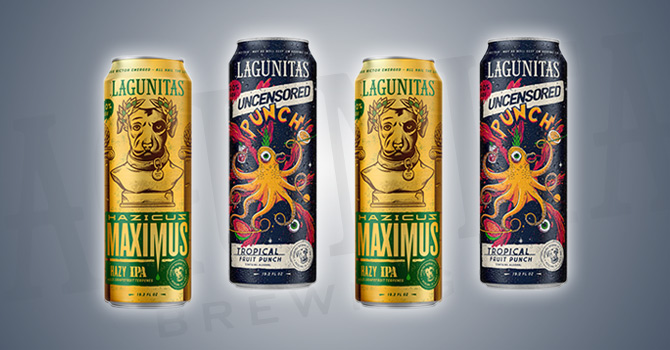
On the other end of the ABV spectrum, Hazicus Maximus, a hazy sibling to Maximus Colossal Double IPA, and Uncensored Punch are making a play for convenience store coolers. Both will be available in 19.2 oz. single-serve cans, with Hazicus Maximus also available in 12 oz. can 6-packs.
These flavor-forward innovations are targeted at two product facets that are growing: flavor and single-serve packaging – which craft is ignoring, to its detriment, Kellerman pointed out. In the broader beer category 90% of the top 30 innovation products were flavor-centric and were predominantly sold in single-serves and 12-packs. The “majority” of new craft products were “unfavored” and sold in 6-packs.
“The category in total is shifting in a way that craft is not keeping up with from an innovation perspective,” Kellerman said.
Across total bev-alc, unflavored products saw their value decline by -$2.9 billion between 2020 and 2023, he added.
“Almost 80% of that can actually be captured as a shift from unflavored alcohol to flavored alcohol,” Kellerman said. “When you look at craft’s losses, it’s a pretty big pain point in particular, especially when you look at what they’re leading with in innovation.”
For the 52-week period ending December 29, 2024, dollar sales of Lagunitas’ portfolio declined -6.9%, to $142.7 million, and volume, measured in case sales, declined -10% at off-premise retailers tracked by market research firm Circana.
The company was the 16th largest beer category vendor in multi-outlet grocery and convenience stores (MULO+C) last year. In convenience stores, Lagunitas slightly under-indexes relative to its MULO+C standing at No. 18, but slightly over-indexes in grocery at No. 14.