
Island Brands USA, its founders and several related business entities are facing an investor lawsuit alleging fraud.
Lisa Pollner and Caleb Fournier, a wife and husband who befriended Island co-founders Scott and Meghan Hansen, claim the Hansens breached their fiduciary duty and committed fraud by using hundreds of thousands of dollars invested in the lager brand for personal benefit.
The lawsuit, which was filed August 28 in the Ninth Judicial Circuit in South Carolina’s Charleston County, also names MOTU and Padgett Thomas, limited liability companies based in Charleston, as defendants.
Although Island Brands remains active on social media, the organization it was founded under appears to be defunct.
American Beverage Holding (ABH), the parent company of Island Brands USA, was dissolved as a business entity on May 12, 2025, according to the South Carolina Secretary of State’s website. A termination of reporting form was filed to the U.S. Securities and Exchange Commission (SEC) the following day.
The prior month, Pollner and Fournier discovered “they had never been investors or shareholders in ABH,” according to the complaint.
The plaintiffs’ relationship with ABH began in 2018, when the Hansens invited them to invest in Island Brands, “a disruptive lifestyle brand with premium products across multiple segments in the adult beverage space,” according to a now-closed crowdfunding campaign on StartEngine.
Between June 2018 and February 2019, Pollner and Fournier gave the Hansens a total of $500,000 they mistakenly believed was being invested in ABH via an account owned by Padgett Thomas LLC.
“Lisa and Caleb’s money was not an investment, it was a support system for Scott and
Meghan,” the complaint alleged.
Instead of using the money for the fledgling beer brand, the plaintiffs allege the Hansens spent it on a vacation, as well as “online subscriptions for Netflix and Xbox, paid for their groceries and medicines, gas, Starbucks and fancy meals.”
When pressed for details, the plaintiffs allege Scott Hansen “took active steps to conceal the truth of the purpose of Lisa and Caleb’s payment by, among other things, having lawyers produce documents showing the investment and the value of it and created narratives.”
Of the $500,000 Pollner and Fournier sent to the Padgett Thomas account, no money “was used for anything other than to financially support Scott and Meghan,” and the account had invested $7,500 in ABH.
Pollner and Fournier received a letter seeking their vote to dissolve Padgett Thomas but “contained no reason or rationale for dissolution or termination,” according to the lawsuit. As of press time, Padgett Thomas is still an active business entity in South Carolina.
After demanding to see Padgett Thomas’ financial records, the plaintiffs reviewed its tax returns, which showed assets of “at most” $514,683.
“The returns accounted for none of the money the Hansens had used,” the complaint said. “Hansen had contributed next to nothing but took all of it out for himself.”
In their complaint, Pollner and Fournier have charged the defendants with breach of fiduciary duty, accounting, fraud, conversion, civil conspiracy and judicial dissolution. They are seeking a judgment against the Hansens for actual and punitive damages, attorneys’ fees and court costs.
Requests for comment to Scott Hansen and Island Brands were not returned as of press time.
More insights into the demise of ABH can be gleaned from the company’s StartEngine campaign, which closed in May.
“Due to unfavorable economic conditions, ABH has been unable to secure the necessary funding to support ongoing operations,” the company wrote in an unsigned note. “Unfortunately, the amount of debt owed by ABH, including secured debt, exceeded the value of its assets. Therefore, to reduce legal expenses, ABH’s remaining assets were voluntarily surrendered to its senior secured creditor. This included all remaining inventory and intellectual property and rights. As a result, all equity shares (stock) in ABH no longer hold any value.”
ABH closed its last StartEngine crowdfunding round on November 16, 2022, in which it raised $1.508 million, according to an SEC filing. The StartEngine page was not updated for another year after that, when the company touted a 71% increase in sales during Q2 2024, reaffirmed its focus on southeastern states and the Caribbean and announced new unnamed production partners.
“We remain optimistic that steady, stable growth is on the horizon,” ABH wrote in an unsigned note.
The next update announced the company was shutting down operations and that “a well-capitalized, multi-brand family that has the structure in place to continue to invest, expand and offer the Island Brand product line” had acquired it. However, the new owners were not named.
To make things right with Island’s nearly 2,000 StartEngine investors, the new owners are offering a 50% rebate on purchases of Island products through March 2026.
“If Island Brands is available in your area, we hope you take advantage of this rebate program, and thank you in advance for your continued support of this phenomenal brand,” the company wrote.
Dollar sales of flagship Island Coastal Lager have increased 76.4% in the four-week period ending August 9 (L4W), according to NIQ data provided by 3 Tier Beverages.
However, those trends stand in stark contrast to full-year sales. In the L52W, dollar sales of Island Coastal Lager declined 18.5% and volume, measured in case sales, declined 14.1%.
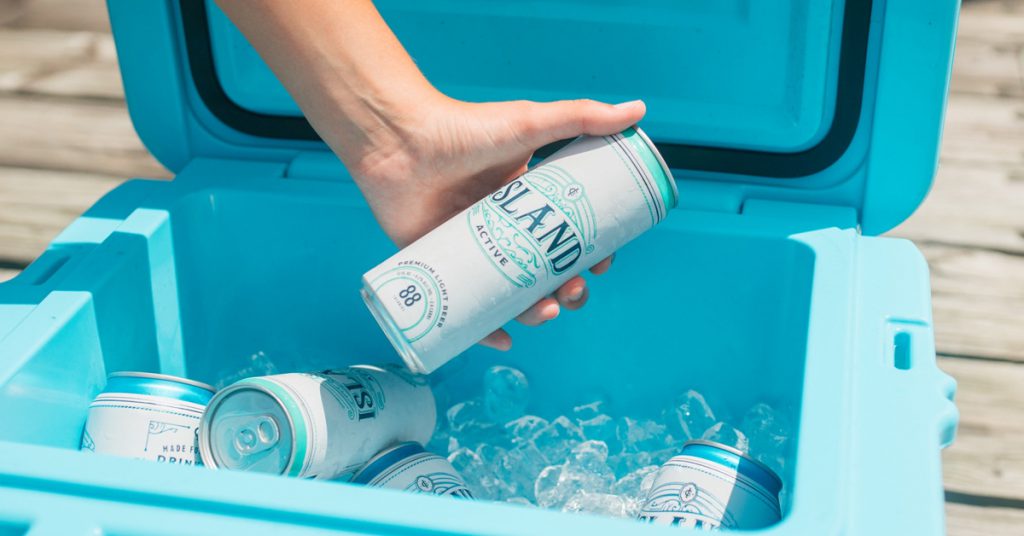
Dollar sales of Island Active Light Beer, which the company positioned as a coastal alternative to Michelob Ultra in its early days, declined 51.7%. Volume, measured in case sales, increased 7.4%.
The Island Active variety pack, which features fruit-flavored variations of Island Active Light Beer, has outsold the base beer on its own. The pack’s dollar sales have declined 3.2%, and volume declined 15.9%.
The Island Active brand family has posted significant L4W declines (variety pack dollars -59.5%, Island Active Light Beer dollars -57.2%).