
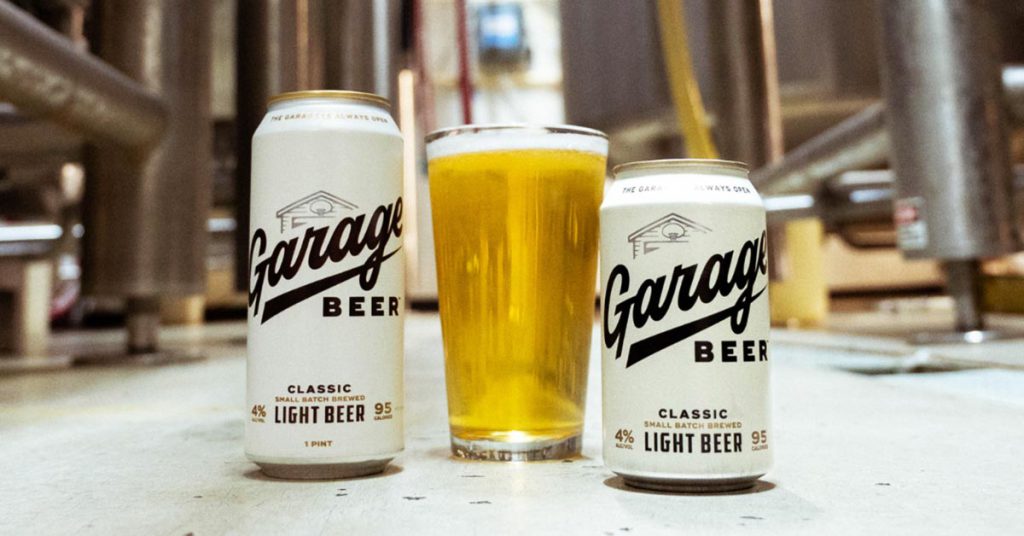
Garage Beer – an “internet darling” turned mainstream lager brand, with the backing of Jason and Travis Kelce – is on pace to ship around 4 million case equivalents (around 300,000 barrels of beer) by the end of 2025.
The brand is trending up “400% or 500%, depending on whether you’re looking at consumption or shipments,” owner Andy Sauer shared with Brewbound.
If the trends hold, Garage Beer would rank just outside of the Brewers Association’s top 10 craft breweries by volume.
The rapid growth follows falling just short of 1 million CEs in 2024 and production of 120,000 CEs in 2023.
“We grew about 10x from ’23 to ’24 and didn’t change our team really at all,” Sauer explained. “It was very much a tight-knit crew, six people that were just having fun, building a brand.”
Garage Beer’s ranks have since grown to 25. Still a lean team, made possible through co-packing primarily at City Brewing in Memphis and supplemented by Founders Brewing in Grand Rapids, Michigan. Sauer said new hires have come on to help “guide and mature the organization” through its rapid expansion, while staying lean and maintaining the company’s culture.
“We want to still be crazy and fun and entertaining on the internet, but we want to start to permeate more and more people outside that,” VP of marketing Corey Smale told Brewbound.
As of early 2025, Garage Beer is now available in all 50 states, primarily through the Molson Coors distributor network. In 2024, Garage Beer was in just six states. Even as new markets have come online, the company is maintaining growth by “digging deeper” in its core Northeastern Midwest markets.
“It’s fun to see those legacy markets growing rapidly as we enter the summer,” Sauer said. “Our oldest market, in Ohio, is up 135% for the month. [Pennsylvania] and other really big markets are up similar growth numbers. So we’re still growing like crazy in our most-established, mature markets, while pressing further.”
The expansion has coincided with placements in about 80% of Walmart’s footprint, which Sauer called “incredibly transformative” for the business.
“As an entrepreneur, you are always excited, but also have some trepidation to lean in bigger with bigger customers,” Sauer said of Walmart. “They’ve been wildly supportive, and we’ve seen great pull through there.”
Sauer touted similar results via expansions in grocery chain Kroger – which was the brand’s first major customer, perhaps owing to both the store and the beer having Cincinnati roots – and independent liquor store chain Total Wine & More.

Having the Kelces attached to Garage Beer, as well as Jason actively involved in advertisements for the brand, have helped elevate brand awareness and reach, Sauer said.
“It sort of smashed together some audiences that then amalgamated into one,” he said. “More people came to the party, but the party didn’t change. That’s the cool part about it.
“You fret those decisions when you bring on new partners who are going to obviously change in scale the nature of your brand, but the brand hasn’t changed,” Sauer continued. “It hasn’t really been impacted. That’s fun to see. Even though the numbers grow, the ethos has stayed very much true to itself.”
Although the Kelces have been active participants, the company has made a conscious effort to maintain Garage Beer’s individual identity rather than letting celebrity overtake the brand.
“It’s important that we are still Garage Beer, and more Garage Beer than Kelce,” Smale said. “We’re very cognizant of maybe a 70/30 split.”
The company is actively striving to maintain that balance and filling it with entertaining content, Smale said.
“Our job is to make the best light beer we can, and then two, be entertaining,” he said.
Garage Beer’s online connection with consumers is also the brand’s “superpower,” Smale added. He said it allows the company to connect and talk to consumers “like a real brand.”
Smale was preparing to ship trading cards to fans when he spoke with Brewbound, an effort to stay true to Garage Beer’s audience. He was also celebrating the brand crossing the 200,000-follower mark on Instagram, a milestone achieved over the July 4 weekend.
“It just feels like we’re building a community,” Smale said. “I really think it’s an ethos, an ideology that we share with our customers. I like to say, ‘We are our audience.’”
Other efforts have ranged from a “BeerBed” giveaway (a new Casper mattress and a frame with a Kegerator attached headboard), to buying a 1% stake in indoor football team the St. Joseph Goats, to sponsoring the National Ball Hockey League, to more recently filming an ad with professional wrestlers Matt Cardona (Zack Ryder in WWE) and Brian Myers (Curt Hawkins in WWE) as part of the brand’s sponsorship of the Major Wrestling Figure Podcast.
It’s all part of Garage Beer’s strategy to tap into “the power of the microniche,” Smale said.
Microniches are small audience segments of broader markets, such as action figure collectors of pro wrestling. Garage Beer’s sponsorship of the Major Wrestling Figure Podcast gave it a “baked in audience” that was used to being marketed to by a beer brand. Pabst Brewing, where Smale previously worked, had been the sponsor for several years prior to Garage Beer taking it this year.
“When you show that you get that niche of an audience, they want to show you how much that they see you seeing them,” Smale said.
“I feel like that’s the only space where you can actually, truly build a community and audience anymore, by showing them that you actually understand the things that they’re into,” he continued, speaking of marketing to microniche communities.
“Otherwise, it’s just blasé, big brand speak. I don’t think that sticks to anyone. I’m happy to go into my nerdy passions and stuff just to prove that it works. And it certainly does.”