
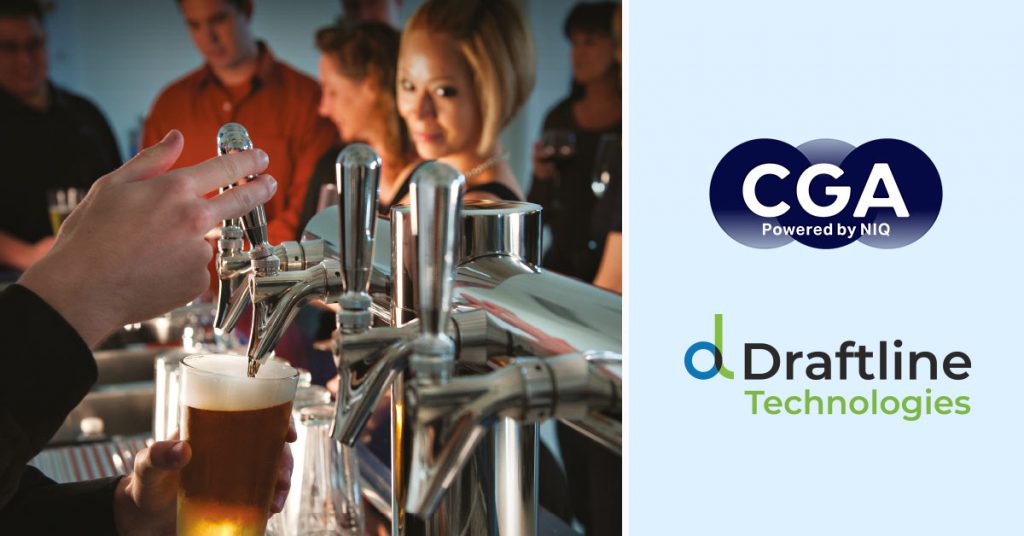
Who drinks draft beer these days?
The typical draft consumer is an older white man who is “relatively affluent” and spends around $201 monthly on dining and drinking in on-premise outlets, according to the latest “On Premise Draft Opportunity” report from CGA, NIQ’s on-premise arm, and Draftline Technologies, a firm that tracks more than 1 million draft beer lines across 40 states and sells products for maintaining draft lines.
Draft beer drinkers are 67% male (33% female), 49% aged 55 and up (15% 21 to 34; 36% 35 to 54) and 85% white (8% Hispanic, 5% Black) with an average household income of $107,000, per a CGA on-premise user survey.
The “highest-spend customers with the most disposable income are the draft beer drinkers,” Phil Thomas, who leads Draftline’s new business development, told Brewbound. He emphasized that knowing who those draft beer drinkers are, and marketing towards those consumers, could be vital for sustaining the industry.
“Why not target where the money is now, not where you think it’s going to be 20 years from now by targeting that younger consumer?” Thomas asked.
Draftline founder and CEO Jennifer Hauke added that those drinkers are “prime consumers” with “money to spend.” Providing them with good experiences is important because they are knowledgeable about how good beer tastes and won’t return to the account if they have a bad experience, she added.
“We probably have the single best sampling opportunity that exists with draft beer, the single best out of any consumer packaged good,” Hauke said.
The latest findings are largely in line with the demographic data from the most recent Gallup survey, which reported that U.S. drinkers are majority men (57%), white (56%), and 35 and up (56% 35 to 54 as well as 55+) with a household income of $100,000 or more (66%).
The draft beer drinker ($201.20) spends more than the average U.S. on-premise consumer ($176.16), as well as the packaged beer drinker ($166.60) on dining and drinking out, according to a CGA consumer survey cited within the report.
The average U.S. on-premise consumer is primarily women (51% compared to 49% men), according to CGA. The channel’s consumers are also majority white (77% compared to 11% Black and 9% Hispanic), aged 55 and up (41% compared to 35% 35 to 54 and 24% 21 to 34) with an average household income of $92,000.
Meanwhile, the packaged beer drinker is primarily male (64% to 35% women), white (76% to 12% Hispanic and 11% Black) and aged 35 to 54 (42% to 26% 21 to 34 and 33% 55+) with an average household income of $86,000.
Those numbers represent both the current challenges and opportunities in connecting with underrepresented groups, especially women and Hispanic and Black consumers.
“The numbers of women and 21- to 34 year-olds choosing a draft serve have both increased by six percentage points year-on-year (YoY), while those aged between 35 and 54 increased by 10 percentage points,” the report states. “Finding ways to continue broadening this base will be key to growth in the years ahead, and in-venue advertising will be a key tool in transitioning drinkers of packaged beer and other categories towards draft.”
One way to attract more draft beer drinkers is through point-of-sale advertising. The report found that 28% of draft beer drinkers were likely to purchase a brand after seeing it advertised in an establishment on the same visit and on future visits.
The most effective vehicles for advertising in bars and restaurants are via coasters (50%), followed by glassware (46%), neon signs (45%), taphandles (39%), posters and banners (38%), menu boards (37%) and menus (32%), per the report.
“Younger consumers heavily over-index for the influence of items like coasters and glasses, while older ones are less likely to be swayed by branded advertising – perhaps because they are focused more on the product itself or have already made their choices,” the report found.
Taste (42%) is the top factor driving consumers to choose draft, followed by freshness (32%), preference for drinking from a glass (30%) and the quality of draft served in their favorite venue (23%).
The report makes the business case for a shorter cleaning cycle (two weeks) for draft lines. Hauke and Thomas pointed to the Brewers Association’s study that showed a 4% to 7% sales increase for accounts that moved from a four-to-eight-week cycle to a two-week schedule. Businesses that extended their cleaning window to five to eight weeks saw a 7% decline in draft sales.
“If you’re driving away that draft beer consumer, you’re driving away your best demographic for everything else you sell as well,” Thomas said.
Number of Beer Selling Outlets Grows
The number of on-premise bev-alc outlets in the U.S. increased 1.9% YoY, to 306,084 beer selling locations, as of January 2025, according to the report. Those gains are on top of a 1.4% YoY increase in outlets in 2023.
Quick serve restaurants (QSR) and neighborhood bars are driving that growth, increasing 15.3% and 3.1%, respectively.
Draft holds a 52.3% share of all on-premise beer volumes through early 2025, increasing 0.9 percentage points YoY, per the report. The average draft beer price increased 1.8% YoY, while its volume rate of sale (ROS) declined 3.2%, which the report called “draft’s biggest challenge in 2025.”
Total draft volume declined 1.3% YoY in 2024, which the report attributed to consumers more closely watching their spending.
Still, “consumers are turning to [draft] as a high-value, high-quality alternative to packaged options and other categories,” the report added.
Imports’ Growing Draft Presence
Sales of imported beer on draft increased 13.7% in 2024, while packaged imports declined 1%, according to the report. Nevertheless, import packages maintain a higher share of the segment compared to draft.
Draft remains important for craft brewers. Craft makes up the biggest segment in draft, but saw sales decline 2.4% in the 13-month period ending in January 2025. Growth segments on draft included domestic super premium (+7.1%), below premium (+6.4%) and hard cider (+1.6%).
“This suggests that interest in craft may have peaked for now, with beer drinkers increasingly looking to taps from other segments for new experiences,” the report reads.
However, the report pointed to “a symbiotic relationship” in outlets with an array of segments on draft.
“When craft alone is stocked on draft, its average velocity is $623, but when imported and domestic premium are added, it rises to $2,346,” the report noted.