
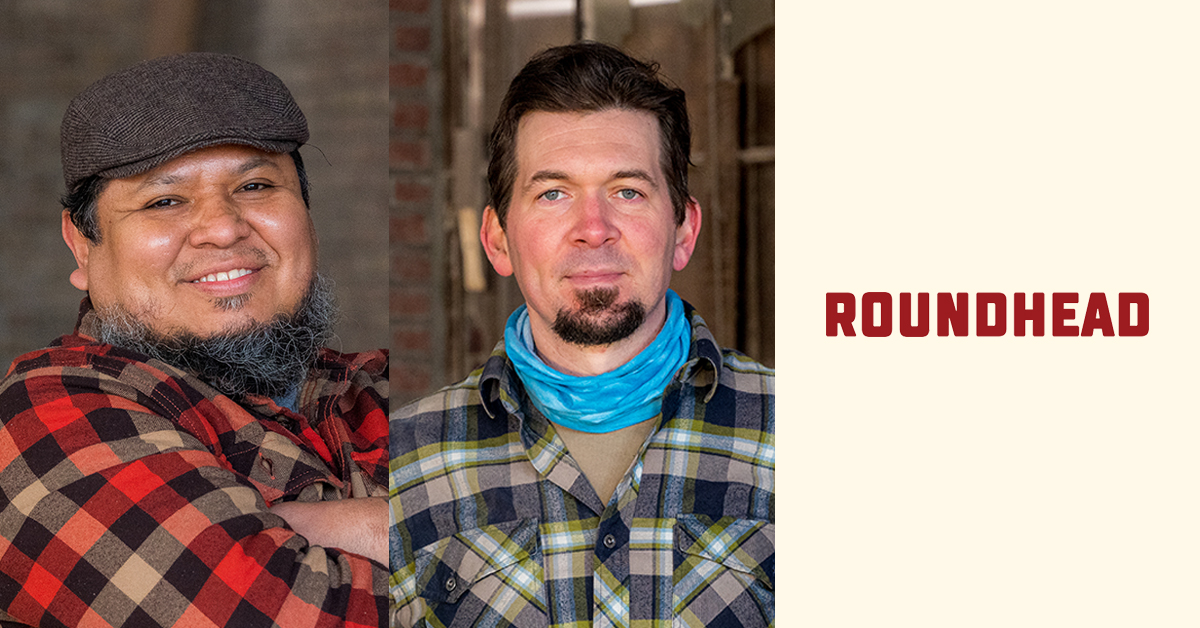
Youth soccer games aren’t just a way to get the family outside and to mingle with neighbors – they are also a great place to meet a future business partner. At least, that was the case for Luis Espinoza and Craig Panzer, the founders of Roundhead Brewing, Massachusetts’ first Latino-owned brewery, located in Boston’s Hyde Park neighborhood.
In the latest A Round With … – a weekly Q&A series exclusive for Brewbound Insiders – Luis and Craig chat about Roundhead’s Peruvian influence, lessons learned from their previous beer careers and their passion for community, which serves as the brewery’s guiding light.
Read the full Q&A below, edited slightly for clarity:
You both have experience in beer, and have seen how craft beer has shifted in recent years. Why was 2022 the right time to officially launch your own brewery?
Luis: We launched Roundhead to craft great beer while representing our Latino heritage. As the industry embraced diversity, we saw an opportunity to create more than just a brewery – one rooted in culture, inclusivity and storytelling.
Coming out of the pandemic, people craved real connections, and we wanted to build a space where beer brought people together – “Cerveza que Reune” – in a meaningful way.
Roundhead’s mission is “cerveza que reúine” or “beer that brings people together.” Why was it important to have this as Roundhead’s guiding light, and how are you incorporating it into how you do business?
Craig: Great beer is Roundhead’s starting point. It’s our invitation to bring people together. We’re not the brewery that forges identity through “beer porn” on the internet: centerfolds that show glistening cans with our logo in 4K. We love beer, we’re passionate about beer, and we’re talented. Great beer is our way of saying, “The table’s set, so come over!”
Our mission is stated in Spanish because that’s also who we are. With Cerveza que Reúne, we raise our flag as the first Latino-owned brewery in Massachusetts, and put people in contact with Latin culture.
[It’s for] someone who doesn’t speak a lick of Spanish, who risks embarrassment by trying to say Pompeando Juntos to order our New England DIPA; Peruvians who see a pizza with sweet potato, pickled onions and porkbelly, smiling when they recognize ingredients from a dish common to their kitchen table; a kid whose eyes light up when we pour a can of non-alcoholic chicha morada, what we call Purple Wisdom, into a glass. It’s fun.
We enjoy our lives in the city, and making a taproom happen to share our talent, our heritage, and to celebrate our community – that’s cerveza que reúne.
Craig, your career history includes time at Otter Creek, and you’ve noted before that your experience has taught you that you “do not want to sell beer across 17 states.” Why is that the case and how has that thinking shaped Roundhead’s strategy?
Craig: I tell friends about my days at Otter Creek – my first job out of college, working in the candy factory. When it was time to give a brewery tour, that was my thing. I loved connecting visitors with the place, the history, the liquid in their cup. Bringing people together at the top of the brewer’s platform, or into the beer cave with pallets piled high – that was my joy: sharing in the wonder, and making people feel welcome.
Fast-forward a couple years, and I’m Otter Creek’s regional sales manager for northern Vermont and southern New Hampshire. One morning, I remember climbing into my Honda Accord to start my day, snow coming down, and I’m thinking to myself, “What am I doing?” Climbing into a metal box to drive icy roads to New Hampshire, so I can evangelize the good word of Otter Creek. These shops already had a great lineup of local beer on tap. Things stopped making sense.
A relationship with a company is hardly a relationship at all when it’s limited to a beer can in my hand at the grocery store. Just like how the margin is best when sales are direct and local, so are the conditions for strong relationships.
My passion: Great beer and bringing people together in Boston. That’s what lights my fire and shapes our business strategy. I believe this is done best as a small-batch brewery powered by a talented local team, so we can serve up meaningful experiences to all the folks who walk through these doors.
Luis, you draw a lot of inspiration from Peru, which isn’t often a place we talk about when discussing beer. What should people know about Peruvian beer and other aspects that you draw inspiration from?
Luis: Peru has a deep but often overlooked brewing history, dating back to Chicha, a corn-based beer that was essential in Incan celebrations and rituals. Still brewed today, Chicha is a gluten-free beer.
The brewing techniques used in Peru are fascinating, from the ancient Incan method of chewing corn to release enzymes, to my grandfather’s ancestors with the method of boiling corn for 8-10 hours to break down starches into fermentable sugars. In my hometown, chicha was brewed a month before the annual festival.
My grandfather would boil the corn with spices and fruits for hours, then transfer the liquid into “pipas,” large clay vessels, covering them with cactus leaves and sealing them tightly to ensure a healthy fermentation. These vessels were then buried underground for a month. I always wondered why they did this, and the answer is simple: temperature control. The earth provided a stable, cool environment for fermentation.
Beyond the ingredients and brewing traditions, Peruvian hospitality, food and the communal spirit of sharing a drink are at the heart of what we do at Roundhead. Through our beers and food, we want people to experience a little piece of Peru.
One of your core offerings is Contigo, a Peruvian lager. Rumor has it the water used is as close to the water you can get in the Andes mountains. How were you able to craft that, and why was it important for the outcome of the beer?
Luis: When I wrote Contigo’s recipe, I knew it had to be original from Peru. While grains, hops and yeast come from all over, water was one element I could recreate from there.
I took samples from the Andes, analyzed their mineral content, and adjusted our Hyde Park brewing water to match its soft, rich qualities. This was key because traditional Peruvian lagers have a clean, smooth finish with a slight minerality that enhances the flavor.
What’s one piece of advice you’d give to someone starting a brewery right now?
Luis: Focus on your “why” before your what. The beer industry is competitive, so having a clear purpose, whether it’s showcasing a unique culture, a brewing style, or a community focus – will set you apart.
Brewing great beer is just the starting point, knowing your story and how it connects with people is what makes an impact.
Have you had any wins recently that you’d like to share?
Craig: We just signed a contract for the second season of our mobile beer garden series – a partnership between Roundhead and the city of Boston. It’s a lot of work, and it’s pretty much a break-even, but it’s a great way for us to build community. We pop up for three weeks at a time at a series of neighborhood parks in Boston. It’s a workout – exhausting, but we get stronger thanks to all the reps.
This summer, you can catch us at Copley Square in downtown Boston, Jamaica Pond in Jamaica Plain, and at LoPresti Park on the waterfront in East Boston, to name a few spots.
Last year you hosted Contigofest, a festival highlighting Roundhead and other Latino brewers. Why did you want to lead that initiative, and what was the response?
Luis: We started Contigofest to shine a spotlight on Latino brewers. It was important to create a space where our culture could be celebrated in this case through beer, food, music and community.
The response was amazing! Seeing so many people come together to support and connect over craft beer – that’s why we do this. It wasn’t just a festival; it was a movement toward greater representation in brewing.
If you could wave a magic wand and change one thing about the industry, what would it be?
Craig: That we continue to see more seats for more people to sit at the table. It’s hard to get into the brewing industry – to share in the knowledge on how to brew, how to manage the finances, how to access the capital and networks you need to do it all. There are a lot of barriers out there. And a lot of risk.
The industry needs more resource partners like the city of Boston’s small business unit, local technical assistance providers like Jamaica Plain Neighborhood Development Corporation, and local nonprofit funders like LEAF (Local Enterprise Assistance Fund) and Boston Impact Initiative. Organizations like these were the lifeblood of support to get Roundhead up and running.