
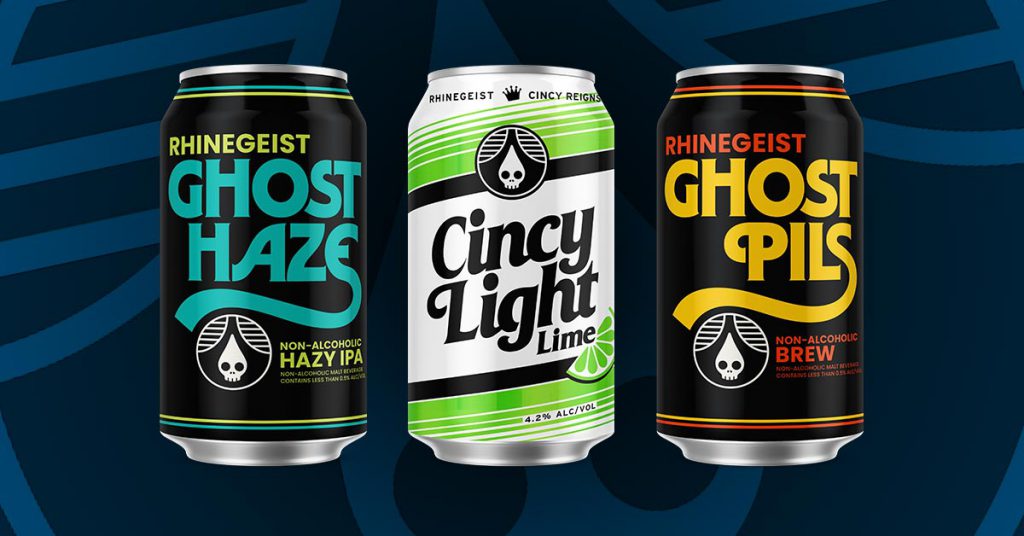
Rhinegeist is ghosting alcohol. The Cincinnati craft brewery will add its first non-alcoholic (NA) beer to its portfolio later this summer.
Ghost is an “affiliated brand” that plays on the “geist” name, meaning ghost or spirit, Rhinegeist CEO Adam Bankovich told Brewbound.
The NA beer is one of two big portfolio additions for Rhinegeist this year, with Cincy Light’s first line extension, Cincy Light Lime (4.2% ABV), rolling out now on draft.
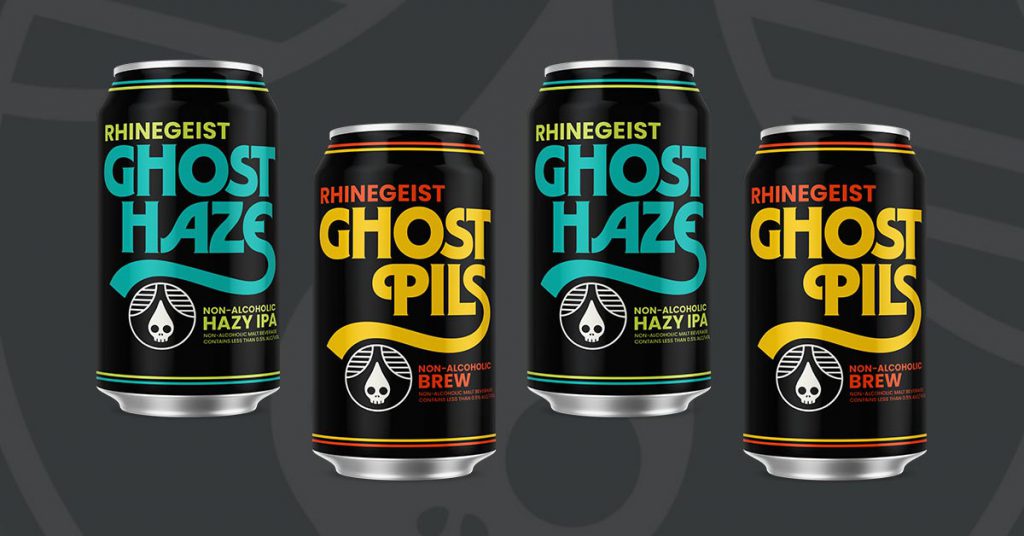
Ghost Haze and Ghost Pils will launch in 12 oz. can 6-packs across Rhinegeist’s full nine-state footprint – Ohio, Pennsylvania, West Virginia, Kentucky, Tennessee, Indiana, Illinois, Michigan and Wisconsin – in mid-August.
Conversations about NA beer have been ongoing since Bankovich joined Rhinegeist in fall 2022. But the company didn’t have a pasteurizer or the space for one. NA beer production is a difficult endeavor to take on due to food safety concerns.
“We got comfortable with this idea that maybe we just don’t make our own non-alc,” Bankovich explained. “If we can’t make it and it’s of the same quality as all the beer and cider and everything that we make, that’s OK.
“We can still put our stamp on it if we have a partner that we trust,” he continued.
Enter Sustainable Beverage Technologies (SBT), its BrewVo technology and their partner facilities.
SBT has worked with other craft breweries to create NA beers, most notably Deschutes Brewery. Rhinegeist is SBT’s latest partner brand, with production of the Ghost line being pulled forward due to initial sales forecasts exceeding expectations, Bankovich said.
Although SBT was pouring kegs of Ghost Haze at its booth on the BrewExpo trade show floor at the Craft Brewers Conference (CBC) last week, the beer will not be offered on draft.
With a mid-20s share of craft beer in the Cincinnati market, Rhinegeist expects to gain a significant piece of NA share in its home market.
“There’s no reason why we shouldn’t have some share of the non-alc beer market, where we have that much share of the craft beer market,” he said.
Rhinegeist is projecting “really modest” growth this year, with the company targeting around 1.6 million cases in 2025, following 7.5% growth in 2024, Bankovich said. Forecasting the impact of NA beer on the business this year is difficult due to scan data not capturing direct-to-consumer (DTC) e-commerce sales, Bankovich explained. However, DTC sales aren’t likely to be part of Rhinegeist’s strategy, he added.
“For now, it’s really modest expectations,” he said. “[NA is] a really tiny bit of our plan for this year, but it could absolutely grow into something meaningful.”
The NA segment remains small, but is growing in both dollar sales and volume, according to the most recent report from market research firm Circana. Year-to-date through April 20, dollar sales of NA beer – which includes major global brewers and craft brewers – increased 23.9%, to $164 million, and volume grew 25.1% at off-premise retailers. The segment gained 0.29 sharepoints, increasing its dollar share to 1.33% of overall beer.
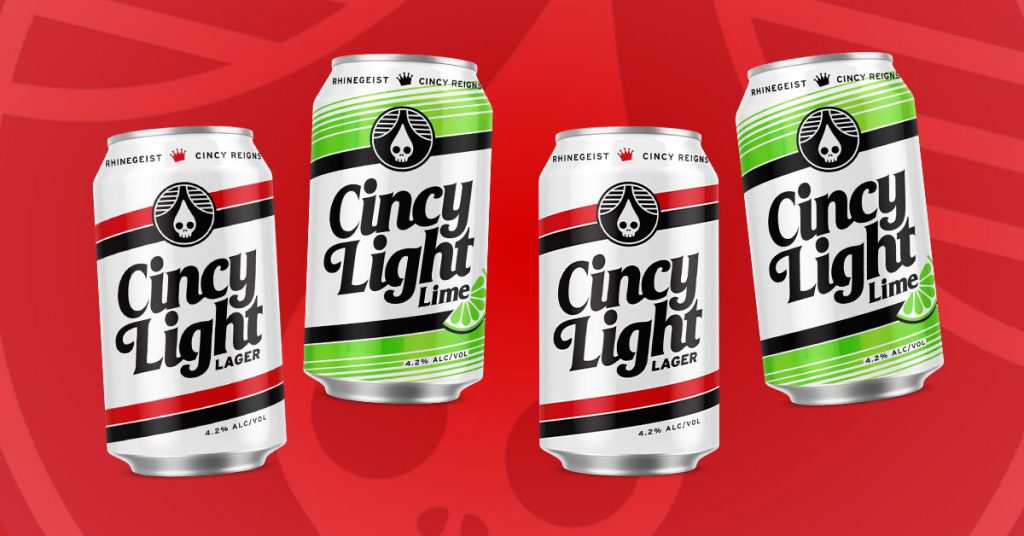
Before Ghost’s arrival, Rhinegeist is pushing out Cincy Light Lime on draft, which hit the Cincinnati market two weeks ago.
Rhinegeist’s previous plan was for a fall release ahead of resets, but positive feedback from consumers led the brewery to kick out Cincy Light Lime faster. Rhinegeist will follow draft with 16 oz. single-serve cans in June and 12-packs cans later in the month, Bankovich said.
“We’ve got some key retail partners that are really excited about [16 oz. singles], which is a new way for us to launch something to both capitalize on summer, but not get the full volume package out there just yet,” Bankovich explained.
Cincy Light Lime’s arrival comes nearly two years after the launch of Cincy Light in June 2023.
Bankovich believes Rhinegeist is capturing new occasions for consumers who wouldn’t necessarily have given the craft brewery’s beer a chance, while also re-engaging existing consumers who may be looking for a lighter beer to drink in their mix with Truth IPA.
Rhinegeist began to look for the next iteration on Cincy Light last year, exploring light flavors such as amber and wheat and testing those beers, alongside the original Cincy Light, in flights with consumers, who were each given a token to redeem on one of the beers in the mix.
The result of those trials was that Cincy Light Lime, while admittedly not novel, is “clearly a winning flavor,” Bankovich said. He believes Rhinegeist learned from those trials that the extension would not cannibalize Cincy Light due to there being a different occasion for the beer.
“I don’t think it’s going to cannibalize,” he said, although he expects there to be some “trading.” “Cincy Light is still going to grow. I think Lime will be incremental this year. Next year, we’ll see how far we want to grow it.”
Cincy Light Lime may also leapfrog the original beer in markets where distributors don’t carry a draft lime lager in their portfolios, Bankovich said.
“If distributors want it and it’s going to work and we can support it, great,” Bankovich said. “So it might pop up in a few pockets where that’s the scenario. I’m not going to throttle the volume. We can make it as much as anybody wants.”
Earlier this year, Rhinegeist added 16 oz. can 6-packs for Cincy Light, following the first release in 12-pack cans and then 24-packs.
“We’re trying to make sure that if that’s how they want to consume Cincy Light at home that they can,” Bankovich said.
However, don’t expect to see a Cincy Light variety pack anytime soon.
“Variety packs have been so successful for so long, and if you look at all crafts, it’s one of the things that is tanking the biggest, especially in terms of the size of its category and downward trends,” Bankovich explained.
Rheinegeist is slow-rolling Cincy Light to new markets. Outside of its home market, the beer is available in Northern Ohio and Kentucky. Columbus is “a major focus,” Bankovich said. And the beer also has some distribution in Indiana.
“The important thing for me is that we grow it organically,” Banovich said. “If we expand it to a market and it fails, we’re not going to get a chance at those placements again. We’ll lose confidence at the retailer and the distributor.
“The cycles are way too fast now, and if you launch and don’t prove yourself immediately, that opportunity is gone.”
Rhinegeist rose six spots up in the Brewers Association’s (BA) list of top 50 craft breweries by volume in 2024, making it the country’s 16th largest craft brewer.