
Glancing at the adult non-alc (ANA) section of a store, most drinkers aspiring to moderate for the first time likely won’t find brands they recognize. They might prefer it that way.
With ANA on its way to becoming a billion dollar category in the U.S., newer, independent entrants have been driving the category. Labels from major bev-alc companies grew +17% in 2024, while smaller brands were up 51%, according to NIQ data assembled for Brewbound’s sibling publication BevNET, by bev-alc data firm 3 Tier Beverages.
But the world’s biggest beer and wine labels are leveraging their brands into extensions. As of now it’s giving their shareholders something to be happy about: About 65% of total ANA sales come from major brands and 35% come from smaller brands, independents or startups.
As the ANA category continues to expand, major bev-alc companies are facing a crossroads about their best path forward: extensions, innovations or acquisitions? Some, particularly in spirits, are still hesitant to jump in at all.
Independent Spirit Brands Drive Discovery, Innovation
Non-alc spirits have experienced the highest growth in the last year (+84%) but the segment is still small in its overall contribution to dollar sales (5%). That’s part of what may be making larger spirits companies hesitant to extend their brand equity into zero-proof versions.
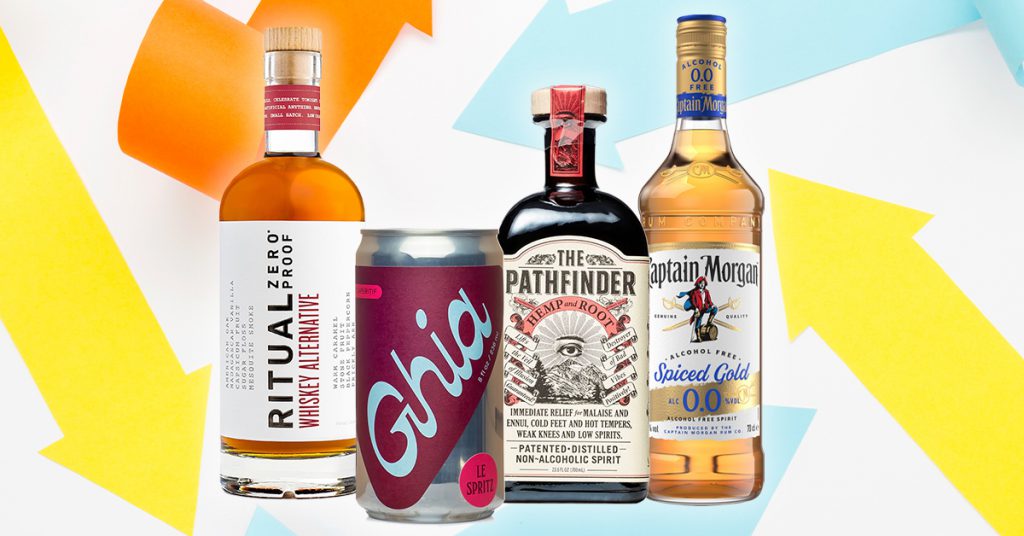
New ANA spirits and ready-to-drink (RTDs) cocktails have flooded the shelves in past years: SKUs have grown from 160 in 2022 to 298 in the last 52-week period, according to NIQ data assembled for BevNET by bev-alc data firm 3Tier Beverages. But virtually 100% of sales are from independent brands. Diageo’s Tangueray, Gordon’s Gin, and Captain Morgan’s Rum zero-proof editions have launched in Europe, where the ANA market is more evolved, but have yet to cross the pond.
“Because the UK as a market is obviously a little bit further ahead than the U.S., I think they are waiting because they know they have it,” said Jill Sites, executive vice president of NA amaro The Pathfinder. “So if all of a sudden a gin takes off outside of say, what Diageo already owns, then they will follow suit.”
So far, major spirits groups have been primarily focused on investments over innovation. Constellation Brands’ venture fund has made minority stakes in TÖST, HOP WTR, and most recently Hiyo. Pernod Ricard took a minority stake in Almave, a tequila substitute from Mexican spirits group Casa Lumbre, while its venture arm, Convivialite Ventures, has invested in canned alternatives Ghia and Free AF. The Stoli Group has brought The Pathfinder into its portfolio.
That’s historically on track, according to Dan Gasper, an advisor to ANA founders who also co-founded Distill Ventures.
“Innovation in drinks has been almost entirely driven by founders, not multinational innovation departments, over the past decade, maybe even two,” said Gasper. “Spirit companies have been highly acquisitive and way more preferred to buy, not build.”
Headwinds have slowed down the acquisition pace in general among multinational bev-alc companies, and skepticism of moderation trends are also likely making executives skittish when it comes to ANA.
“I think it’s fear of spending and taking money away from the things that they need to spend on, because right now they’re just letting the smaller brands, the independent brands, fight it out,” Sites added.
Sites has consulted with some of the ANA industry’s newest brands. Many of those zero-proof spirit and RTD startups are premium positioned – as is the bulk of the segment thus far. But that’s a problem for big booze, she said, which relies on economies of scale and often leverages underpricing in order to gain distribution placements.
Diageo has been the most active acquirer of ANA spirits, bringing Seedlip and more recently, Ritual Zero Proof, into its fold from incubator Distill Ventures. If those two brands were to count under “larger brands,” the split of sales across ANA spirits would still be 30% to 70%. The spirits serve different roles each fulfilling a need, according to David Crooch, general manager of Diageo Non-Alcohol and co-founder of Ritual.
“Ritual is a direct substitute for a spirit, while Seedlip can be considered more of a designer product,” he said.
Ritual offers a clear one-to-one replacement for multiple spirits, whereas Seedlip may provide more flexibility, serving as the base for simple serves, classic cocktails, or entirely new creations. But while Seedlip and Ritual battle other ANA spirits for the limited space on a backbar, consumers have shown they aren’t eager to do their own mixing. ANA RTDs are gaining more traction within the segment: up 165% in the last 52-weeks while ANA spirit bottles are up 39%, according to NIQ Data assembled for BevNET by bev-alc data firm 3Tier Beverages.
Straight zero-proof spirits are also more challenging to replicate in flavor and mouthfeel compared to beer, and bigger formats are more costly to the consumer, added Gasper. Those barriers also explain why major spirit label extensions might not earn a spot on a drinker’s home bar when they can opt for a new experience altogether – a wood distillate, a canned functional beverage, or a bitter liqueur that may provide an easier mixer.
“There’s a sense of discovery driving the ANA category,” Gasper said.
Independent Craft Leads Beer Category, Large Winemakers Dominate
Non-alc brewers have seized the momentum, molding the ANA category as a whole into a beer-heavy phenomenon making up roughly 84% of all sales, according to NIQ Data assembled for BevNET by bev-alc data firm 3Tier Beverages. Major beer groups have jumped in and are finding more success than spirit groups – although there’s a clear brand to beat in beer.
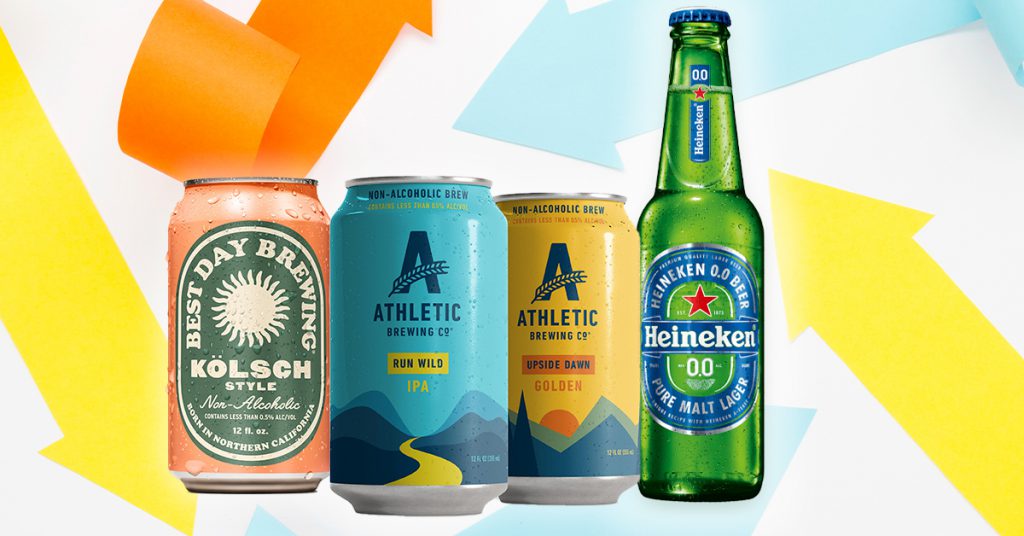
Independent NA-exclusive craft producer Athletic Brewing has paved the way for the segment, taking a 25.3% share in January as the top-selling NA supplier for the month, according to an analysis by Bump Williams Consulting.
The brand has also pushed NA craft beer to the top as the single largest contributor to total ANA sales, followed by import beer (largely Heineken) and premium domestic, according to 3Tier Beverages. Craft is also seeing the largest growth (roughly +50%) within beer, followed by imports (+18%), while domestic and below-premium beer fall closer to flat growth. Meanwhile, NA seltzers and flavored malt beverages (FMB) remain relatively small in size.
There’s less competition among beer brands than in ANA spirits, which may aid independents like Best Day to follow in Athletic’s footsteps: as of January 2025, 129 NA beer suppliers were selling products, up from 62 suppliers in January 2022.
The top four brands that follow Athletic come from beer giants Anheuser-Busch InBev, Heineken, Molson Coors and Constellation Brands – but all lost share in January, according to Bump Williams Consulting. Other top-10 suppliers – Diageo’s Guinness, Sierra Nevada’s Trail Pass, HOP WTR, and Best Day – all gained share.
Looking at wine, the sales breakdown is closer to beer than spirits: the majority of NA wine sales (80%) are driven by large, existing brands like Fre (Trinchero), Ariel (J. Lohr), Stella Rosa NA (Riboli) and Geisen 0%, according to NIQ Data assembled for BevNET by bev-alc data firm 3Tier Beverages. Smaller, independent labels are growing at a slightly faster growth rate versus last year, but make up a smaller share of total category sales.
Pressure On Brands: “It’s Getting Noisy”
As independent ANA brands build on momentum, they’ll also have to withstand the pressures of a fast-growing category.
“I think we’re at a point where it’s getting noisy and claustrophobic a little bit,” Sites said.
Already, retailers have told Sites they don’t want to see new products.
Fundraising is also sparse and challenging, added Gasper, with founders facing the added apprehension of non-believers in the wider drinks industry.
“I think as ANA continues to develop and the sales accelerate, and as retailers and hospitality venues recognize the importance of inclusivity and the profitability perspective that ANA provides, I think that’s when you see a lot of those pressures start to be relieved,” Gasper said.