
Ready-to-drink cocktails are now allowed at more retailers and restaurants in Pennsylvania, but that doesn’t mean drinkers in the Keystone State are cracking open an array of canned cocktails.
Starting in mid-September, the Pennsylvania Liquor Control Board (PLCB) allowed restaurants, bars, beer distributors, grocery stores, convenience stores, and other outlets to sell alcoholic RTDs with ABVs not exceeding 12.5%. Under the previous law, only the state-owned wine and liquor stores were allowed to sell products in a category that has surpassed $13 billion in off-premise sales.
But as many control states evolve liquor regulation to align with market innovations, suppliers and retail buyers can often get caught in new complex and costly processes. For some, the new regulations represent a myriad of rules to navigate through for minimal sales rewards so far, while for others they present unique sales opportunities.
The Cost of Doing RTD Business
Pennsylvania’s new RTD permits cost private retailers $2,500 with a 2% renewal fee on the gross sales of all RTDs. There are also stipulations on when and how the drinks can be sold: licensees may sell Mondays through Saturdays until 11 p.m, with restaurant and hotel licensees with a Sunday sales permit able to sell every day. There are other hidden costs as well.
W & S Distributors, which functions as a family-owned independent beer and wine store but is labeled a distributor in Pennsylvania, is still required to buy out-of-state RTDs from the PLCB, which means W & S doesn’t get wholesale prices but rather just 10% off the state’s retail price. That forces the Northumberland-based store to price many of its RTDs, such as High Noon and Malibu Cocktails, a little higher than state vendors in order to make a healthier profit.
“If I could get wholesale pricing on High Noons and that high-volume stuff then I could run some real sales and compete,” owner Craig Specht said.
Buying from state wholesalers also costs 6% sales tax up front, for which Specht gets reimbursed once the items are sold.
“I have to keep track of that sales tax and submit that rebate every month for what I’ve sold,” he said. “There’s an upfront cut in my margin there.”
In FY 2022-23, state stores made about $89 million in RTD sales, growing +43.4% over the prior fiscal year with premium price segments experiencing the greatest uptick (+53.4%). As of now, RTDs are 3% of overall sales for W & S Distributors with a bigger spike (up to 10%) on Fridays and Saturdays. That’s not much, but as sales possibly pick up in warmer weather, there might be other ways private outlets can squeeze more out of their sales.
A Boost For Local RTDs?
With state stores acting as a funnel, finding a diverse set of RTDs to stock is tricky, but may have a payoff for any of the 177 Pennsylvania craft distilleries that are already or could make them.
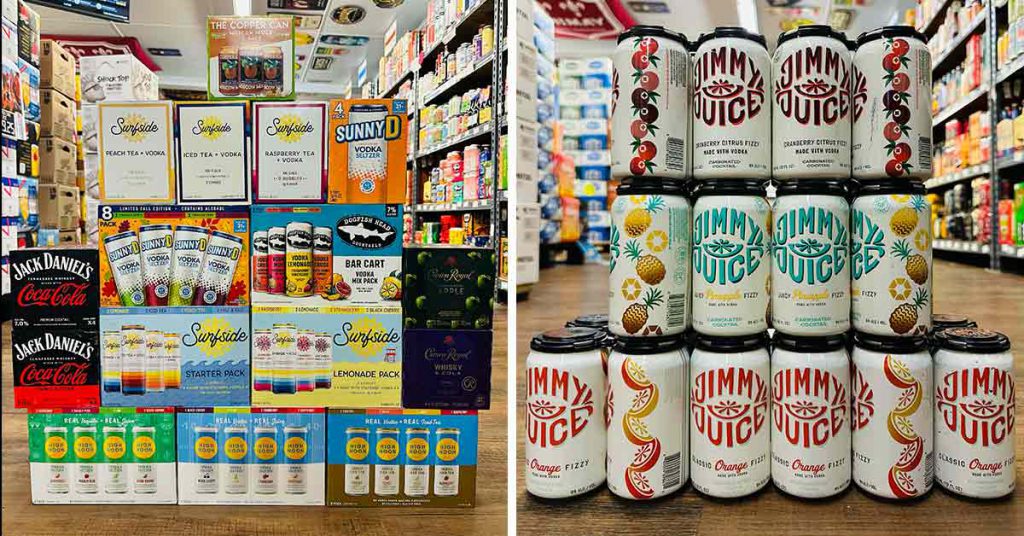
The PLCB is Specht’s only resource for national brands such as Jack & Coke or Cocktails by Crown Royal, but it can be a bottleneck for accessing smaller brands or even different flavors of national brands requested by customers. The retailer has struggled to get Boston Beer products, except for an initial small amount of neighboring Dogfish Head Cocktails.
In the meantime, W & S is building up a roster of locally made products available for wholesale prices, as existing Pennsylvania distillers have now been afforded the opportunity to self-distribute RTDs within the state (with some restrictions).
“Anybody who has a nice looking product and then gives me a sample to try and it tastes good, we roll with it,” Specht said.
He’s procured local RTD recommendations from customers like Mason Dixon Cocktails, Jimmy Juice, and Hidden Still Cocktails. He’s also eager to buy Surfside products direct, which rank as the highest selling Pennsylvania spirits products in state stores, but are being distributed to more populated areas of the state first. Local brands have been doing samplings, which Specht cited as vital for sales.
“It definitely requires some customer education,” he said. “But as soon as I tell customers that a product is made down the road and they sample it, it’s gone.”
John Logan of Rectified Spirits said in the first 60 days business picked up significantly for his flagship product, Fishtown Iced Tea, a canned cocktail containing vodka, rum, tequila, and triple sec.
For Logan and other local distillers, the new laws represent a course correction in the industry, yielding more choice and better value for consumers, and increased revenue opportunity for distillers and RTD permittees.
“This is really another great opportunity for us, particularly when you can just cut out one of the tiers of the three-tier system, in terms of gross margin and managing your business pretty directly,” said longtime craft distiller Andrew Auwerda, founder of a hybrid retailer and distillery, BOTLD.
Auwerda is now planning on taking his collaborative spirit brand with the Philadelphia Eagles, Bird Gang Spirits, into RTD format, and sell at supermarkets or anywhere else that has a license.
As local distillers make their moves, Logan is concerned about one thing: the possibility of interference from the large distribution houses leveraging their resources to squeeze out competition from start-up brands.
“A small part of the new RTD legislation is Pennsylvania distillers and homegrown brands punching back at the bullies, and the bullies may not take it well,” he said.