
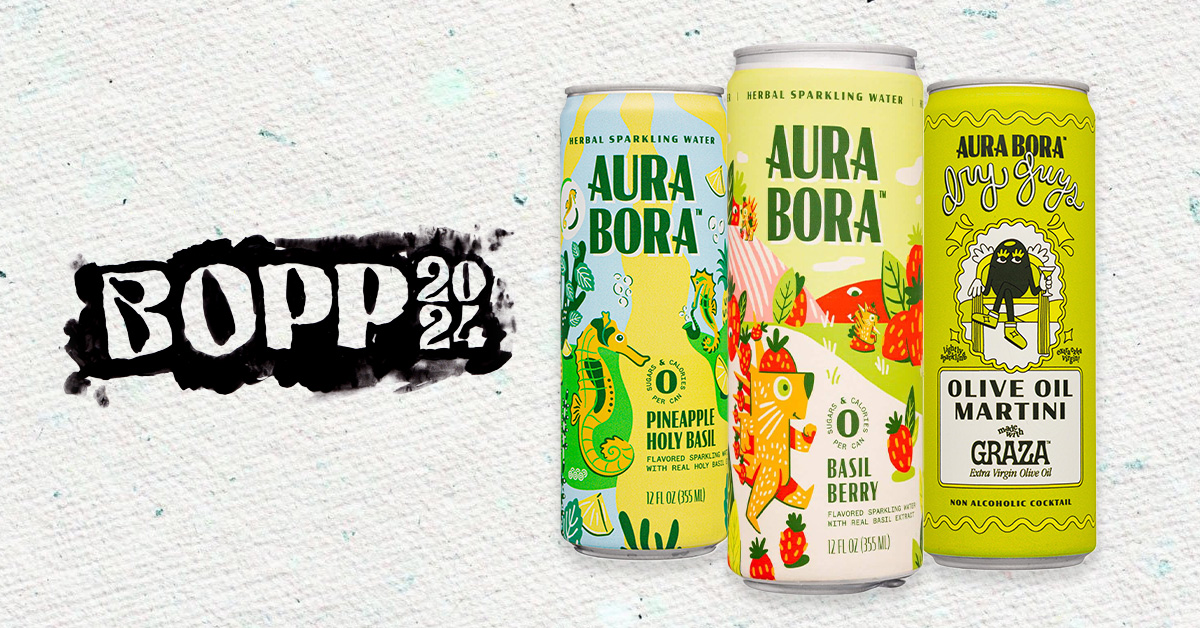
Not all “beloved” CPG brands have soul, but all brands with soul are beloved, according to Jesse Howell, art director for sparkling water brand Aura Bora.
Howell and Aura Bora co-founder and creative director Maddie Voge spoke during Day 2 of Stout Collective’s BOPP Beer Design Conference in Chicago. The duo walked through the creation of Aura Bora’s recognizable branding and “world-building” – including lovable creatures and food-themed lands – and how that “soul” is translated to consumers.
The concept of a brand’s soul is both an art and a science, according to Voge. The art is the intelligible feeling that a brand’s imagery or product gives the consumer, similar to how two people can have a connection, but you can’t quite put your finger on why. The science part of a brand’s soul can be divided into three segments: lore, world-building and religion.
“We could talk a bit about brand voice, brand identity and trend cycles, all things that are amazing and really important,” Vogue said. “But if we’re here to build something really special, I think it’s great to go a level deeper.”
“While lore, world-building and religion are not non-negotiables for success, they’re the most powerful tools we found that create an iconic brand,” Hoge added.
Lore
Lore is the simplest of the three parts of a brand’s soul – it’s the creation story. For Aura Bora, that was Voge and her husband experimenting with a Sodastream in their kitchen.
For consumers to care and connect, they want to know about who is behind the brand and how it came to be, according to Voge and Howell.
“It’s the storytelling, your creation story, the copy on the back of the product, the ‘About Us’ page on the website,” Voge said.
The duo suggested brands ask themselves five key questions when establishing their lore:
- Where did the idea of the brand come from?
- Who brought it to life and why?
- Can you describe the brand in three words?
- What does your brand care about?
- What aspects of your lore do you want to be public facing?
World-Building
World-building is where founders can start to really flesh out the soul of their brand. Aura Bora took world-building literally and created a universe of characters and the environments they live in, referred to as Aura Bora Land. The land includes “ingredient-heavy ecosystems,” clean and bright colors and “earthy” environments. That world is then translated onto Aura Bora packaging and throughout its branding and marketing.
“This world doesn’t necessarily have to be visually available to your audience or even understood by them – you don’t have to have cute little creatures and landscapes on your products,” Howell said. “But building a world around your brand and thinking through those intricate details of the world your brand could exist in and what it could be like, allows you to open up a whole new world – pun intended – of creativity and delight.”
World-building also includes designating “vessels” for your brand, or people and things that a brand’s personality can inhabit.
Inspired by the world of Neopets, Aura Bora’s vessels are creature mascots that represent each of the company’s more than 30 flavors. Each flavor has its own creature with its own name, temperament and species. For example, Strawberry Basil features Spike Lee, a hedgehog who is both irritable and soft and is always marching around the lands searching for strawberries and impaling the best ones with the spikes on his back.
“Giving each creature their own personality and humor and hobbies and habitat helps consumers build relationships with these players,” Howell said. “It puts a real face to get to know and establish connection and warmth with our products.”
Vessels don’t have to be cartoon creatures. They can also be “a talking paperclip, a cast of characters, brand ambassadors and athletes, or even co-founders as spokespeople,” Howell said.
One example of world-building in a less literal sense is Apple. The technology company has a consistent image that is communicated through stores and marketing that creates a world in the mind of the consumer.
“I like to think about this world as very similar to the beautiful afterlife train station in Harry Potter, just without that creepy baby,” Howell said. “And there is a reason why all their stores are so clean and inviting and beautiful. It’s because they have this consistent world that they’ve built.”
Religion
A brand’s religion is what it worships – what values and images are core to a brand’s identity.
Aura Bora’s religion is encapsulated in a Pinterest board that is shared and collaborated on across the company. The board includes images of small creatures, fresh fruits and vegetables, blurry and absurd memes and actor Michael Cera.
The company uses these touch points in its marketing and social media presence, drawing in consumers who have similar passions and building a connection. Consumers who feel that connection then become loyal to the brand, and even fanatical, Voge said.
Aura Bora follows a rough guideline that 67% of its social media presence should be soul and 33% should be directly selling or promoting products.
“People who are following you, unless it’s your mom, they don’t care,” Voge said. “You can post your product all day long and put it in new positions and in new landscapes, and have really expensive photographers shoot it, and at the end of the day, it’s a bit tiresome. Because honestly, other people are tired of social media too, and they’re super tired of brands.”
Aura Bora sees its social media as more of a “mood board” and a representation of things the company cares about. The company avoids loading posts months in advance to give “freedom to move,” and posts things such as funny gift guides, behind the scenes content and memes.
“It’s the things that our brand on Tumblr would be writing weird fan fiction about,” Voge said.
Brand religion can also help guide collaborations and what other brands it would be beneficial to work with.
“The fastest way to water down a brand is a poor collaboration,” Voge said. “It pulls a very loyal audience into a brand world that they did not consent to and oftentimes it doesn’t feel in alignment, and then they no longer feel in alignment with your brand.”
Aura Bora had explored collaborations in the past, but did not find one that felt in-line with the company’s religion until Graza Olive Oil. The two companies “worship the same things” including “delightful packaging,” earthy color palettes and natural, premium ingredients, Voge said. So the two companies came together to create Olive Oil Martini, the first offering in its Dry Guys series of non-alcoholic sparkling cocktails.
“It was a big hit,” Voge said. “We got pulled into a lot of spaces we’d never been in before. We started getting stocked behind bars and restaurants, and the audience that held Graza in high esteem started holding Aura Bora in high esteem too, and vice versa.”
The questions Voge and Howell suggested brands ask themselves when forming their religion include:
- What does your brand worship?
- How does it worship?
- What is hung on the walls of its shrine?
- What does it see as the ultimate sin?
- What does your brand believe happens in the afterlife?