
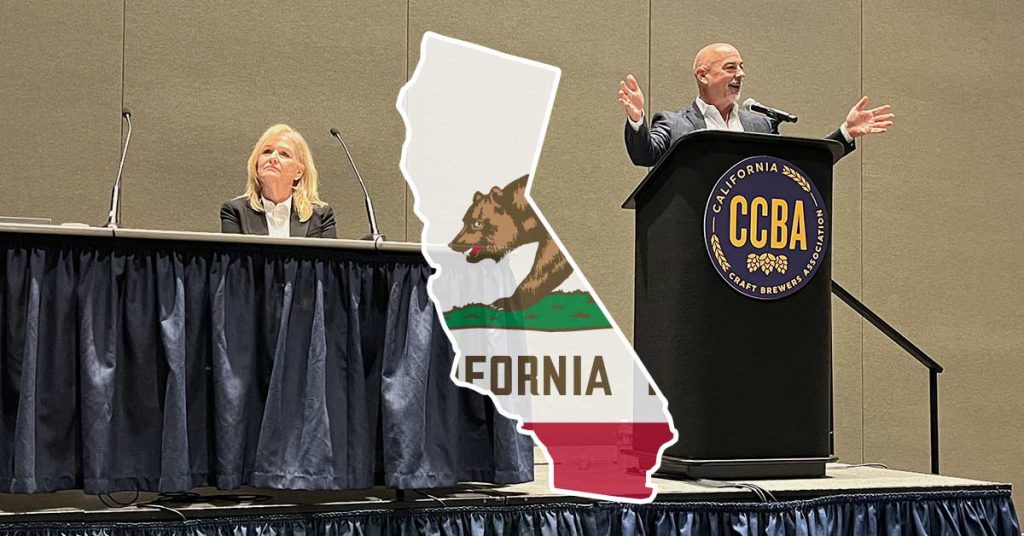
California craft breweries may soon have an easier time selling their beer at special events beyond their taproom walls, thanks to the California Craft Brewers Association’s (CCBA) sponsored bill in 2024.
AB 2174 would “authorize a licensed beer manufacturer to apply for, and the department to issue, a beer caterer’s permit for the sale of beer manufactured by or for the licensee for consumption at specified locations and events, including, among others, conventions, sporting events, and trade exhibits.”
Beer catering permits would allow craft brewers to benefit from events they are often invited to participate in but cannot, CCBA executive director Lori Ajax said last week during the CCBA’s California Craft Beer Summit in Sacramento, California.
“Right now, the only way you can get your beer there is if you donated it to a non-profit and you can’t take anything from the sale of that,” she said. “It has to go to the non-profit.”
The bill, sponsored by Assemblywoman Cecilia M. Aguiar-Curry, was introduced on February 7 and referred for the second time to the governmental organization (GO) committee.
During a legislative day that kicked off last week’s summit, members met with legislators to discuss AB 2174 and five expressed interest in becoming co-authors, Ajax said.
Beer catering permits have the potential to introduce craft beer to new consumers who may not interact with it otherwise, Ajax said.
“Right now, you really have to rely on people coming into your premises,” she said. “This gives you a chance to go outside of your premises and find new customers and really market your brand.”
Ajax and CCBA lobbyist Chris Walker discussed other legislative highlights and priorities during the trade group’s annual summit, including two bills the CCBA helped pass last year. Those included SB 388, which returned transparency to production data, and SB 788, which extended cider- and perry-making privileges to small breweries.
“It only allows you to sell what you produce under the cider/perry 23 license to other licensees that are able to resale wine, because it is considered a wine,” Ajax said. “It doesn’t allow you to self-distribute that in your taproom, and I know that’s a barrier for a lot of you.”
Breweries producing 60,000 barrels or more annually were granted the ability to make cider and perry in 2015 with the same restrictions Ajax described. Allowing smaller breweries to do the same eliminated “one of the last differences” between privileges for large and small breweries, she said.
Other bills the CCBA is continuing to watch in 2024 include SB 277, which aims to allow spirits-based, ready-to-drink (RTD) cocktails under 10% ABV to be sold in off-premise retailers licensed for beer and wine.
“One of the worst parts of the bill is that it actually puts in percent alcohol as being the distinction,” Walker said. “So for the first time within the statue, 10% alcohol – anything above that is not allowed in beer and wine [retailers], anything below that is.
“That’s not how we look at alcohol beverage categories,” he continued. “We don’t look at percentages. We look at beer, wine, fermented product versus distilled product. And by blurring that distinction, it causes chaos in the statutes.”
The CCBA, Anheuser-Busch InBev, the Wine Institute and other groups representing producers of fermented beverages have lobbied against the bill, which is “not going anywhere,” Ajax said.
“We don’t always agree on a lot of things, but on this everybody was in agreement that this would not be good for either beer or wine industry,” she said.
Another bill that was held in 2023 but has yet to be killed is SB 430, which would grant Amazon an exemption from tied house regulations, allowing the company to sell advertising to bev-alc producers on its streaming platforms even though it is a licensed retailer through its acquisition of Whole Foods Markets.
“Their argument basically was ‘We’re so big, we have so many holdings that you have to give us an exception because this unit of our company doesn’t communicate with this unit of our company,’” Walker said, adding that it is “absolutely a bizarre defense to say we’re so big we get to violate the law.”
A similar bill, AB 2896, is set to make its way to the Legislature seeking a tied house exception for Disney to sell bev-alc ads on its streaming platforms even though it holds retail licenses in its parks. Ajax and Walker explained that Disney parks differ from Whole Foods because they are an “enclosed, captive environment” that patrons need tickets to enter.
“We see the distinction between them and Amazon,” Walker said. “Their retail licenses are different. But that’s a distinction without a difference to Amazon.”