Search across the BevNET CPG Media network including BevNET, Nosh, Brewbound, Taste Radio, Nombase and CPG Jobs.
Brew Talks Boston 2023: State of the Industry A Three Tier Reality Check
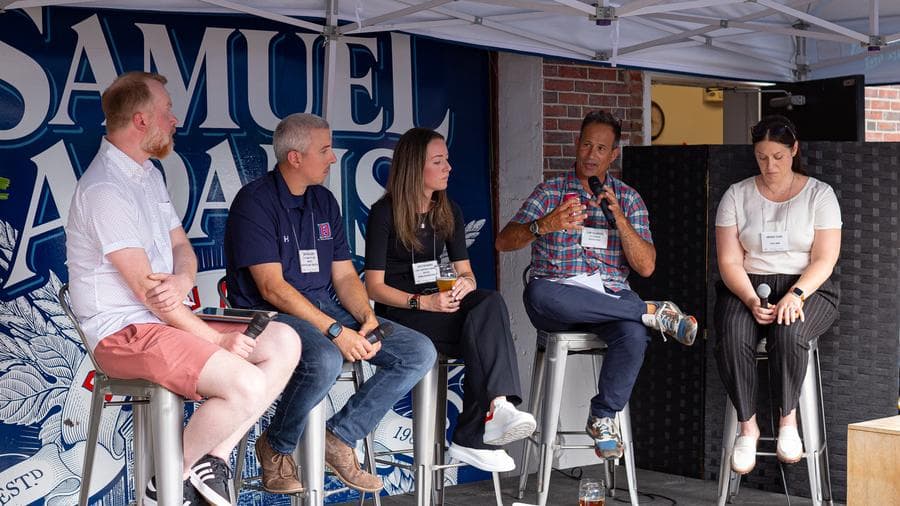
Featuring:
Dave Williams, VP of analytics and insights, Bump Williams Consulting
Sam Calagione, co-founder, Dogfish Head
Kristen Burke, Chief Corporate Growth Officer, Burke Distributing
Andrea Starr, Director of Beer Merchandising, Total Wine & More
Transcript
Note: Transcripts are automatically generated and may contain inaccuracies and spelling errors.
Speaker 1 [00:10] Welcome back to Brewox presented by Dogfish Head and sponsored by the Reyes Beer Division. I'm your host, Justin Kindle. We are live in Boston at the Samuel Adams Brewery in Jamaica Plain. This is our 2nd conversation. We've got a great panel here. We're gonna dive into the state of the industry and let's introduce our guests. Starting on the end, we have Andrea Starr from Total Wine and more. Thanks for being here, Andrea. We also have Sam Calagione, the co-founder of Dogfish Head. What's up, Sam? Also joining us is Kristen Burke, the Chief, or Chief Corporate Growth Officer for Burke Distributing. Thanks for being here, Kristen. She has her own cheering section. Yeah. And finally, last but not least is Dave Williams, Bump Williams Consulting's VP of analytics and insights. Thanks for being here, Dave. Thanks for
Speaker 2 [01:09] having me, Justin.
Speaker 1 [01:11] So we're going to do something a little different for Brewals. We're going to have Dave start us off with an overview of Bump Williams Consulting's three-tier survey of brewers, distributors, and retailers on their growth priorities and strategies and where they converge and where they diverge. So take it away, Dave.
Speaker 2 [01:30] Well thank you Justin. Um, hey everybody, so I'll just jump right into it because I don't want to take up too much of your time with this opening, but every year BWC conducts a survey across our three tier partners. We ask them just a simple question What are your strategies for growth for the upcoming year? Now we know that growth can mean different things to different people, right? More sales, bigger in size, bigger in awareness, maybe more efficient, but whatever your end goal is, what strategies are you going to implement to achieve set goals? We take all the feedback back from each of the tiers, distill it down, and create some top 10-ish lists across each of those individual tiers in the business. And then the fun starts, right? So the first thing we look at is overlap across these growth strategies across each of the tiers. Now inherently the way these businesses are set up, there's not going to be 100% overlap. There are going to be unique strategies to each, but when there is that overlap, that brings me joy because that means that there is common thinking when it comes to striving for growth for the upcoming year. On the flip side of the coin though, when there is little to no overlap, well, that makes me a little bit concerned because although everybody is trying to grow. They're kind of rolling in separate directions when it comes to achieving that growth, so you wonder about how that's going to be achieved. The next thing that we like to look at though is change. How have these strategies changed year to year? And that's what we're here to really talk about today. As the landscape evolves, as consumers evolve, so the growth strategies. Some of those evolve out of foresight, some of those evolve out of sheer necessity, but there's always going to be a little bit of change and What I distilled down was some of the top 3 growth strategies for each tier that we're seeing today for 2023, but also into 2024 until those strategies come in and inevitably change a little bit too. And what do we have to think about when it comes to growth and overlap or divergence across the three tier. On the retailer side of things we're seeing a lot of allocation shifting when it comes to space, space dedicated more to the fast moving areas, flavors, ready to drink, mostly spirits based cocktails where legal, and then imports. There are obviously exceptions to that space shift, but when you see space shifting one direction to another, someone's gaining, someone's losing, and how does that impact your strategy when the ax might be coming your way? The other thing we see is an expansion of single serve. Now single serve is not a new concept to beer, but this new wave has a bit of a different look, different shoppers, different occasions, different price points, and it's an incremental occasion. That means it's mostly in addition to what other consumers are buying in the stores. So there's going to be expansion on that side as well. And then finally we talk about efficiency and variety on the retail side. Maybe not about adding more to satisfy variety, but being a bit smarter about how to check a lot of boxes from an attribute perspective while maintaining a tight shelf set and thinking about velocity. In the middle tier, a lot of growth strategies we're looking at changing is the service model evolution. How do you address an area where you need to be more hands on and where can you afford to be a bit more hands off? And how does that impact you as a supplier when your strategy requires maybe a more hands on approach? The other thing we're looking at is portfolio evolution, looking beyond just Beer, and I don't mean beyond beer. I mean past beer, maybe past beverage alcohol, maybe past beverages in general. What else is going on those trucks that's going to allocate resources and keep the pipeline of growth flowing for a distributor and how does that impact a beer supplier in said house? And then finally, on the wholesale side, it wouldn't be 2023 if I didn't mention M&A. Anytime there's volatility in the industry, a lot of eyes open up, right? Not how can I take advantage of this, but how can I grow through this? Maybe that's acquiring, maybe that's consolidating, or maybe that's exiting, whatever that strategy is. And again, how does that impact you if you're on the supplier side of the coin? And then finally we come down to the brewers. The first thing we see about change for this year for brewers and looking ahead is approach to retail and chains. I think 2020 opened up a lot of eyes into the value of having a direct pipeline to your consumers, a reliable pipeline through the three-tier system, but a lot of other people are thinking the same thing. So it's not just chain approach, it's how you're going to go about achieving that. Approach in staying on the shelf on top of that, we saw a lot of self reflection being mentioned as a strategy for growth, looking at portfolio, looking at tactics, looking at footprint maybe contraction is a growth strategy, but it's a lot of self reflection looking in the mirror as what brewers are thinking about or manufacturers I should say, are thinking about moving forward and then ultimately the last point here is alternative dollar venture. being maybe a bit more willing and open to look outside the box of your core competencies when it comes to seeking out incrementality or incremental dollars, bigger portfolio, different footprint, different approach. I think the receptiveness there ties into growth and looking ahead for where you can possibly find that incrementality as a supplier. So I know I rattled off quite a few things. I'm sure we're going to cover a lot of other growth strategies in this.
Speaker 3 [06:50] Check. OK, we're back. All right. Uh, uh, so, uh, I'm gonna answer that like from a, a company perspective and from a Dogfish brand perspective, that's all right, uh, Justin. So, um, I'll, I'll say I'll kind of use the, the, the rules of three. So, um, you know, to somewhat Dave was saying it's tumultuous times and picking the priorities that are gonna like Run through all three tiers, uh, gracefully is critical, uh, and so being more judicious with innovations is a part of that and we have, uh, uh, we are proudly a portfolio company which we're at a moment like this when customers, consumers, beverage lovers are looking for choice. We feel at BBC we've got something for everyone, but we do have like priorities and from a, uh Uh, uh, uh, BBC wide perspective rules of Three. Right now, if you look at our priorities beyond beer, they are clearly truly, uh, both malt and spirits, twisted tea, which volumetrically is our growth engine right now, and Dogfish spirits-based canned cocktails nationally, those are 3. If you look at BBC Wide from a beer perspective, beer is our middle name. Never change. I don't know if Jim's still here, but he was drinking beer the whole time he was here earlier tonight. That will never change. So top three beer priorities Sam Adams, Dogfish, and our taproom environment. The last panel did a great job of talking about how they use their smaller systems to innovate, you know, in a way that does not disrupt the marketplace and their three-tier suppliers, innovate in a small. incubate, give it oxygen, test it, and then bring it to market. That's what this place, I'm looking over the brewers of JP right now. That's what a place like this or our Coney Island or our Angel City or our Dogfish locations are all about. And then lastly, growth priorities for Dogfish brands specifically, rules of three in terms of what's driving growth. Number 1 would be canned cocktails for us. Number 2 would be sort of I'd call them off-centered beers. I'm holding our biggest growth driver right now, which is Citrus Squall, which we'll talk about a little bit later. And number 3 would be IPAs. So volumetrically still dogfish majority IPAs, 60 minutes down a little bit, 90 minutes up a little bit, but those are essentially our growth drivers.
Speaker 1 [09:13] Andrea, at total, what, what are the growth priorities at this point in mid-year?
Speaker 4 [09:20] Sure, so we have seen a huge shift into what we call hard beverage, so the FMBs, seltzers, including spirits space, etc. um, so a huge shift into that, especially as we're in the warmer months. So for us it's really looking forward and thinking about what we're going to see and how that's going to impact our fall and holiday business. Um, so if you look at our craft business, we are, we are down. A little bit, but really when you dive in, it's all about the seasonals are a little bit stagnant and we're seeing that go into the hard beverage portion of our business. So as we look to fall and holiday historically some of the really big craft times of year, how does hard beverage play a part? Does craft really come back into the picture, or do the bottled RTDs start to take on a new personality? What really happens with the mix shift as we go down the road into the Uh, to the later to the holiday seasons.
Speaker 1 [10:14] So at the midway point of the year, Kristen, for Burke Distributing, how have the growth priorities shifted?
Speaker 5 [10:20] I would say we always focus on portfolio, people and process. So from a portfolio standpoint, Boston, although it's a small city, is incredibly diverse. So ensuring you have the right product in the right place in the right city, in the right account or right town, right account to ensure that you're reaching the proper consumer for the brand, um, that's always gonna be a focus for us. The shift might change, but that's always a priority from a people standpoint for Q1 and Q2 we were still trying to work up to being fully staffed. Um, we're finally getting fully staffed, which is really allowing our people to do what they're supposed to do, which is sell, and we're so fortunate that in Boston we really overindex with amazing supplier partners with people with people on the street to help us, um, so hopefully now we can kind of continue to grow and continue to sell instead of having to do other jobs, um, from a process standpoint that would be about service so just continuing to service every single day being everywhere and ensuring that, um. We can get those jump balls because we, our goal is to out service.
Speaker 1 [11:25] So we have a text line and that is 617-336-8560, 617-336-8560. If you have questions out there, send them in. This is a state of the industry panel and it's a brewox day, so of course, there's chaos in the market and that starts with Anchor Brewing. They're ceasing production. The business is being liquidated. Sam, as we sit here, you know, in this moment, you know, with an iconic brand basically being folded or, you know, it's going to have a new owner, the IP will at some point, I would imagine, you know, what does this say to you? What is the lesson that we learned from this at this point?
Speaker 3 [12:06] I, I think, uh, the, the biggest lessons is it kind of draws into focus to an amplified degree how it's kind of uh quickly accelerating into a bifurcated marketplace uh either and Dave talked about some breweries strategic model is actually receding geographically to focus on their home markets uh and also look at their state's laws to potentially maximize their ability to sell direct to consumer. Um, versus those that are call it now top 20 IRI defined craft, and that middle space is really challenging and even just 5 years ago to think a brand as iconic and durable as Anchor would, would be challenged to the degree that we found out today seemed unthinkable, and I suppose that's kind of the reasons for that I think are twofold. The younger drinker might not be coming in, is definitely not coming into alcohol through craft to the degree they were 10 years ago, and they're going to You know, we call it Beyond Beer. We'll get into that a little bit later. Or the younger drinker is supporting taproom breweries or they're supporting supporting top 10, top 20 IRI defined that they see on a C store shelf or on a stack at a top 20. Volume retailer, it's really challenging to be in that, call it 20,000 to 200,000 barrel range that's relying majority on outside your state for sales, and I think today was the biggest wake up call to just how quickly it's bifurcating.
Speaker 1 [13:42] Kristen, when you see a legacy brand like that go through hard times and, you know, essentially pull from the market. How does that shape your view of craft at this point?
Speaker 5 [13:55] I don't think craft is going anywhere. I, I think the struggle distributors have is, um, balancing like they're our partners we're a representation of those brands, but at the end of the day those are it's your baby that we're representing and we wanna do the absolute best that we can. It's not something we ever wanna see, um, and I think it's something we just have to all work together to try to shift away from, but I don't think that's a representation of the category as a whole.
Speaker 1 [14:23] I'd like to get the retail perspective as well, Andrea. How does that shape your view of craft?
Speaker 4 [14:28] So as I'm, I'm, uh, as I mentioned earlier, the craft business for us really is what's suffering is the seasonal and again, and when you dig down deeper what Sam mentioned, it's kind of that mid-tier those regional breweries that are having the biggest challenges, um, and when we talk to those breweries, a lot of times they do, it does seem that they don't quite know what direction to look and how to, to proceed, um, and what we always like to tell them is, you know. Know yourself, know like how, how did you get where you got, right? Like you had something special and people liked that. So you have to kind of like look back to your roots and I heard somebody on the earlier panel say, you know, do what you do best. So I think really just kind of like doing some self-reflection and seeing how you can, um, you know, recapture that magic and what's really going to work for you and your brewery and what makes you special and stand out from the crowd.
Speaker 3 [15:18] I gotta, I just want to put a, I'm looking at my wife, Mariah. We got a good friend Matt DeSab who owns a little restaurant group in coastal Delaware, and he's got a great entrepreneurial statement which every entrepreneur is sick of the, the, the statement when they're in their business environment. Do you know what you should do? Everyone's always telling you, do you know what you should do? And his answer is, is to say, Yes, yes, I do, and walk away before they say what they should. And to your point, I think those mid-size beverage makers are under siege because they're not growing and so they've got the distributors, their own coworkers, etc. saying, Do you know what we should do? Do you know what we should do? And oftentimes what they're looking to is IRI trends or what the bigger guys are doing, whereas Maybe they should be more, uh, you know, stoic on why they decide to go on that entrepreneurial journey and and be themselves. So I appreciate what you just said there.
Speaker 4 [16:06] I like to call that chasing the ball. I recently adopted a son and I've had the pleasure of watching youth soccer. They all just keep chasing the ball. So that's what's what I like to akin that to.
Speaker 1 [16:17] Love that. Dave, how are we seeing this for the, the mid-size breweries play out in the numbers as far as uh distribution goes?
Speaker 2 [16:26] I think everybody's kind of hit it spot on. That's a soft spot, you know, when we're looking at the numbers and I can see even stability in national distribution or market distribution, stability is a win right now because that squeeze is coming for Kraft overall and you look down that list of top 25, you can bring it down to top 50, top 100. More are down than are up, so that tells me that nobody is immune. But if you do have a focused approach, if you do have clear priorities, and you can actually execute on those priorities, that allows you to somewhat stand above while everyone else. For lack of a better word, is floundering right now.
Speaker 1 [17:06] So one of the things that I also want to hit on with you, Dave, is we know that there's a lot of upheaval in the market. You see it in the Bud Light numbers each week in scans in the off-premise data. One of the things that your dad mentioned recently was that retailers are beginning to do summer reevaluations of shelf sets, and I'm curious to know how is that playing out and what opportunities is that potentially creating for the other breweries out there.
Speaker 2 [17:39] So I think some of these summer reevaluations should have been spring reevaluations. It just got delayed, but I think a lot of them are also, I mean, summer is the time for beer sales, right? Highest weeks, highest, you know, most popular holidays, a lot of eyes and attention on it. So I think it's only wise that retailers take a look at how focus and space is being allocated to the movers and the shakers, right? You want to maximize the short window of time you have when there's a big event going on. Um, for craft specifically, I think if you look across some of the major classes of trade, there's some ups and downs in there. In grocery, we're seeing craft numbers dwindle in terms of SKUs and brands that are being sold and scanned at retail, but in this back half through Q2, trends have actually stabilized a bit. We're seeing velocity flatten out and start to creep back up on a per item basis. So this assessment or evaluation. is starting to, to pay off and hopefully that leads to growth and, you know, uh, snowball effect in the future. Inconvenience, I think that channel in general has evolved their look to better cater to how consumers of beer or beverage alcohol shop today in general and Kraft has been a massive beneficiary of that. We've seen average items jump in C store. Yes, a good amount is single serve, but not all. Craft brewers in general are seeing that now as a viable outlet, and retailers are seeing craft as a viable segment when it comes to incrementality and meeting what the consumers are looking for. So I think market to market, channel to channel, retailer to retailer, that narrative is going to differ a bit, but I think any time that there's eyes on the assortment and willingness to make a shift. Just be prepared to jump on that or jump up for that jump ball. Uh, have a plan, have proof to support your plan and come prepared for anyone that asks you, hey, we've got an opening coming up. What do you got for us?
Speaker 1 [19:37] Kristen, how do you see those tremors sort of playing out in this market?
Speaker 5 [19:42] Well, so Boston as a whole is about flat, uh, on premise is up about 9 or 10% and the on the off-premises down around 5%. The on premise, that's a bit misleading just because we had some COVID mask restrictions going on in Q1 and Q2, whereas the off-premise that's pretty stable and, and where it's going. So I think as you look at um what we're trying to what sorry. Basically, yeah, that's where we're at. Sorry.
Speaker 3 [20:15] I got a question there because it is a unique market how much draft craft beer over indexes. Can you talk about your ratios on that? Absolutely.
Speaker 5 [20:22] So our, um, on our on-premise is about 50%, like it's 50% draft, and of that draft, it's 50% craft. So craft is absolutely critical for us. So craft draft is something we're very bullish on and something we're going to continue to fully commit on no matter what. It's, it's critical to win.
Speaker 1 [20:39] Andrea, as we see a lot of upheaval in the marketplace in totals, you know, you're everywhere, just about. Uh, so like how is that playing out across your stores?
Speaker 4 [20:51] So we, we do have stores in a variety of markets and every market and really every store has its own personality, so it's hard to say like globally but generally we do see again Kraft is, you know, still has its place, um, and we just have to, you know, continue to look at what's happening and adjust and shift as we can as much as I would like, you know, to snap my fingers and have the shelves reset and you know things re-spaced as as. The sales trends change week to week. We can't do that. So we kind of have to take a step back and look at what the larger trends in the industry are and then what we're seeing in each individual stores and markets and through our reset reset refresh process, make sure that we're making those changes accordingly. And then when there's something really disruptive that happens, being able to react quickly. So I think if you are familiar with our stores, you've likely seen over the last year and a half. A big change in how we set our, you know, our seltzers, our canned cocktails, etc. That was an intentional move, and we did that outside of our normal processes because we knew we had to make a change in that space. And then something else that we're really looking closely at is our non-alcoholic space and how that's working and, you know, really as Kraft is maybe a little bit down, if you bump in like Kraft non-alk, you're really in a great position.
Speaker 1 [22:05] Kristen, I want to circle back to the, the draft question, and I don't want to put you on too much on the spot, but we talked a little bit about the number of draft beer drinking accounts that there are fewer of in Massachusetts now. How many fewer are there?
Speaker 5 [22:21] So we have about 17 less buying accounts on the on-premise from today to Pre-COVID now that 17% is a net net, so that's the closings and the openings, but the problem is what was involved within those closings are the whiskeys of the world that had 24 hour draft lines. Those are no longer they were getting replenished by accounts that are more food centric or cocktail centric. So and with the accounts that stayed, the ones that had 12 draft handles mostly have 8. So also the consumer is a bit more promiscuous in the way that they're gonna be drinking a beer, a cocktail, and maybe a glass of wine. However, I think all of that, there's a lot of optimism within it because I think some of those are triggered by some of the labor issues that are happening. So the bartender who's the one that's selling the craft beer and can romance and tell your story, they're also. The busser, the bar back, taking orders, delivering food, and as the labor market starts to try to find some equilibrium there, I think there's a lot more opportunity and you're gonna start seeing a lot more momentum with that craft draft.
Speaker 1 [23:25] Sam, one of the things you mentioned was the Citrus Squall is your growth driver and that beer is overperforming on draft and in 192's and you're holding a 12 ounce can, but it's underperforming in, in six packs. What does
Speaker 3 [23:40] that I'm trying to help that performance of six pack.
Speaker 1 [23:42] And if y'all could help him out as well, you know, that would help as well. Uh, but what does that say about the market, uh, that we're in at this point?
Speaker 3 [23:52] Well, you know, I, I would say first of all, uh, you know, finding white space is a lot more difficult today in a world of 9000 breweries, much less, you know, a world where craft beer is not, not growing and Beyond Beer is and for us at Dogfish, we kind of were Beyond Beer company before that, that was a category like our whole mission when we opened was we committed to brewing the majority of every You know, recipe we made outside the Reinheitsge about using culinary ingredients like April hopper first, you know, fruit-infused IPA in '97 and then opening up for our distillery over 20 years ago and kind of taking that. Uh, you know, that, that knowledge set and applying it back and forth from the world of distilling and, and brewing and as we came in this moment we were, you know, uh, thinking, hey, you know, maybe we can work hard as, as on-prem comes back as Kristen was talking about to kind of create a Trojan horse where the average person coming out of COVID, uh, that's young, legal drinking i.e. volume, drinking age maybe came into their You know, legal drinking age, not focused on craft beer but focused more on seltzers, cocktails, foolproof spirits, and say, hey, let's take all of our experience in cocktails and bring it into something that can be super approachable on the draft side and yet have an equal kind of perfect storm of craft beer DNA, golden ale DNA and true cocktail DNA. So the perfect storm, the Citrus Squall name is a that it's like, you know, double digit percentage of the fermentables from agave, double digit percent of the fermentables is from grapefruit juice, so it has as much, you know, cocktail character as it does beer. But in terms of packaged performance, we, we, we researched it and we trialed it and evolved it. It used to be called tilia because we really wanted to drive the phonetic association to tequila and, and, uh, and then we trialed that. Our own properties for two years, dialed in the recipe and once we had it super drinkable, we're like now we'll bother our three tier partners with it after we took two years honing it, perfecting the messaging and the recipe and then launched it in like February and we've already had to, you know, reorder tap handles, the bright, beautiful pink tap handles twice and it kind of feels like, you know, late 90s again. It feels good to grow a brand on premise. One pint at a time. A lot of the brands that we launched from, you know, spirits-based RTDs to seltzers, they grew off-premise, and we, the craft beer phenomenon renaissance grew on premise. So this one feels really good where it's overindexing on premise. My wife and I are going to go embarrass our daughter and order a round of beers at Seaport Social, a great account that Kate and Kristen and the team opened in downtown Boston where our daughters. A waitress tonight and it's selling really well, well there, you know, on draft. So 19 2s of this beer overperforming, draft overperforming, but yeah, 6 packs are not where we want them yet. So net net net, it's, it's higher, it's bigger volume than we wanted, but I think we have to be concerned if we can't also make it work in traditional off-prem packages to the degree that we forecasted 6 packs, 12 packs, etc.
Speaker 1 [27:07] Andrea, we hear a lot about 192s, we hear a lot about variety 12s. How do those packages perform at total and, you know, is that shift mix changes up, you know, how, how do you sort of reallocate for that?
Speaker 4 [27:24] Yeah, so, yeah, mix variety twelves are up. They're doing wonderful, and I, you know, I think just some of the better performing ones are ones that customers aren't going to have that leftover beer in the fridge, right? So the IPA mix packs do really well, um, the packs with something special in it do really well, so we love those, um, in terms of space, our, if you're familiar with our stores, our shelves are very fluid, so, uh, within the, the craft areas of. Stores, there's a lot of room to give and take, and we do add items every day. We also discontinue items every day, so there's a lot of in and out when you look at our stores. And in terms of 192's, it is something that we are definitely talking about looking at. It's certainly a C store package right now and in terms of that sort of package, what we've traditionally thought is that it needs to be sold cold and cold space is at a premium for us. But it's definitely something we're really diving into and thinking about how we might be able to take advantage of that 19.2 and what it means to the current consumer.
Speaker 1 [28:23] Kristen, how is Burke approaching the sea change with those packages? Yes,
Speaker 5 [28:28] so 192s have always been an opportunity for us. Boston is over indexes in all liquor licenses and not just beer and wine. We only have about 100 beer and wine liquor stores where Everything else is all liquor and so they've always been a challenge for us because we're fighting the nip and I don't know if you guys have walked around Boston but there are nips quite literally everywhere. Um, so I think as we look at 192s we were really looking at being targeted in our approach as to absolutely owning those wine and the beer and wine accounts and then targeting the correct accounts so we can try to really fight the nip as we look forward through this.
Speaker 1 [29:05] So I don't want to throw everybody into an existential crisis, but here's an audience question. Uh, the current 21 to 25 year old consumer is the first generation in the craft business whose parents were craft beer drinkers. Traditionally kids drink differently than their parents. How does craft combat that? I guess we'll start with you, Sam.
Speaker 3 [29:28] OK. All right. How do we combat that? How do, uh, triple fist. As I triple fist, yeah, I, I can get rid of this. So I, I would say how do we combat that? I would say to, to just make sure we, we make beer fun and, you know, you know, to, to try and make beers that can appeal to people of all ages and not be like, this is our beer for old people, you know, we did a beer called OK Boomer, and we got more shit, you know. It's, it's so, so, uh, you know, I would just say we go into this thinking not in terms of this is our thing for the 24-year-old, this is the thing for a 34-year-old, this is our thing for a 54 year old, but we do kind of use and Mariah deserves a lot of credit for this, we kind of do, we don't do a lot of traditional advertising and even in our family of Boston Beer, five national brands. Dogfish does by far the least amount of national advertising, but what we really do is try hard to engage in You know, human scale dialogue with our 1.3 million followers and when we do a project like we did a beer called Asteroid City with Wes Anderson, the film director, it didn't get to Burke. It didn't get distribution, but you know it created created, you know, I don't know how many millions of conversations nationally and listening to who were echoing back to us on that collaboration and to think about what in our international portfolio might resonate with them. was a really, really important part of that. And a project like that isn't going to scale revenue-wise, but it is going to matter to a really broad age demographic. So we're always trying to be thoughtful about making sure the conversations happening with legal drinking age. People of all ages, um, more so than we're worried about, oh shit, we've got to think about the 24 year old that's drinking in volume. Dave, is it a
Speaker 1 [31:19] foregone conclusion that craft brewers will have to extend beyond the normal definition of beer to stay relevant?
Speaker 2 [31:27] No, I don't think that's a foregone conclusion. I think the beauty of craft is its flexibility. It's got a wide spectrum of styles. You can dial up and down a lot of the attributes along the way. You know, we see it with this single serve in the format only. The beer is available in multiple formats to Sam's point, but single serve seems to resonate to reach a different consumer. I think it's a very specific occasion. It allows drinkers that want to control how much volume they're having per occasion. It says it right there. They can spend a little bit less, bring a little bit less, walk away happy. So I think there are a lot of avenues that craft beer, traditional craft beer in your head. Um, can go about reaching different consumers. It might not be a demographic reach, but an occasion. Start there with certain occasions. What are you looking for for a beach occasion, uh, a party at someone's house occasion, you know, start there and then figure out how you can fit that mold, but without going way outside the box that you're used to.
Speaker 1 [32:28] Kristen, I want to circle back to package with you for a second because 4-pack 16 ounce cans were super important in this market. How are those performing at this At distribution,
Speaker 5 [32:40] yeah, absolutely. So the 4 pack 69 cans is absolutely critical for us and it's been, it's done phenomenal in Boston. Um, only recently where there seems to be a bit of maturation there where when we just did a, um, recent, uh, survey there was a bit more than we would like out of code on the warm shelves. So I think we're really learning that the coal box is absolutely critical now to win with the 4 pack 16 ounce cans. The other thing we've started to really determine is that if that's your lead package it does a lot better if it's incremental off of a new of a package that's already successful unless it really has it's bringing a new experience or a new occasion to the consumer it just seems to get a little bit lost whereas if it's your lead and it's in the coal box, it continues to crush.
Speaker 3 [33:27] Can I ask, uh, you're probably asking Andrea too cause I bet that's relatively regional like what we're finding. Can you maybe talk about the regionality of 4-pack, 16 ounce or even compared to 192?
Speaker 4 [33:39] Yeah, so it definitely is a regional thing. So Northeast we see huge, uh, penetration of the 16 ounce can 4 packs. Um, that's not to say they don't sell well elsewhere, but honestly I think it's more of like what the breweries have had access to and what they do to me. I mean this is completely anecdotal, but I do think that that package signals local to a lot of customers. So like that's an easy signal for them to say like. OK, great, I'm going to pick up that package. It's a local item or it's something like crafty and that's what I want. So what we do see is as you get further away from the home market, they do start to slow down and exactly what you said, Kristen, if it's a secondary package or quite frankly if they're a large national brewery, the 16 ounce 4 pack doesn't seem to work.
Speaker 1 [34:23] So I'm going to piggyback off that with an audience question and Uh, can I interest you in an 8 pack, 16 ounce craft variety pack? Yes, you can. How about you, Kristen?
Speaker 5 [34:40] Yes, if she says yes, then yes. This
Speaker 3 [34:44] is how the 3 tier works. This is how the 3 tier works. And now we'll start making that in between.
Speaker 1 [34:57] That's the perfect answer. I don't know what else to do after that, you know. Oh yeah, that totally should, but another audience question How much growth is too much growth? At what point do we shift focus from growing to maintaining? As asking specifically about volume. So I guess I'll ask you, Sam, you know, will we ever be satisfied?
Speaker 3 [35:21] How much, how much growth, I, I, you know. Uh, we, you know, we have to grow. I mean, that's that's biology at its, at its base, um, but making sure that we're growing in a way that's like sustainable and thoughtful, I think a, a big part of that. Um, I'm not sure if that's specific to, to craft or, or what it's specific to, um, but, uh, I would just say growth is, is, is life. So it's like part of reality. I don't know how to answer that seemingly existential question. So
Speaker 1 [35:55] I guess we heard that 8-pack, 16 ounce craft variety pack is potentially a yes, but what do you want to, what do you not want to see at this point from the suppliers who are pitching you?
Speaker 3 [36:12] Truth serum here. What do you got?
Speaker 4 [36:14] Well, it's, you know, going back to earlier, the, the, you know, the 150th, you know, mango IPA or fruit punch IPA or, you know, just the, you know, the iterations of in terms of packaging specifically, obviously I'm very happy. 22 ounce Bombers, bye, thank you. It was a great ride, but you know they take up a lot of space on the shelf, so I'm happy to be. Um, out of that business and then just, you know, unique packaging is good. 8 packs are working in what in hard beverage, obviously, so that's why I said immediate yes. 8 pack works well. It's it's premium and you can get a price point similar to a 12 pack and so it's not scary to a customer, um, but kind of those like really wacky off the wall things we've seen a lot of interesting things, um, with like K-cup style products and those, you know, they'll they lose interest very quickly, so they again they, you know, we bring them in, they take up some room on the shelf, and then. You know, they go away and that's nobody really wants that.
Speaker 1 [37:13] Kristen, is there anything Burke doesn't want to see any more of?
Speaker 5 [37:16] Well, I, I agree. I mean, the distributor at me says anything that doesn't stack, but you know, whatever, it's, you know, anything that doesn't, that doesn't work or isn't incremental or doesn't offer a new experience, it's really by the supplier working together determining, you know, is it, is it redundant or is it adding additional value to your brand that's really the cornerstone of the conversation.
Speaker 1 [37:39] Dave, we've seen a lot of price taken over the last couple of years. Um, how wary should brewer suppliers be that they're pricing the consumer out?
Speaker 2 [37:50] I mean, price sensitivity is always a a reality, you know, to different degrees, to different shoppers. Uh, I, I think though, if we look at the different price tiers within Kraft. It used to be where a majority if not all of the growth was driven by those higher tiers, 40 $50.60 dollars a case equivalent brands. This is all to consumer. No behind the scenes pricing numbers I'm mentioning here. We're seeing that narrative not be quite as true these days, but that doesn't mean that value is selling off the shelf rapidly either. I think at the end of the day if the consumer in their mind can justify the quality that they view in that product on the shelf. You know, high-end craft still works. Apex craft still, still works, you know, occasions, you know, special brands, brands that mean a lot to you, brands you're willing to extend for. So sensitivity is always a concern no matter what the business is, and it might not be as gung ho as it was 456 years ago, but those core competencies and behaviors of the craft consumer are very much still there, masked under all these large level trends. It's very much still there
Speaker 1 [39:02] audience question here, um, how concerned should our distributors about brands marketing initiatives given the controversy surrounding Bud Light? So do you have an increased sensitivity to marketing initiatives at this point and, uh, how much forewarning do you want?
Speaker 5 [39:20] That's, that's an excellent question. Um, I mean, I. I would like to think that that was a one off because as much as we're doing well because of it, the first people I think of are the people that are actually selling the beer, you know, no one wants that for anyone, um, yeah, I think, I think the name of the game is collaboration and working together to, you know, whether it's a heads up and allowing feedback to be heard or um you know, working together a lot of our partners we we really do. We really are partners and it's, you know, we listen to each other both ways, um, and I think if we had any real concerns we would hear about it, but yeah, it's, I, I hope that never happens to anyone, you know.
Speaker 1 [40:03] Sam, has that changed Dogfish had Boston's approach at all to the way that they handle their marketing initiatives?
Speaker 3 [40:11] You know, you know, my wife Mariah runs DEI for Boston Beers, uh, sitting here, uh, and, uh, you know, we would say that we watched it carefully, you know, Mariah oversees social impact and we're watching it carefully and kind of echoing Kristen's concerns. We're very sensitive to the conversation. I mean, we're proudly rocking our, our Love Conquers Ale uh banner and program here. So we're a super inclusive company in all degrees, but we're watching those conversations carefully and just echoing like the concern for all the people who are impacted by these conversations, so watching carefully.
Speaker 1 [40:48] We'll go final question here, um, we, a little bit of what I talked to Adam from Castle Island about was focus and simplification. As we're sitting here now, you know, mid-year, how would you like to see your partners focus and simplify as we head into the fall and next year and I'll start with you, Kristen.
Speaker 5 [41:11] Um, I think for us we always sit down and we create a plan for the year, so there's a lot of noise that happens throughout the year, but staying focused on the plan that we make as partners together and not getting lost in the weeds and simplifying the objectives of how we achieve it, I think is probably the best thing we can both, we both can do.
Speaker 1 [41:31] Andrea, what kind of simplification and focus would, would you like to see from brewers?
Speaker 4 [41:38] I agree completely with Kristen. It's just about, you know, doing things intentionally and making sure that what we're, uh, what we're working on with our suppliers and deciding to do is executable for everyone and simple to put in place for, uh, uh, for all markets, um. So really just and also just kind of like closing that feedback loop and that's something that you know we can all work on. We can all be better at it. I could be better at it, just making sure that we're all aligned in what we're trying to do and making sure that everybody agrees that what we're doing is possible.
Speaker 1 [42:08] Do you feel focused, Sam?
Speaker 3 [42:10] I'm sorry, what did you say, Justin? And that's how we end. Well, I do wanna, I, I want to add to that, which is just to say, uh, because the last panel did an awesome job. I thought of addressing this too is, um, you know, in this tumultuous moment when there is so many, uh, skews from beer and beyond beer, when you're bringing, uh, the recipes that you love towards the three-tier, you got to be more judicious and go deeper with fewer skews. But that doesn't mean you got to go deeper with fewer and less innovations as we use our smaller brewing systems to perfect in our own taprooms, our own state liquids that we're excited about, recipes, beers that we're excited about, but then take advantage of things like a variety pack which you got, you said we're growing or a seasonal program where it's one skew but you get To bring that creativity into something that's not going to disrupt inventory control for the distributors or shelf place for the retailers. I think that's something we all as craft brewers can, can really take advantage of those that we want to distribute in a three-tier system is how do we use fewer SKUs to bring a disproportionate amount of innovation and excitement to the customer.
Speaker 1 [43:23] Well, please give it up for Andrea, Sam, Kristen, and Dave. This was a great panel. And Sam, I know. I know you want to shout out some folks too, so, uh,
Speaker 3 [43:35] so I, I, I just wanted to just give massive thanks preparing an event like this in the middle of summer. So Travis, May, uh, Devin, Matt, all of our co-workers at Boston Beer, could you give it up for those that really put a shit ton into hosting this? I, I I do want to say, and you said this at the top of the first meeting, Justin, I think we have 5 New England, guild leaders here representing, I think, over 1000 craft breweries. So when you talk about rising tide lifting all ships, here's to all the 1,000-ish, brewers represented by the guilds that are here tonight. Together we are heavy.
Speaker 1 [44:16] And I want to thank the earlier panelists, uh, Adam, Dino, Megan, Kimberly, Naveen. Thanks to all of them for doing this. Uh, thanks to all of you for coming out here supporting the guild, supporting Brewals. We really appreciate it. We're going to be back here. Well, not here. We're going to be in Denver for the Great American Beer Festival. September 21st is the next Brew Talks event, so circle that on your calendars and thanks to the Brewbound team and everybody behind the scenes. Give it up for them and Zoey and everybody and let's get a beer.