
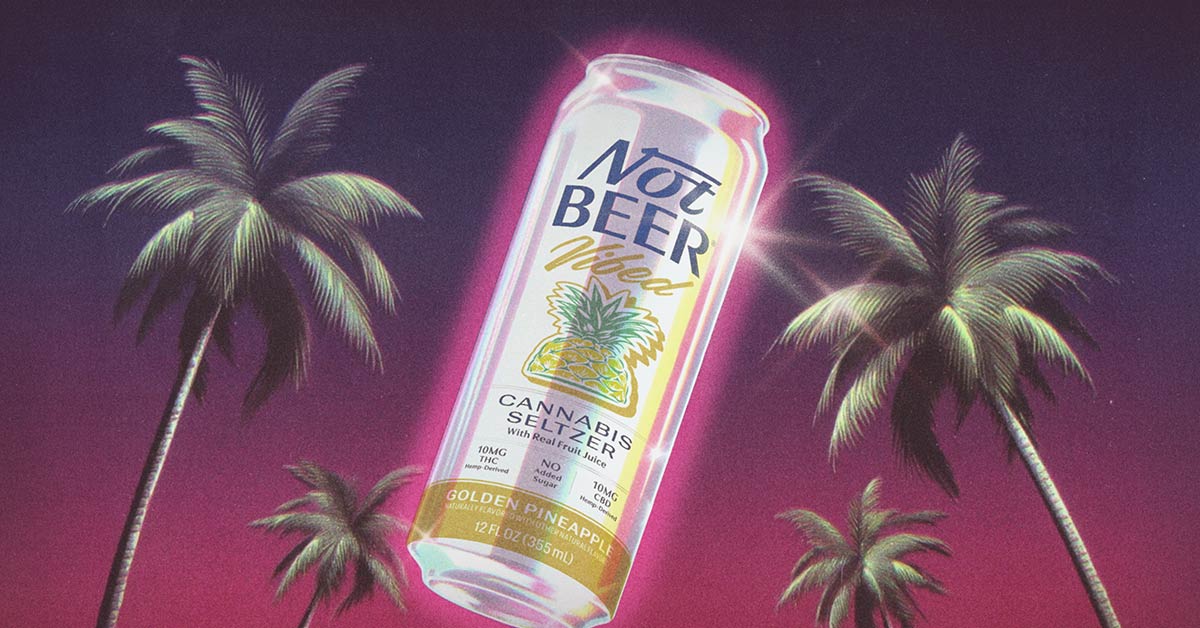
It’s still Not Beer, but now with a buzz.
Dallas-based beverage brand Not Beer is expanding beyond alcohol-free sparkling water for the first time with Not Beer Vibed, a 10mg THC/10mg CBD seltzer available online in 12 oz. slim cans. The brand is positioning itself as a value-driven option with flavor formulation and pricing as differentiators in the crowded category.
Not Beer founder Dillon Dandurand was introduced to the hemp-derived THC category during a conversation with his flavor house partner last fall, he told Brewbound’s sibling publication BevNET. The following week, Dandurand serendipitously cracked a canned THC drink at a friend’s house before a Dallas Cowboys game and was “blown away by the experience.”
“As we started to learn about the category, it felt like too good an opportunity to pass up,” he said. “We didn’t want to wait around because time is of the essence.”
Seeing the window closing for new entrants to the set, Not Beer formulated its three varieties – Rosy Raspberry, Golden Pineapple and Ruby Grapefruit – in about six months. Each has 15 to 20 calories and no added sugar, using fruit juice (8%) instead of natural flavors.
Value is also represented in its dosage. Initially, Vibed was targeting 5 mg THC, but learned during its formulation that most distributors and retailers preferred 10 mg.
“Every single distributor partner told us that 10 [mg] was outselling five [mg] four-to-one. Tens are absolutely crushing fives,” Dandurand said.
About 39.2% of hemp-derived THC drink consumers are prioritizing 10 mg options, according to Brightfield Group tracking.
Dandurand is sensitive to this idea of providing value after operating in the flavored sparkling water set for over a year, where larger, strategic-backed incumbents can easily undercut emerging brands on price and “somewhere around 45% of volume is driven by promotions,” he said, anecdotally.
With that in mind, the hemp-derived THC category appeared to be a calculated risk for Not Beer. The regulatory growing pains of producing and distributing cannabis drinks could be seen as a category moat rather than a growth impediment, Dandurand said.
“It is keeping the big players out,” he said. “Entrepreneurs and small businesses have the chance to take on that regulatory risk and gain market share in the early days, such that you can build a sizable business in what could be a very large category without the risk of the big guys coming in and outpricing you.”
With that in mind, Not Beer Vibed is targeting $3 per can as its subscriber price for a 24-pack, about $0.33 per milligram. The THC drink brand is “sacrificing percentage margin, for total margin over time” to move more volume, Dandurand said.
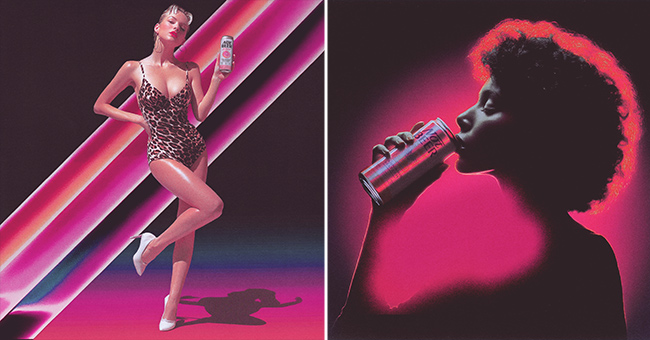
Last spring, Not Beer launched its “American” sparkling water brand with a nod to Liquid Death’s satirical marketing approach. Vibed has employed a slightly different, retro style that elicits ‘80s-era movies and video games. The visuals are aimed to be eye-catching but also “clearly message” the value proposition to consumers without typical stoner tropes.
The stylistic choice is aimed at drawing in the broader adult non-alcoholic (ANA) consuming audience, Dandurand said. “I do think you should be able to sell this product anywhere you can sell alcohol. Our primary channel that we want to win in is grocery.”
While grocery chains have been slower to jump into the intoxicating hemp category with some exceptions, there are more on-premise and live event space operators bringing in THC drinks as NA options for sports, music festivals, bars and restaurants.
Vibed is targeting these on-premise “lighthouse” accounts to fill out an “alternative channel mix” where it can build awareness, but more importantly, build meaningful relationships with beer distributors, Dandurand said.
“We want them on our side because they could help us legitimize this category, which is our biggest challenge and our biggest opportunity,” he said. “It’s a very risky game, and there’s a lot of other special interests that have a big incentive to keep us out of the market.”