
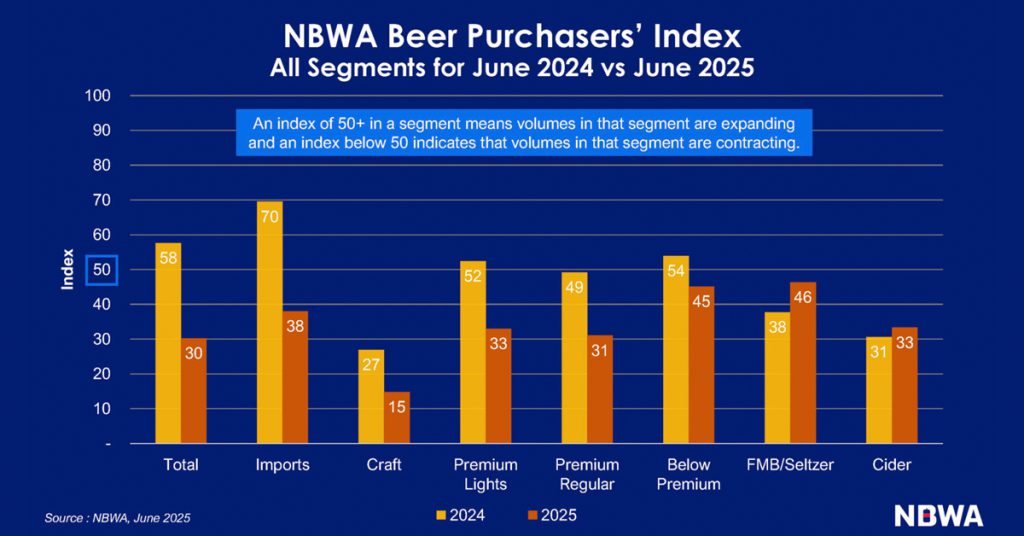
The beer category’s summer selling season arrived with a whimper, according to the latest Beer Purchasers’ Index (BPI) from the National Beer Wholesalers Association (NBWA).
Total beer and each segment of the category contracted in June 2025, according to the survey, which asks wholesalers if they are ordering more or less product each month than the month before. An index of 50 or more indicates a segment is in expansion, while 50 or less indicates contraction.
“The combination of readings for the BPI (30) and at-risk inventory (52) measures signals a contractionary state for the industry,” NBWA chief economist and VP of analytics Lester Jones wrote.
Total beer’s index of 30 marks a decline of 15 points from May 2025 and 28 points from June 2024. At-risk inventory – beer in distributors’ warehouses that’s within 30 days of its out-of-code date – was the only metric in expansion.
The June 2025 report reveals a step back from May 2025, when survey results showed “sequential improvement” over the previous 30 months. Last month, Jones noted that the industry could be moving “from contractionary territory to a more cautionary state,” a shift that failed to manifest.
Imports recorded the steepest year-over-year (YoY) decline, further sliding into contraction with an index of 38, down 32 points from the segment’s June 2024 reading of 70.
Premium lights posted the second-largest YoY decline, dipping 19 points, to 33 in June 2025. Premium regulars followed closely at -18 points, to 31.
Craft recorded the lowest reading across all segments at 15, a 12-point YoY decline.
Below premium, which was the only segment other than imports in expansion territory in June 2024, dropped 9 points, to 31.
Although still in contraction, flavored malt beverages (FMB) and hard seltzer (+8 points, to 46) and hard cider (+2 points, to 33) were the only segments to improve readings YoY. Hard cider’s reading of 33, flat from May 2025, is the segment’s “highest June reading since 2021,” Jones noted.
Month-over-month (MoM), declines are less stark, but nearly all segments dropped in June 2025 compared to May 2025. Premium regular (-11 MoM) posted the steepest dip, followed by craft (-5), premium lights and imports (both -4), and below premium (-2).
In addition to being the only segments in YoY growth, FMB/seltzer and hard cider were also the only two to show MoM improvement. Cider was flat, and FMB/seltzer increased seven points MoM.
That at-risk inventory is in expansion indicates the beer industry “is having a hard time finding an equilibrium,” according to financial services firm Jefferies’ recap of its conversation with Jones. At-risk inventory has increased 24% compared to August 2020.
“This summer is looking rough with beer sales declining 4.5%,” Jefferies analysts wrote, citing NIQ data covering the four-week period (L4W) ending June 14. “We see limited top-line upside for our U.S. beer names ahead” of Q2 earnings reports.
The average price per case has increased $0.46 year-to-date (YTD) through June 15 and $0.43 in the L4W, according to market research firm Circana. However, both dollar sales (-3.1% YTD, -5.3% L4W) and volume (-4.5% YTD, -5.2% L4W) continue to falter. This indicates “there’s little room for more pricing” increases, Jefferies noted.
With summer 2025 off to an inauspicious start, industry watchers are awaiting July 4 scan data with bated breath.
“The Fourth of July will be critical,” Jefferies wrote. “While premium beer, [ready-to-drink offerings] and non-alc[oholic beer] are still gaining share, it hasn’t done enough to provide a lift for the industry.”