
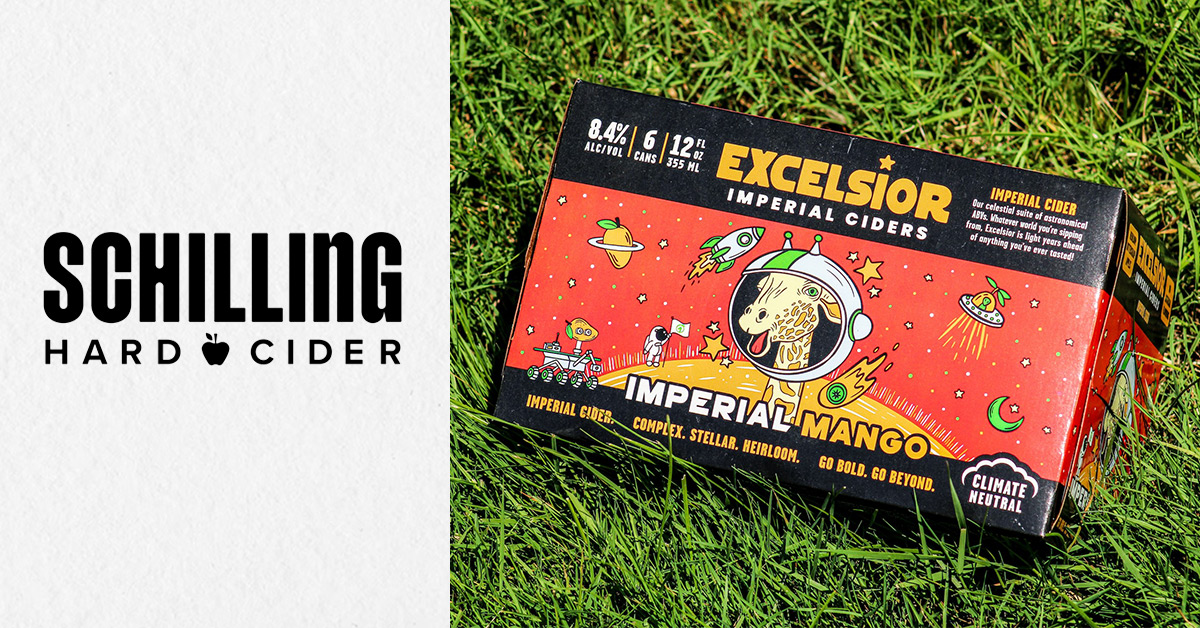
Schilling Cider’s Excelsior Imperial Mango, the No. 2 hard cider in the Seattle-based company’s lineup and the “No. 1 fruited cider” in the U.S., is now “climate neutral.”
As of this month, “any greenhouse gas emissions generated through the cider’s entire lifecycle” – from the production of Imperial Mango to its “disposal” – are entirely offset, both through Schilling’s own emissions reductions and through the company’s purchase of carbon offset credits.
Imperial Mango is now the second offering in Schilling’s portfolio to be climate neutral, joining the company’s No. 1 offering, Excelsior Imperial Apple.
Through Schilling’s partnership with Tradewater, a B-corp certified company Schilling buys carbon offset credits from, the company now eliminates 105% of the emissions from the lifecycle of both ciders through funding projects that “permanently prevent some of the most potent greenhouse gases” from being released, such as the capping of oil and gas wells, and the destruction of refrigerant gases.
“If we weren’t buying the credits, and if customers weren’t buying these products from us, then there would be no funding, and these [gases] would eventually leak into the atmosphere, greatly accelerating climate change,” co-founder and CEO Colin Schilling told Brewbound.
“So when the consumer drinks a Schilling Excelsior Imperial Apple and now an Excelsior Imperial Mango, that is completely carbon neutral and climate neutral,” he continued. “So we’re offsetting everything from all the way down to the refrigeration at their house, which is pretty rad.”
Schilling’s climate neutral SKUs are just the latest in a slew of climate-friendly moves by the company. Other initiatives according to Colin Schilling and the company’s website include:
- Switching power sources to buy “green power;”
- Moving carbon suppliers from Tennessee to Vancouver, Washington, “for shorter shipping distances;”
- Switching to an all electric vehicle fleet for its sales team, eliminating the use of thousands of gallons of gasoline a quarter;
- Installing “more efficient boilers” and “more efficient processes” for less water use;
- And using 100% recyclable or reusable packaging, “from the cartons and cans to the shrink wrap and pallets.”
“We have a lot of work to do in terms of just getting the messaging out, but it’s always important that we’re doing the hard and authentic work first, and then we work backwards to kind of story tell,” Schilling said. “That’s what this is all about, is making sure that we’re doing it fully compliant, fully transparent.”
Admittedly, communicating to consumers what “climate neutral” means or how a company is operating more sustainably isn’t something that is easily translatable in point-of-sale material or on packaging, Schilling said.
“We tried to set our website up so whatever level of curiosity you have, you can go that deep,” he said. “So if you just want to go on our website and see we’ve spent X amount of dollars over the last couple years on sustainable initiatives – which, by the way, is over $300,000 at this point – you can see that. If you want to read our 10-page disclosure document, which is required by the state of California for making a carbon claim or a climate claim, you can read the whole thing.
“It’s really choose-your-own-adventure on how deep you want to go, but I think that it’s going to continue to be something we’re going to focus on as a pillar of who we are, and the type of storytelling we want to do about the fact that we’re the most sustainable cider company
In the country.”
Schilling also began taking its “greenhouse gas inventory” in 2021. Last year, the company worked with Point B Consulting to dive deeper into areas it can improve.
“We were one of the smallest clients they’ve ever worked with, so it’s interesting for us, learning how to work within the system, because the system is definitely set up for larger companies,” Schilling said. “We would love to pass on the knowledge that we’ve learned and the ability to everybody else in the industry who wants to follow and care.
“We’re not trying to be the only ones in this space,” he continued. “We really want to see other people jump in and also benefit from being seen as a more sustainable product and being a more sustainable product.”
As of 2024, Schilling’s internal carbon footprint is down to 14% of its overall footprint, with the rest coming from “upstream and downstream vendors,” such as orchards, distributors trucks, refrigerators, etc. Its total operational footprint also decreased 20% in 2024 compared to 2023.
Becoming a more sustainable company isn’t just a passion project for Schilling leadership – it’s also an advantage in today’s competitive bev-alc landscape, according to Schilling.
“Especially younger consumers, the data is showing that they care more and more and more [about sustainability],” Schilling said.
“And interestingly enough, there’s one thing that Gen Z cares about that has more impact on their buying behaviors than being a sustainable company – it’s being seen as an unsustainable company,” he continued. “They will leave your brand forever, very quickly.”
It’s unclear without consumer anecdotes whether Imperial Apple’s sales were boosted by the offering becoming climate neutral last year. However, it certainly isn’t hurting the brand’s sales.
In the last 26 weeks through July 12, 6-packs of Imperial Apple recorded a 20% increase in off-premise dollar sales year-over-year (YoY), according to NIQ data shared by Schilling. The offering is also the largest cider SKU, excluding offerings from Boston Beer Company’s Angry Orchard.
Year-to-date (YTD) in NIQ-tracked channels, Imperial Apple’s total dollar sales are up 8.7%, with volume increasing 8.5%, and trends have accelerated in the last four weeks (dollar sales +12.1%, volume +11.7%), according to data shared by 3 Tier Beverages.
“We know we have the best liquid, but what other reasons are there to buy, and what other reasons are there to return to this [product]?” Schilling said. “That’s really what these claims are all about from a business perspective, is, why do you have a reason to come back to this SKU versus potentially trying other things?
“Cider is already one of the lowest carbon footprint alcohols you can drink just naturally, so I do think that cider already has a competitive advantage,” he added. “And if we work together as an industry, we can create a really strong selling point for the whole cider industry, not just for Schilling.”
Hard cider sales are about flat YTD (+0.2%) in NIQ-tracked off-premise channels, with volume declining -1.1%, according to data shared by 3 Tier Beverages.
However, trends could be improving, according to the latest figures from market research firm Circana. In the last four weeks (data ending July 27), the segment’s dollar sales (+1.4%) and volume (+1.6%) were both in the black in Circana-tracked channels, and recorded improvement compared to the last 26 weeks (dollar sales -0.3%, volume +0.9%).
A boost from sustainably minded consumers would be welcome for Imperial Mango, according to scans shared by Schilling. The offering’s dollar sales (-12.9%) and volume (-13.5%) are both down double-digits in NIQ-tracked channels YTD, with declines accelerating in the last four weeks (dollar sales -17.1%, volume -18.6%).
Notable, the offering now being climate neutral will not have an impact on consumers’ wallets, as its price remains unchanged. However, the weight of Schilling’s sustainability efforts on its own budgets will determine when other SKUs can be added to the mix in the future.
“We really have to see consumers lean in, and we have to see the sales grow to continue to add SKUs for this,” Schilling said. “I absolutely have a dream of us being a climate neutral company at some point, but liquid is heavy.
“Our industry is very carbon intensive, that’s just the reality of a heavy product,” he continued. “So we will continue to add SKUs as long as it makes sense, and we’ll continue to do work that we feel like is aligned with our values and our ethics as a company. We will always work to be as sustainable as possible. But where we’re directing those dollars does depend on what the consumers respond to.”