
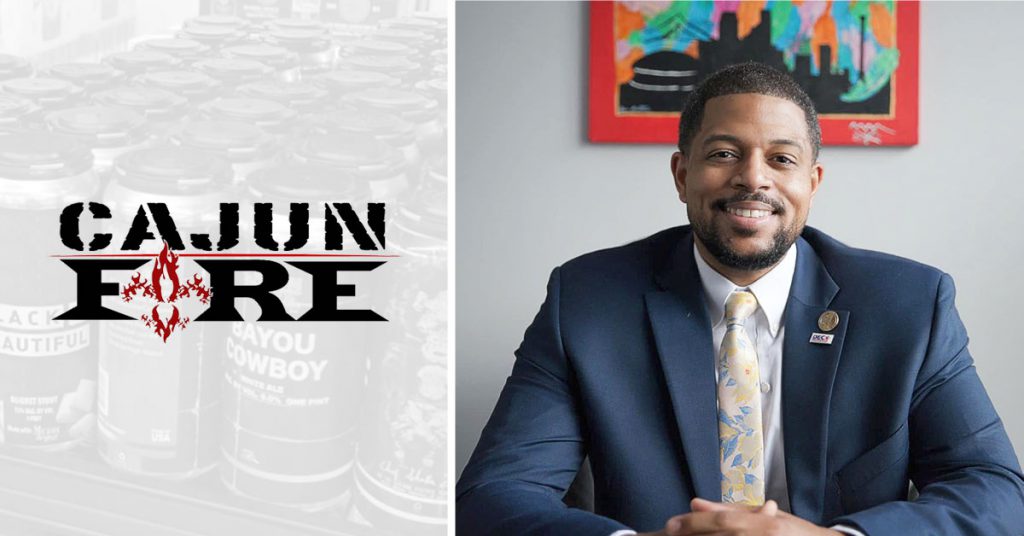
Jon Renthrope, CEO and brewmaster of New Orleans-based Cajun Fire Brewing, grabs A Round With Brewbound in this Insider-exclusive Q&A with industry leaders.
He shares insights gained from founding the first Black-owned brewery in Louisiana since Prohibition, and from exploring international markets, as well as goals for his term as president of the National Black Brewers Association (NB2A).
Here is our conversation with Jon, lightly edited for clarity …
Your hometown just hosted the Super Bowl and is in the middle of Mardi Gras season. What does the influx of visitors to New Orleans mean for Cajun Fire’s business?
Jon: It is often an afterthought, however, New Orleans is very much an international city that pulls in a considerable amount of tourist traffic for a city its size. In any given week, there are substantially more visitors in Orleans Parish than taxpayers.
What that means for Cajun Fire’s business is in most cases it allows our company to experience a vast amount of settings and open opportunities to build relationships around the world. Admittedly, there is never really a downtime season in consumption that mirrors the majority of the United States.
Cajun Fire opened in 2011, when there were just eight craft breweries in all of Louisiana. How has the industry changed locally since then?
Jon: Louisiana still has some of the most restrictive craft beer regulations in the U.S. It’s arguable, but from my position, outside the dynamic of emerging THC beverage brands on store aisles, I do not see much change in the industry landscape.
Many craft beer companies in Louisiana have closed over the past two years. The restrictive regulations have not been the sole cause of all closures. However, from my understanding it has played a significant factor in operations failing to scale to meet demands and cash flow needs.
You’re the first Black owner of a brewery in the state since Prohibition. What has that meant to you personally?
Jon: Being the first of anything carries with it a high level of responsibility and accountability. Because of the significance, my company is put in a space of expectation where it is front-facing.
While it does add to anxieties of running day-to-day operations, I feel the brand operates within a headspace where we have to succeed to ensure that we are not the last Black-owned company in my region.
Unfortunately, my company serves as a case study of just how impactful historical redlining, Prohibition, lack of access to capital, Jim Crow laws, eminent domain and supplier discrimination still are. These are things that I as an owner in this industry have to navigate in the present day. It is a landscape that necessitates the need for entities like the NB2A to not only exist, but be successful in its mission.
You just kicked off your term as the president of the NB2A. What do you hope to accomplish in that role in the year ahead?
Jon: In my term, I am genuinely hopeful that I will earn the respect of my peers. Leading non-profit organizations that are stacked with committees and board representatives who are essentially all CEOs in some capacity comes with a high bar of accountability and expectation.
I will take a toll of milestones, accomplishments and losses when my term is over. I have a lot of empathy for my fellow business owners and professionals.
I will feel accomplished when members of the NB2A get access to resources and can see value in being a member. Hindsight is truly invaluable. It is a three-year-old entity, and at this stage, the infrastructural building blocks to creating an institution are being developed. I hope my leadership and the efforts of our exceptional team produce tangible results.
In just two years, the NB2A has done measurable work to help Black-owned breweries advance in turbulent times. How could Cajun Fire have benefited from the support of an organization like this when you opened?
Jon: I am proud to announce that my company in 2024 was the recipient awardee of the NB2A’s equipment grant donation opportunity that was sponsored in collaboration with Russian River Brewing Company. It is very generous of their team and it is truly a shining example why they are respected as leaders in our industry. Just to be short and concise, it is a life-changing opportunity and act of philanthropy that will significantly impact the sustainability of my family-owned brand and create jobs in my community.
When I first became invested in the craft beer industry in 2010, I would legitimately long for organizations like the NB2A. I would long for organizations that could intentionally hyper-focus on, advocate for and address small business needs that were addressed specifically to business ownership that reflected myself.
How does a more diverse craft beer industry translate to a stronger craft beer industry?
Jon: More diverse craft beverage ownership translates to more market penetration and more exposure for the craft beer to renewable bases of purchasers. The data derived from numerous consumer market trends for the past decade have indicated a significant lack of intentional investment in consumer outreach to diverse markets.
I believe this is quite a substantial loss for stakeholders in the craft beer industry that spirit entities have embraced and profited significantly from.
In some regions, I believe lack of investment and promotion of diversity in craft beer in underutilized markets has contributed substantially to closures and depreciating interest in craft beer consumption by younger generations at large.
You’re heading back to Tokyo soon for FoodEx Japan as one of only two U.S. bev-alc brands represented, after a previous trip to the ATO Tokyo Product Showcase. What was that experience like and how relevant are international markets for Cajun Fire?
Jon: We as small business owners operate in a globalized world. The majority of companies that the average small business is competing against in North America are not of U.S. origin.
My experiences over the past six years of export trade missions and exploration has been nothing short of life-changing. Given the affluence of American-made products, I firmly believe brands are doing a disservice to their operations if the option is not, at minimum, explored.
Exploring international markets for my brand has undoubtedly been a very daunting experience for a first generation company our size that is only in its 13th year of operation. However, my team is confident, understands that we produce a world-class product, and has a professionalism that has been groomed in a city renowned for its hospitality.
Trade is significant for the health of the U.S. economy, and international markets relationships are just as significant as maintaining our domestic relationships.
What beer release are you most looking forward to in 2025 from both Cajun Fire and other breweries?
Jon: My company makes two originals that are an infusion of cultural food staples that truly are incredible. Our original Praline Ale is an infusion of a traditional brown ale that sees incorporation of my family’s recipe for pralines, which are a Southern tradition and a signature sweet of New Orleans.
The other beer that we produce that I am always anxious for coming into production rotation is our signature Beignet Stout. It is what most have experienced as a pastry stout; however, we add actual beignets to the boil. It produces quite a spectacular flavor profile. Both beers are very satisfying and distinguishable.
Beyond Cajun Fire beers… in no particular order:
- Warcloud Brewing Company (California) – The Heights IPA
- Creature Comforts & Brooklyn Brewery — Fonio project collaboration beer
- Love City Brewing Company (Philadelphia) — Cream Ale