
Editor’s Note: 3 Up, 3 Down with 3 Tier Beverages is a quarterly insights series available exclusively to Brewbound Insiders, via the Chicago-headquartered, bev-alc-focused consulting and data firm. Contributors include 3 Tier Beverages consultant Danelle Kosmal and founder Donn Bichsel Jr.
The beverage-alcohol landscape doesn’t slow down, even when categories do.
In this latest quarterly installment of 3 Up, 3 Down, 3 Tier Beverages takes a data-driven look at what’s gaining momentum – and what’s losing ground – across beer, wine, spirits, and non-alc (NA), with NIQ off-premise data through August 9, 2025.
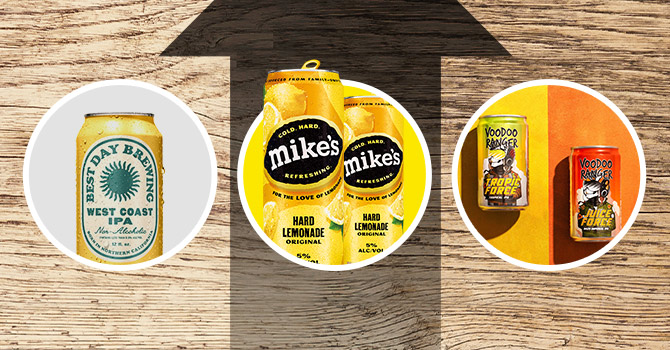
THREE UP:
NA Beer Beyond Athletic
The NA beer segment is now much bigger than one brand. Best Day Brewing, Deschutes, Bero and Sierra Nevada are among the top 10 growth brands in NA for the last 13 weeks (L13W). RationAle Brewing, while still only in eight states, ranks among the top 20 NA growth brands nationally – and is growing distribution while also increasing velocity (+37%).
Larger suppliers are reinforcing the trend. Anheuser-Busch InBev’s (A-B) Michelob Ultra Zero was the largest contributor to NA growth in the L13W, followed by No. 2 Constellation Brands’ Corona Non-Alcoholic and No. 4 Molson Coors’ Coors Edge.
Even with all of these new entrants, NA-dedicated craft brewer Athletic remains a massive growth driver, ranking No. 3 in terms of growth dollars and No. 1 in total dollars in the NA segment for the L13W.
This isn’t just seasonal “Dry January” demand anymore – NA has become a year-round growth engine.
Hard Tea and Lemonade Lead Spirits-Based RTD Growth
Teas and lemonades have fueled spirits-based ready-to-drink (RTD) bev-alc growth in recent months. They now account for nearly three-quarters of the top growth flavors in the segment.
Spirits-based lemonades grew 116% in dollars, while spirits-based hard teas were up 63% for the L13W.
Outside of teas and lemonades, other top flavors include tamarind and spicy mango. Retailers are taking note, with some aligning seasonal summer promotions around spicy mango.
While RTD innovation may feel crowded, the familiar formats have connected with shoppers and proven they can drive engagement at shelf.
Alternative Packaging
Mini cans and larger pack formats are reshaping how shoppers buy and packaging strategy has become as important as style or flavor in landing and keeping shelf space.
NA brands are especially leaning on 12-packs to build household penetration, while spirits-based RTD brands are experimenting with smaller single-serve cans to encourage trial.
Within beer, mini sizes (6 to 8 oz.) grew 3.4% for the L13W, significantly outperforming the traditional 12 oz. size, which declined 5.8% in dollars during the same period. 7.5 oz. cans were the strongest mini performers, up 25.4% in off premise channels, with A-B’s Lil’ Ritas, New Belgium’s Mini Rippers and Mich Ultra leading growth.
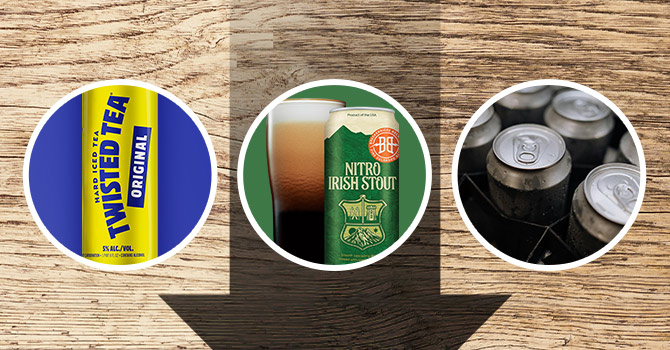
THREE DOWN:
FMB Cyclicality
Flavored malt beverages (FMBs) remain stuck in boom-and-bust cycles, and retailers are watching closely, pruning underperforming SKUs.
Hard seltzers peaked in 2019 and have been in sharp decline since. Other subsegments – hard kombucha, lemonade, coffee – never held their ground long enough to offset the losses.
Hard tea led growth for several years. However, its momentum has been unsustainable with recent double-digit dollar sales declines (-12.5%). Hard tea is likely losing sales to the growing segment of spirits-based teas, such as Boston Beer’s Sun Cruiser and Stateside’s Surfside.
Craft Stouts
For the total beer category, stouts are one of the few bright spots, with dollar sales increasing 0.5% over the past 52 weeks, driven almost entirely by Diageo’s Guinness (+3.5% year-to-date [YTD]).
By contrast, craft stouts continue to decline (-9.3% in the L13W). Downward trends are tied largely to distribution losses (-8.3% YTD), and a decline in the overall number of craft stout brands selling, which has declined 12% YTD. As a result, stout’s share of craft beer has slipped to 1.5% of craft dollars, down from 1.8% two years ago.
Still, the segment isn’t without opportunity: 40% of craft stout brand extensions are growing, with success spread across many breweries rather than led by one player. Flavored stouts, particularly chocolate and espresso styles, show notable momentum.
6-Packs Under Pressure
Traditional 6-packs continue to slip, both in full-strength beer and NA. In the L13W, beer 6-packs were down 5.9% in dollars, while 12-packs declined 6.1%. In convenience stores, the package format recorded even steeper declines; down 5.8% and 6.3%, respectively.
Consumers are trading down to smaller pack sizes, with singles and 3-packs leading growth (+1.1% and +3.8% respectively).
Collectively, 6- and 12-packs lost 1.6 share points in the L13W compared to the same period in 2024. For brands still banking on 6-packs as the core unit, it is becoming harder to justify space in cooler doors.