
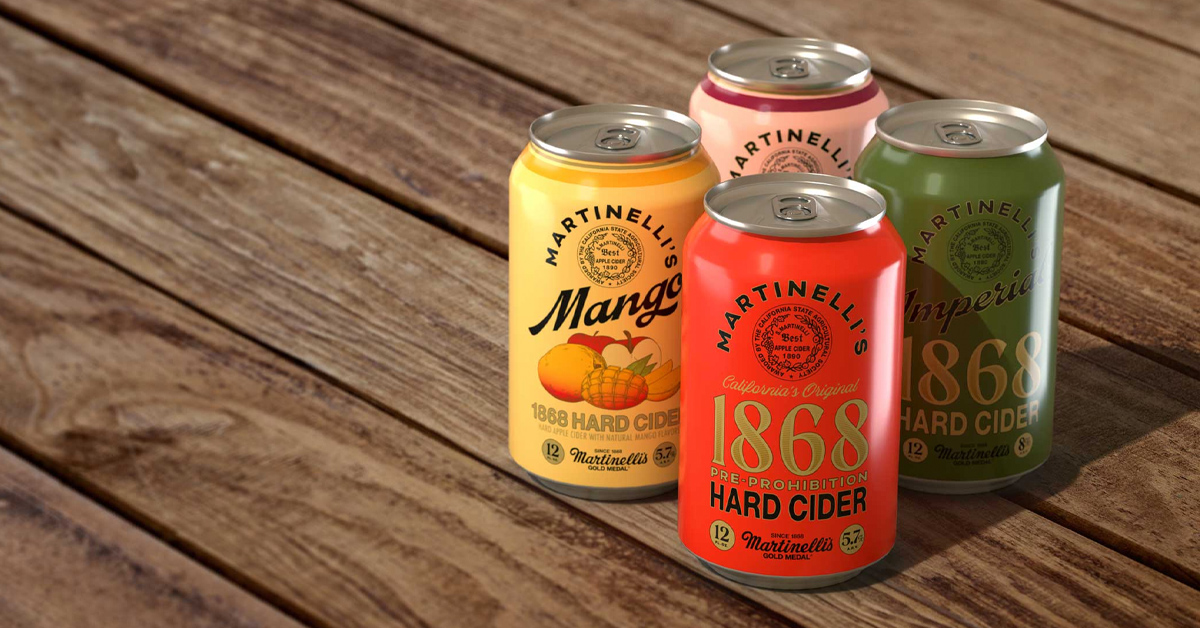
In its 157-year history, Martinelli’s has become a staple in many U.S. households; from its squat 10 oz. apple juices that fit conveniently into kids’ lunch boxes, to its green sparkling cider bottles that allow consumers of all ages to toast and celebrate without booze.
But the company realized it had a problem: Consumers were forgetting about the brand. After consumers grew up, Martinelli’s became more of a memory or nostalgic reminder of their childhood, and a brand they wouldn’t reach for again until they had kids themselves. And then the cycle would begin again.
Martinelli’s had a consumer gap – those in their 20s and 30s – that were looking for beverages to meet occasions Martinelli’s wasn’t participating in, including bev-alc.
“As we look at our future as Martinelli’s, our core business is strong and we love the core, shelf-stable 100% juice business,” president and CEO Gun Ruder told Brewbound. “But as you look at the beverage world around us, opportunities for us to extend our brand in an authentic way, where we feel we have a distinctive ability to bring super high quality premium products, are important for us.
“As we think about the sustainability of the brand, our ability to remain family-owned and resilient and relevant for generations to come, innovation is going to be more and more important for us.”
Enter Martinelli’s 1868 Hard Cider.
Martinelli’s launched the hard cider at the end of 2024 exclusively in California. The offering is available in three 5.7% ABV flavors – 1868, Mango and Berry Blush – as well as an 8% ABV Imperial 1868, packaged in 12 oz. can 6- and 12-packs.
“If you look at the life cycle of our consumers, many people know us until they’re kind of in their high school years, and then they become college age and [in their] 20s before they start having kids, and people forget about us,” Ruder said. “Then they start having kids and we’re back in people’s minds.
“[Hard cider] is an opportunity to bring something interesting and new to young adults that knew our brand, loved our brand, and now they’re seeing it again in a different space that may be of more interest to them as they enter their 20s and beyond,” he continued.
To avoid consumer confusion, the hard cider line features “1868” predominantly on packaging, larger than the Martinelli’s name.
1868 Hard Cider technically marks Martinelli’s return to bev-alc, as the company was founded as a hard cider company in the same year it’s named for. It eventually was forced to move away from bev-alc ahead of Prohibition, and focused its portfolio on NA sparking and still apple juice.
Martinelli’s has brought hard cider back a few times in limited batches, as recently as 2018, when bottled hard cider was available to celebrate the company’s 150th anniversary. But this marks the company’s first return of hard cider as a permanent piece of its portfolio.
As an homage to Martinelli’s roots, the hard cider brand’s packaging and artwork has a retro feel.
“We really wanted to call back to our heritage and call back to who we have been, and that this isn’t something we’re just saying ‘Hey, let’s go speculate on can we build up make a hard cider?’” Ruder said. “Calling back to 1868 as a brand name, that’s the year the company was founded, and in the look and feel the packaging, we wanted to have a a heritage feel – not quite a throwback, because it looks different than what our labels were at that time, but something that felt more rooted in who we have always been.”
The brand’s style is what Martinelli’s marketing team has started referring to as “newstalgia” – something that is fresh and “new,” yet still evokes a feeling of nostalgia for consumers. That feeling is authentic to who Martinelli’s is in 2025, but also speaks to trends among some of the youngest legal-drinking-age consumers, Ruder said.
Martinelli’s re-entry into bev-alc comes as hard cider continues to grow despite a challenging environment. The segment has increased dollar sales (+1.1%) and volume (+0.7%) in Circana-tracked off-premise channels year-to-date (YTD) through September 7 – one of only three beer segments to do so. Meanwhile, the total beer category remains in the red (dollar sales -2.8%, volume -4.4%).
Regional cider brands have been on the rise for several years, but the latest growth has been boosted by a resurgence in national brands such as Boston Beer Company’s Angry Orchard, which is consistently posting double-digit growth in Circana-tracked channels this year.
Martinelli’s is a national brand. However, 1868 is only available in its home state of California, for now. The company is being intentional about expanding at first, as it sees how consumers respond to the brand, Ruder said.
Martinelli’s has about 95% of the NA sparkling cider market in the Golden State, according to Ruder. California is also one of the largest states for hard cider consumption and production, along with states in the Pacific Northwest and Northeast.
“We were fortunate that it was a sizable market,” Ruder said. “We’re fortunate that it’s a market that our brand is very distinctive [in], so the value proposition that we’re developing should play here first and foremost. And if we can develop the skills and grow to market capabilities, which we have done for California and we’re successful here, that will provide a strong foundation to expand.”
Additionally, slow expansion is necessary as Martinelli’s itself – and its team of leaders all new to the bev-alc industry – learns how to operate in the three-tier system. Ruder admitted that the brand’s efforts to be distributed throughout California – now complete – progressed slower than expected, due to the company navigating “really complicated” bev-alc distribution for the first time.
“Obviously, there are some distributors that are good partners of ours, where we bring our non-alcoholic product to market in different parts of the U.S., but 95% of our business, we’re talking directly with retailers,” Ruder said. “So it’s a whole different prospect of going through distributors, and that whole relationship of how you first have to figure out your structure of distribution before you start selling your product to customers.
“We obviously knew that was part of the deal when we evaluated entering the market, but actually doing that, going forward and negotiating with distributors and signing up different distributors to have just California full-state distribution was a layer of complexity and time that we underestimated on the front end.”
Martinelli’s now has a network of primarily Anheuser-Busch InBev (A-B) distributors. The 1868 offerings are available at most major retailers in the state, with further additions expected by spring resets in 2026.
“Because of our brand and because of who we are in California, the distributors actually have been very responsive, and it’s been really encouraging to see them come to the table,” Ruder said. “It’s taken time, but they’ve been really eager to partner with us because they believe, as we do, in the value proposition bringing Martinelli’s to hard cider and the excitement that will bring.”
Once that value proposition is fully established in California, Martinelli’s will begin to explore other markets, such as the rest of the West Coast and the Northeast.
The company is also exploring how it can further expand the 1868 portfolio, acknowledging that
“bringing different flavors to market” and “keeping that excitement level and awareness level” for new brands is important in the modern bev-alc environment. Additionally, Martinelli’s is exploring how else it can expand its overall portfolio with other new additions.
“As we look at our business as a 157-year-old company, we have our great core business, but innovation is important,” Ruder said. “Hard cider is a significant innovation, and we’re going to continue to take our learnings from how we’ve come to market and the successes we’ve had in hard cider, and look for other opportunities to innovate.”
“We hope hard cider is one of a few innovations that we’ll be bringing to market,” he continued. “This will be a bev-alc [brand], some others might be in the non-alc space, but it’s really exciting to have the benefit of such an authentic, strong legacy brand to give us a platform to look for opportunities to innovate in a way that’s authentic, in a way that we can bring our loyal consumers and new consumers offerings that are distinctive and add value to their lives.”