
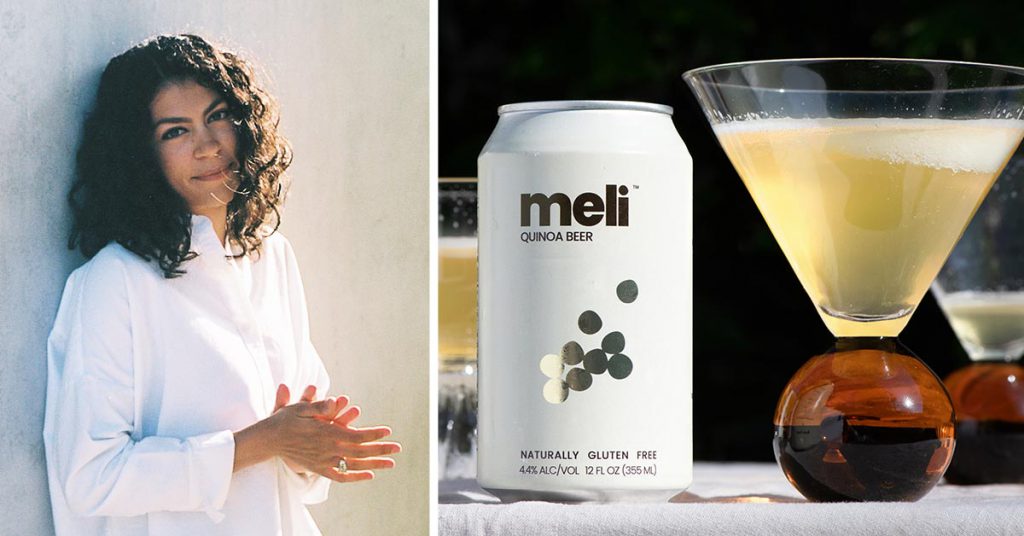
Samara Oster would prefer consumers to meet Meli with “no expectations” of how it might taste.
Meli (4.4% ABV) is brewed with 100% organic quinoa sourced from small farms in Bolivia, making it gluten-free.
The beer is “designed to be an easy drinker – pleasing to beer aficionados but also approachable to those who typically prefer other categories,” Samara said during the semi-final round of the Brewbound Pitch Slam during the Brewbound Live business conference last December in Marina del Rey, California. [Check out the rest of Samara’s pitch starting at 30:40.]
Meli’s go-to-market strategy for its June 2024 launch was to target top restaurants and hotels to drive trial in its home state of Massachusetts, and then funnel those drinkers to off-premise accounts.
Nearly six months after her Pitch Slam appearance, Brewbound caught up with Samara in the latest edition of A Round With – our Insider-exclusive Q&A with industry leaders.
Here is our conversation, edited slightly for clarity:
How did you come to discover quinoa as a beer ingredient?
Samara: Many years ago, I took a trip to Peru with my family and saw quinoa beer listed on a menu, so I decided to try it. I loved its crisp, light taste. When I got home, I researched the beer and learned that there are many quinoa beers in Peru, and they are brewed with barley, plus a quinoa adjunct. In the states, there are also many breweries using quinoa as an adjunct — particularly, gluten-free breweries. Making a 100% quinoa beer was another story.
What was the most challenging part of Meli’s development process?
Samara: Can I pick more than one?! I think the hardest part was when, after years of experimentation, we had developed a recipe we loved at pilot-scale, but it completely fell apart when we moved over to commercial machinery. That kicked off another year-and-a-half of test brews and process modifications before we had something replicable and commercially viable.
Quinoa is a magical ingredient when the conditions are right for it to shine, and it can create the most clean and crisp beer, but if any part of the process isn’t optimized for its unique profile, you either have a stuck mash or a subpar final product.
How important to Meli’s identity is its gluten-free status?
Samara: We like to think that we’re in the business of making a great-tasting beer that happens to be gluten-free. Meli is about overall wellbeing – working with clean, ethically sourced ingredients; using a transparent and complete nutrition label; offering a flavorful but lower-ABV option – and part of our aim is to remove inflammatory properties like sugar and gluten that can make some drinkers feel unpleasant after drinking beer.
We are thrilled that we have a loyal community of celiac and gluten-sensitive drinkers, and we take their safety and enjoyment seriously, but what we really aim to do is to brew a beer that someone who can have gluten is just as likely to crack open as someone who cannot.
Who is Meli’s primary target demographic?
Samara: Our ultimate aim is to expand the number of drinkers in the beer aisle, by showing drinkers that beer can take a cue from the other alcohol categories and offer options that are “better for you” – clean, nutritionally thoughtful and tasty. With this in mind, our target drinkers are generally, but not exclusively, women, who are health-minded and have a willingness to pay for high-quality products.
You’re distributing in Massachusetts and shipping direct-to-consumers using Liquid Rails. What have you learned about your consumers through both channels? And does one sales channel inform the other?
Samara: The reality in the field is that we have attracted a diverse group of consumers, from the frequent beer drinker looking for a lower-bloat option, to the never-beer drinker, who tries Meli and says, “I would drink that!” This is part of why we don’t put a beer style on our label.
We like for people to come to Meli with no expectations, and to draw their own conclusions about what it tastes like. For every person who says Meli tastes like an IPA, we have another person who says it doesn’t taste like beer at all (and that ends up closing the sale).
For e-commerce, we are really early days, because we have been laser-focused on building our brand in our own backyard. As more orders start to come in from around the country, I’m excited to engage directly with some of these consumers to get their feedback, hear how they discovered the brand and try to build loyalty.
To ensure Meli is safe for drinkers with Celiac, you perform a full sweep of the brewing equipment the day before a Meli brew to clear any traces of gluten from previous brews. What kind of complexity does this add to your production timelines?
Samara: We are fortunate to work with contract brewing partners who understand the gravity of cross-contamination. They work with us to schedule brews such that we have a full cleaning day beforehand. They typically have CIP days built into their calendars, so we try to schedule our runs around those, or brew Meli several days in a row, to avoid multiple cleans in a short time span.
In addition to cleaning measures, we also do extensive testing on equipment run-off water, post-clean, as well as on the brew itself at various points in the process, to ensure gluten is undetectable.
Other than how to pronounce it, what else does the average U.S. consumer not know or understand about quinoa?
Quinoa is an amazing food! It is an ancient grain, originally farmed by ancient civilizations in the Andes about 4,000 years ago. Today, there are thousands of varieties that grow all over the world, with seeds of different sizes, colors and nutritional values. It is a drought-tolerant crop, requiring far less water than typical brewing grains like barley or wheat. And nutritionally, quinoa is a great source of protein, as well as some vitamins and minerals.
What’s next for Meli? Any innovation in the pipeline yet?
We’re starting to look at market expansion for 2026, so we’re in the process of evaluating a few potential opportunities. In terms of our product pipeline, we have been doing some really exciting work on flavor development, in partnership with an ingredient company that specializes in ethical sourcing.
At Meli, we tend to spend years in development before we launch a new product, so we’ve been working on new products for a while now. Once we’re ready to scale those up, we’ll be very excited to see how they expand our audience to bring new consumers into the beer aisle.