
Editor’s Note: 3 Up, 3 Down with 3 Tier Beverages is a quarterly insights series available to Brewbound Insiders, via the Chicago-headquartered, beverage-alcohol-focused consulting and data firm.
In the first installment of 2025, 3 Tier consultants Danelle Kosmal and Devon Hevener share a trio of insights on industry growth, and accompanying downward trends, with NIQ off-premise data through January 25. Hot topics include high ABV beer and beyond, craft beer 6-packs and hard cider.
THREE UP
High ABV
While low- and non-alcohol products have been getting a lot of attention lately, it’s worth noting that high-ABV products are also experiencing some big wins.
For the 13-week period ending 1/25/25, the high-ABV segment of 7% to 9.9% ABV beer grew +5.7% in dollars. This growth spanned across all major channels, with c-stores (+6.6%) and grocery (+6.5%) as the primary drivers.
In terms of pack size, the majority of growth came from singles (+9.3%) and 12-packs (+26.5%).
The dollar sales growth of 7% to 9.9% ABV products is outpacing the same products’ distribution growth, which increased +5.1% in the last 13 weeks (L13W). This indicates there is still room for further expansion – and potentially more shelf space for these popular beers.
Craft beer is the largest segment within the 7% to 9.9% ABV range and accounts for nearly half of total dollar sales. However, it is not the primary driver of growth. Most of the dollar sales growth is from hard seltzers and flavored malt beverages (FMBs), which grew +43.8% and +8.3%, respectively, in the L13W.
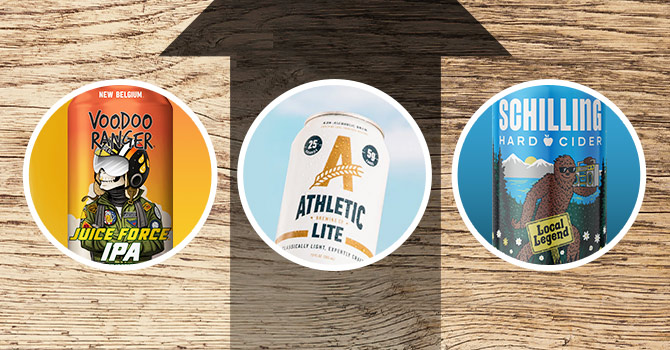
Mark Anthony Brands’ White Claw Hard Seltzer and Boston Beer Company’s Truly Hard Seltzer and Twisted Tea were three of the top five growth drivers in this high-ABV segment, accounting for 39% of the growth. New Belgium and Goose Island are the craft beer standouts, with Voodoo Ranger Tropic Force and Goose Island Big Juicy Beer Hug among the top growth brands.
NA Adult Beverages During Dry January
Overall, the non-alcohol adult beverage (ANA) market continues to thrive, up +25% in dollars for the four weeks ending January 25, 2025, and up +23.6% for Q4 2024 in NIQ-tracked off-premise channels.
Beer remains the largest driver of growth in the ANA market, up +22.5% and accounting for 78% of ANA dollar sales in January. However, as wine and spirits are finding a foothold, beer’s share of ANA declined slightly, down 4.8 share points from two years ago.
That said, the NA market for beer, wine and spirits has grown +72% in the last two years, showing continued promise for all three categories.
Innovation and expanded distribution of existing brands are fueling this growth. Distribution of NA beer increased +27% in convenience stores and +24% in traditional outlets of grocery, club and mass merch (NIQ xAOC channel) for January 2025 compared to January 2024. NA spirits distribution also soared, with the average number of items on shelf up +33% and distribution points increasing by more than +100% in NIQ xAOC in January compared to last year.
Regional Cider and Generation Z
While total cider is down -1.8%, regional cider accounts for 56% of total cider dollars and is growing (+3.3%).
As a relatively small segment, cider’s growth depends on expanding its consumer set. According to NIQ Omnishopper data, 6.9% of bev-alc drinkers purchase cider, compared to 71.3% purchasing beer. This shows a lot of the market has yet to experience cider products.
We see significant opportunity in cider with Gen Z (legal-drinking age), where cider penetration is 8.2% among this cohort, up +0.4% vs last year. Additionally, compared to craft beer (78 index), cider performs well among Gen Z LDACs (120 index), meaning legal-drinking age Gen Zers are 20% more likely to purchase cider. There is an opportunity to increase engagement with these consumers to ensure they stick around.
THREE DOWN
Craft 6-Packs
Craft beer 6-packs declined -3.7% in dollars and -5.6% in volume in NIQ off-premise channels for the L13W.
Six-packs account for more craft dollars than any other pack size, representing 42.9% of total craft dollars. However, that is down nearly 1 share point from last year.
Bottles are the primary driver of declines, declining -10.3%, while 6-pack cans are essentially flat (+0.4%). Dollar sales from 6-pack bottles are in decline across all channels, with liquor stores (-10.7%) and c-stores (-12%) as the two biggest contributors to decline. Six-pack can sales are also down in liquor (-5.8%), but holding steady in c-stores (0.1%).
Similarly, 6-packs are in decline across most regions and divisions, with the exception of New England (+2.2%) and the East South Central division (+0.7%). The biggest declines in dollar sales are across the East North Central Division (IL, MI, WI, IN, and OH), which is down -4.2%.
Of note, Athletic is the primary growth driver for craft 6-packs in its New England home market. Without Athletic, craft 6-packs would be down -2.9% in that division.
Low ABV Wines
Similar to beer, high ABV wines (more than 14.6% ABV) are growing. However, low ABV wines (less than 8% ABV) are in decline, down- 10.4% in dollars sales for the L13W in NIQ off-premise channels. Declining distribution is a contributor, with total distribution points down -12.2% since last year.
Varietals and wine types that are driving most of these declines are flavored wines, Moscato, and some rosé and sangria. These flavor-forward and sometimes sweeter wines are most likely losing space to, and competing directly with, ready-to-drink cocktails (RTDs).
Cider Distribution
For the latest 52 weeks ending 1/25/2025, hard cider dollar sales declined -1.8%, with distribution down -4.3% across all census divisions compared to last year.
This decline is attributed to the growing competition for shelf space, as more products vie for visibility. While regional cider has shown positive growth (dollar sales +3.3%, volume +2.7%), the losses in distribution are outpacing many major beer segments, including craft, premium, and below premium.
The New England and Middle Atlantic divisions have been hit hardest, with distribution losses of -5.6% and -5.9%, respectively. To reverse this trend, hard cider producers must look for ways to boost their visibility among today’s consumers through outreach tactics such as social media or promotional and collaborative events. For example, brands participating in National Cider Month – a brand-agnostic marketing effort to promote hard cider in October – experienced an average increase in dollar sales of +6.4%.