[00:00:00] Justin Kendall: Heading to CBC? Kick things off the day before at Brewbound's meetup at Love City Brewing in Philly, Sunday, April 19th from 5 to 7 p.m. Connect with beer industry leaders, grab a drink, and catch up with the Brewbound Live. It's free to attend and walking distance from the convention center. Head to Brewbound.com slash lovecity.rsvp. And don't forget to catch the Brewbound Live at booth 956 during CBC. Next on the Brewbound Podcast, why year 10 is a make or break year for mini craft breweries. Hello and welcome to the Brewbound Podcast. I'm Justin Kendall.
[00:00:48] Jessica Infante: I'm Jessica Infante. And I'm Zoe Licata.
[00:00:50] Justin Kendall: And this week, we're bringing you a feature interview with Tomme Arthur of The Lost Abbey. Tommy's going to share what The Lost Abbey is up to. They've been on the move The Lost year. And he's going to share why that second lease, the end of it, is often problematic for craft breweries because landlords are really bumping up rents. So stay tuned for that. But how y'all doing? Did you have a good Thanksgiving?
[00:01:20] The Lost: I mean, look, this is we're busy. This is a busy time of year for us. The conference is coming up. The news has certainly not slowed down.
[00:01:29] Justin Kendall: So I remember last week sending you a message that said help.
[00:01:34] The Lost: You did. You said, I need help with various letters capitalized. And the only thing that crossed my mind when you sent that was when my toddler signs for help. And she says, help me with her, you know, like the thumbs up sign language motion. I'm sure there's a much more eloquent way to describe that. But Cora does baby signs. She started doing baby signs like when she started talking more, which is kind of not the point, but she signs for help. And that's what I figured what you were doing as well.
[00:02:02] Jessica Infante: Yeah, I saw that message while I was driving and was like, what on earth is happening? Like, I got really scared.
[00:02:10] Justin Kendall: We will share what's happening in our news portion of the show, but it is a busy time. I spent some of the weekend doing prep for Brewbound Live, which is coming up December 10th and 11th. You still have time to join us in Los Angeles, so give it a look-see.
[00:02:24] The Lost: Yeah. I mean, really, I don't think geography is any excuse here. You can decide at the time that you hear this that you want to join us on the East Coast and start driving. You'd get there.
[00:02:33] Justin Kendall: That's right. Not too late.
[00:02:35] Jessica Infante: Nope. You can listen to many Brewbound Podcast episodes on the way.
[00:02:39] Justin Kendall: You sure can. So head over to Brewbound Live to get your tickets now. Anyway, let's just jump into it, get into the news. And the reason I needed help was I was digging around in some court documents. And it just so happened that Rogue had just filed for Chapter 7 bankruptcy, which is liquidation.
[00:03:00] The Lost: Yeah, man. And it was lengthy. It was a 137-page document.
[00:03:05] Justin Kendall: Yeah. Lots of creditors.
[00:03:07] The Lost: Let me tell you what I am thankful for this year, and it is rogue for giving me dinner conversation topics with my in-laws who are interested in craft beer and very financially minded. So we had a long talk about this, and my father-in-law, who has spent his career as a CFO for various companies, usually in the construction industry, said this was The Lost thorough bankruptcy filing he had ever encountered. So no wonder you needed help, Justin.
[00:03:32] Jessica Infante: Yeah, my dad also brought this up during Thanksgiving. It like made the rounds. Wow.
[00:03:37] Justin Kendall: Definitely our most read story of The Lost week and possibly probably this year. This year. Rogue Ales more than $16.7 million to its creditors. It's got a lot going on.
[00:03:54] The Lost: That $16.7 million needs a little bit of an asterisk on it because $10 million of that is a pending potential payment to a family. I want to make sure I say this right because it is a very sad story. Should we not get into this just yet?
[00:04:11] Justin Kendall: No, I think we should get into it because the largest portion of this bankruptcy is an unsecured claim for $10 million. And was it, I want to make sure that I get this right, was it DRAM shop negligence?
[00:04:26] The Lost: Yeah, jam shop negligence, which I mean, if you're listening to our podcast, I assume you have a leadership role of some sort or you work in the beverage alcohol industry. So you should know what this means, but it can mean a lot of things. But part of it, and particularly here is when a patron is over served at your establishment. and leaves in a vehicle and creates harm, which is what happened here. So in September of 2022, look at the news stories from Oregon around that time. It appears the driver had been at a few breweries and bars or named, it's not just Rogue, but a woman had been visiting them and she got in her car to leave and she got into a head-on collision with a woman, Nancy Thickstrom, who died as a result of the crash. which all of that is terrible, like really, really awful. So there is a $10 million negligence claim filed against Rogue via Nancy Vickstrom's estate and their law firm, but Rogue in their filings had checked the boxes for unliquidated and disputed. And I don't know obviously like Rogue is filing for Chapter 7. And this is not at all like the reason why it happened. It's just when you see the numbers, they seem shocking. But when you think about that $10 million is this claim, it's maybe a little bit less bad. But I think this lawsuit is still pending. A lot could still happen. I don't want to be a Debbie Downer, but I don't really see that ever being paid out. I feel like that doesn't often happen.
[00:06:00] Justin Kendall: And their secured creditors are their banks. So that's where first priority is going to go on whatever money they are able to recoup from liquidating whatever is left of this business. And one of the things they put value on was $2 million on the intellectual property brand recipes, all of that. So will there be a suitor for that? Maybe. I don't know at this point.
[00:06:30] The Lost: Yeah. I mean, Justin, you dug into the potential suitors and I'm glad you picked up on that because I don't know that that's something that I immediately would have jumped to in this document. But people were interested. There have been a few people who have asked to see their books.
[00:06:45] Justin Kendall: Yeah, The Lost included Tilray Brands, the address was Sweetwater, so we knew that. Ackley, Ackley Brands was one of them, which was, they're into wine, but they also have Mack and Jack's, and there's another brewery that I'm blanking on.
[00:07:00] Tomme Arthur: Silver City.
[00:07:00] Justin Kendall: Silver City. Ninkazi, Great Frontier Holdings, so possibly looking there. I'm trying to think of who else off the top of my head.
[00:07:09] Jessica Infante: It's very much familiar names of folks who were picking up things that might not necessarily be on the up and up, but could have like a brand that they could move forward with.
[00:07:19] Justin Kendall: So there's that. They have the sales partnership with US Beverage. You would think that since they've already worked with the brand, they already have those accounts, maybe they might be interested going forward. You never know in these situations who might come out of the woodwork.
[00:07:33] The Lost: No, and you know, this isn't the first Chapter 7 bankruptcy we've seen this year. You know, Iron Hill filed the same earlier this fall, and we've already seen that there's a potential for that brand to make a comeback. So perhaps the same can happen for Rogue. We'll find out.
[00:07:47] Justin Kendall: And they owe hundreds of thousands of dollars to several of their supplier companies, Hops Direct, John Ihaas, Great Western Malting, Portland Trailblazers, who they did Rip City I think it was a lager at one time and maybe an IPA later. And I think that that beer might have just released this year or last year, last October. So Rip City IPA. Anyway, so a lot going on there. We can look into the ownership. Jack Joyce's widow owns the largest share of the company at just about a third of it.
[00:08:29] The Lost: It's all still just about entirely privately owned and family members of founders. It's been interesting. One of the largest unsecured claims in the 29 pages of unsecured claims is a total of $620,000 in two promissory notes from shareholders, which I take to mean the board. And it just seems like people really wanted this to work, like they were willing to continue contributing money. And I think, you know, we we do know that it just got to a point where they had said this is over and it's just not going to be a thing.
[00:09:06] Justin Kendall: An email obtained by the Lincoln Chronicle from co-founder Jeff Schultz had this to say. He saw no, quote unquote, path forward to meaningful profitability. Quote, we decided that it was in the best interest of our employees, creditors, and shareholders to shut down now with the resources that we have to maximize our ability to pay out stakeholders. I am one of the two surviving co-founders of the company, so I report this with a heavy heart." End quote.
[00:09:37] The Lost: Yeah, and Jeff, you know, we've seen in the filings, he owns 5.01% of the company and he was really working as the agent between the shareholders who were continuing to issue those promissory notes and company leadership.
[00:09:49] Jessica Infante: And all this comes after Rogue had had several years of pretty notable production declines too. It seems like a lot of folks had really prioritized distribution and had a lot of volume growth right after 2020 and were at 88,000 barrels of production for beer according to the BA. And that was cut almost in half by 2024 down to 45,000 barrels. So that's a pretty notable drop. you're going to lose a lot of incoming money because of that.
[00:10:21] The Lost: Plus they're in all 50 states in more than 50 countries. And when Rogue got its start, that was the goal. The goal was if you were starting a craft brewery in the late 80s, early 90s, you really wanted to get to a 50 state footprint. But the game changed in between. And And that's not really The Lost profitable way to be running things anymore. And we could also see that Rogue Ales also, they did have a pretty robust on-premise business division. They've had several pubs, but they've also closed several pubs. And that is a tough business model right now, especially when you've got to split your focus like that.
[00:10:58] Justin Kendall: And you can see how the business operations have deteriorated for the company. They shared in the filing that this year they had recorded just under $15 million in gross revenue from January 1 through the November 24 filing. The company had reported more than $19.685 million in gross revenue from operations in 2024 and $23.567 million in 2023. And that's before you're taking out any costs, taxes, whatever, you know, that's just gross revenue. So definitely quite an erosion of their business in The Lost three years. Not much more to say on this right now. We'll be tracking this bankruptcy filing and seeing where this goes. And we'll be also tracking the liquidation process whenever that begins for the company. So stay tuned for all of that at Brewbound.com and in the insider version of our newsletter.
[00:12:03] Brewbound Podcast: This episode is brought to you by the Craft Brewers Conference, where big ideas, bold beers, and brutally honest shop talk collide. Join thousands of industry pros leveling up their game. Don't miss it. Register now at CraftBrewersConference.com.
[00:12:24] Justin Kendall: Let's move on to another story, and it involves Torch and Crown.
[00:12:28] The Lost: Yeah, another bit of a downer. Torch and Crown permanently closed down their taproom in Manhattan's Soho neighborhood, which was reported in Beer Marketer's Insights at first. And we couldn't quite confirm it ourselves, which is something that I always like to do, particularly with news that's that big. And eventually we were able to confirm with leadership there that the Soho taproom is indeed closed. Did a little bit of digging around into the New York City tenants and landlords division and it turned out that they have had three eviction notices filed against them this year, two in February and then one in September. And what is contributing to the brewery's inability to pay its rent was the fact that its outdoor space which accounted for half of the square footage that is able to host the public, was rendered incapable of hosting guests because it belongs to a different tax parcel? Which confuses me. I assume this has to do with their license. But it is still included in their lease and they were still paying rent on it, but they weren't able to derive revenue from it. So Torch and Crown co-founder John Dantzler told me that they worked out a deal with their landlord for reduced rent and they were doing that, but then their landlord reached a point where they've decided to move forward with another tenant. So that has shut down. a couple weeks now, and I assume they will be moving out. Earlier this fall, we did report that Torch and Crown and Aslan Beer Company out of Virginia have merged to form the Driven Collective, and we will see what happens there. The plan had been for the Soho taproom to really serve as an R&D hub. You guys ever been? Beautiful taproom.
[00:14:11] Justin Kendall: I have not, but those photos. Gorgeous. It looked expensive.
[00:14:15] The Lost: Yeah. One of my favorite tidbits about Torch and Crown is that John and his co-founder, Joe Correa, who left the company after the merger, were on the hunt for a home in Manhattan. They really wanted to find a home in Manhattan. It's hard to do because Manhattan is Manhattan and it's not really set up for manufacturing. And one of the spots they had looked at was the ground level of a co-op building and to move into a co-op building, all of the other people in the co-op need to agree. one person in the co-op building said, yes, I like these guys, let's let them move in. And everybody else said no. And that one person was Macaulay Culkin. How very seasonally timely. I know, right? Which, like, not on topic, but on season. I think Home Alone 2 is just as good as the first Home Alone, right?
[00:15:05] Jessica Infante: I would concur. Minus the one cameo.
[00:15:08] The Lost: Well, yeah.
[00:15:14] Justin Kendall: Draw your own conclusions there. I mean, Catherine O'Hara is a gem, a true, I mean, beer spokesperson.
[00:15:22] The Lost: Yes. Yes. A beer spokeswoman. You ever see like the memes that go around where people are like, people always want to know what Kevin's dad did, but there's no way that Mrs. McAllister owned all of these fantastic pantsuits and was a homemaker. Like, yeah. True. Very true. She easily could have been that breadwinner.
[00:15:42] Lost Abbey: Get into that lore.
[00:15:43] The Lost: Dude, the house was for sale like last year. We don't need to go down the Home Alone rabbit hole.
[00:15:49] Lost Abbey: I mean, it's been happier than a lot of things that we're talking about right now. So maybe that's the route to go.
[00:15:56] The Lost: Yeah. Look, on Thanksgiving, we were, you know, prodding my two-year-old to say things. And sometimes she like, she like kind of like knows how to zing me where she'll sit down at my desk and like bang on my keyboard and be like, I read the news. Cause like that, I'd say, okay, mommy has to read the news, whatever. So we were trying to get her to say what I do to her grandparents. And I was like, what does mommy do? Mommy writes the, and my husband interjected and said business obituaries. So.
[00:16:24] Justin Kendall: Why don't you share one thing that you're excited about, about this year's Brewbound Live?
[00:16:30] The Lost: Oh, you know what? I have one. And I think it's a good one. One of the panels that I am hosting is a conversation featuring Mike LaRosa of New Trail Brewing and Rudy Kellner from Freem Family Brewers. And we are talking about how to succeed in your home market, which I think is a super valuable lesson. Both of these breweries have been able to record really impressive volume growth and neither of them have really ventured out any farther than their immediate couple of neighboring states. I am really psyched to dig into how they're able to do that, what they focus on, what they look at, and how they're really looking at the industry right now. Because as we talked about at the top of this conversation, breweries of a certain age really prioritize national footprints and these days that ain't it. So Mike and Rudy will tell you a lot more about it. We had our prep call and they had never met. And it was like, I don't think I need to be here. Like they were like, got on with each other, like a house on fire. And eventually they were just like interviewing each other. So maybe I just will take a break and like sit in the audience. and just let them go because they were cooking.
[00:17:34] Jessica Infante: Yeah, that seemed very similar to a couple of my prep call conversations, including one for the panel that I'm very excited about, which is our Craft M&A Trends panel, which has Sam Hendler from Hendler Family Brewing Company and Charlie Berger from Wilding Brands. And they both were just kind of relaying strategies with each other and their process of creating their craft-focused platforms. I really didn't have to do very much, so I'm excited to basically do the same thing on stage and have them kind of walk through what has worked for them and what they're looking for when it comes to potentially expanding and any advice they have for other folks, because they definitely have a lot of it.
[00:18:16] Justin Kendall: I'm excited about our presentation that Burkhard Nessen from Rabobank is going to give about Gen Z consumers because there are so many misconceptions about Gen Z and he really digs in in a way that I don't think anybody has done before to understand how things like cell phones have affected this generation compared to other generations, and how things aren't, you know, apples to apples comparisons that people are trying to make about this generation. And Zoe, you did a great recap of his report. I think we're going to get an updated version of that because he's had time to sort of tweak things and learn some more things. And I think we're all going to benefit from that.
[00:19:04] Jessica Infante: Yeah, he did a very brief overview recently at the Beer Institute's meeting and it was without a doubt like The Lost popular conversation and everyone had lots of questions for him afterwards. So I'm excited to see how he expands off of that because it's just, like you said, he's providing insights that it actually is giving structural information to kind of the vague, like just generalizations that people are saying about Gen Z. So it's super helpful.
[00:19:30] The Lost: One of the really interesting things to me, and he and I have talked about this a lot, is that we know that younger legal drinking age adults don't drink as much as their predecessors, but it really goes back to the fact that they don't drink when they're underage. Underage drinking has really fallen off a cliff. And you could put that on multiple different things, but something that we're forgetting is that when I was an ill-behaved youth, nobody had a cell phone. There was not any way for, or certainly not a cell phone the way that they are right now. There was no way for anybody to photograph you, video you, live stream you, call your mom and like snitch on you. You know like these kids are they're really growing up with like under the surveillance of their own peers which is crazy.
[00:20:17] Jessica Infante: Yeah you're being tracked by your parents all the time for what location you're in you grow up in a culture of if you mess up in high school, that can affect your future forever because it's going to affect what colleges you get into, it's going to affect future employment, like it's something that is constantly being drilled into their heads. So it's a total cultural shift.
[00:20:39] The Lost: Right, and I think once they do become of age, they do discover alcohol, but they discover it in different ways than we did. The world is just different now. And thanks, Steve Jobs.
[00:20:52] Justin Kendall: It's a good thing that underage drinking has been cut to this degree. I don't know that I would go as far as to say social media has been a good thing for youth in that, as you pointed out, you're under surveillance at all times. Somebody could post a picture of you like If any of the pictures of, I don't want to go into it, but like the parties that I went to as a youth, if photos of those got out, there would be no life for many people that were at those parties.
[00:21:26] The Lost: Yeah. I mean, I wonder if things are different now with AI where you could just say, oh, that's fake.
[00:21:30] Justin Kendall: The one great use of AI.
[00:21:32] The Lost: maybe the thinnest of silver linings. We just threw my mom a surprise birthday party and I was trying to get her to share her location with us so that we would know where she was on that day. And I did it by sharing my own location and then inviting her. And none of that worked, but then I turned it off and she was like, well, I don't know where you are now. And I'm like, well, I am almost 41, does it matter? So she had it for two days. and apparently can't live without it. So I feel for the kids.
[00:22:04] Justin Kendall: Well, and to bring this back to Rogue, I think we may have a look at sort of the fallout from our NIQ CGA presentation, because I've asked Kaylee Theriault and Drew Hummel to sort of look at what that, how to quantify what the closure of a brewery might mean for others in the marketplace, whether it's draft handles that might be up for grabs or something like that, market share to gain. So hopefully we'll be getting a view of what that might look like and maybe benchmarking that against other breweries to see how they performed anonymously, of course, against some other top breweries.
[00:22:49] The Lost: That'll be interesting.
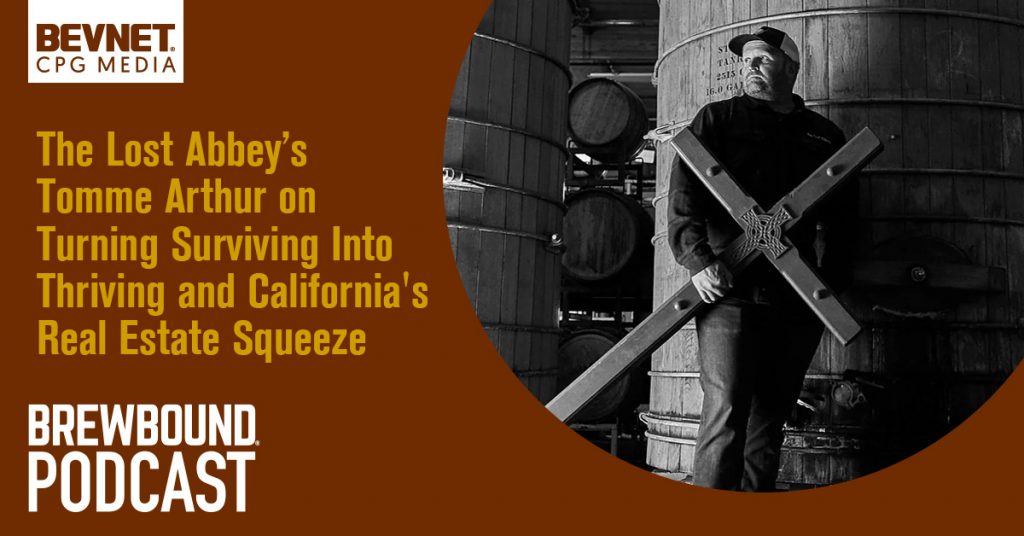
[00:22:50] Justin Kendall: Lots to look forward to next week at Brewbound Live and more to look forward to here with Tomme Arthur of The Lost Abbey. Tomme Arthur is here from The Lost Abbey. I'm Justin Kendall with Brewbound and we're at the California Craft Brewers Association Summit in Irvine. Thanks for doing this, Tommy.
[00:23:12] Tomme Arthur: Yeah, it's fun to be here. You know, thanks for the invitation. Got me out of bed, so let's rock and roll.
[00:23:17] Justin Kendall: It's early in the morning, why not?
[00:23:18] Tomme Arthur: Yeah, it's shocking in the early, but apparently everybody's up and at them. The conference is starting back up today and people seem to be in good spirits.
[00:23:25] Justin Kendall: So let's talk about what's going on with The Lost Abbey. You've made some changes, you've made some moves with the taproom. Bring us up to speed on what's going on there.
[00:23:35] Tomme Arthur: So the long story, short story is back in May of 2023, we ended up moving out of our San Marcos location. At that point we moved over to Vista, which is kind of one city over, and spent some time using the Mother Earth facility in Vista. That was about 18 months worth of time there. Determined that the facility was not going to suit our long needs and really it was an inefficient brew house for us for what we needed to accomplish. And we ended up using a lot of our time and energy to move things in and out of the building on a daily basis. So it ultimately was just too small and inefficient. So we contacted the people at the EPIG Mason group and asked about the EPIG facility that was about a mile down the road and it was not being used. In December of last year, we moved our entire operations again, which was kind of crazy. But that brewhouse is much better suited for what we're trying to accomplish and has allowed us to bring on some contract partners. It's a 30-barrel brewhouse with a lot of 30-barrel and 60-barrel tanks and just way more efficient for kind of what we're trying to accomplish.
[00:24:36] Justin Kendall: So what are you trying to accomplish?
[00:24:37] Tomme Arthur: Well, we're trying to get to next year. That's I think the standard answer. Next year will be our 20th year in business. So it's a pretty big milestone in terms of continuity or continuation. So definitely looking forward. And what we're trying to do is just really establish the right size and scale for the brewery. You know, we have A total of four tasting rooms now, three of them are satellites. We're making about 2,000 barrels of beer, which is not a lot of beer on a system of that size, but also with our contract partners, that puts us closer to about 5,000 barrels. I would say we're just trying to weather the storm like everyone else. My current tagline is we're surviving, not thriving. We know we'd love to turn that into thriving, but right now it's just about finding the smallest margin wins we can and keeping the lights on.
[00:25:19] Justin Kendall: Not long ago, we had a conversation about getting small to grow. And are you still on that trajectory? Is that still where your mindset is? Or do you feel like this move was, we had to get a little bit bigger than we expected that we would need to be?
[00:25:35] Tomme Arthur: No this move came at a little bit of a head scratch for a lot of people because you know we had told everyone we were going to be growing down and then we went from a 20 rail system to a 30 and we were on a 30 previously so it didn't really feel like we were growing down. You know we're still kicking the tires on every situation trying to find the right balance, the right mix of tanks and scale and operationally you know there's There's no real one way to get out of bed every day other than to get out of bed and to keep the doors open. But in The Lost couple of weeks, I've taken tons of meetings and I have more coming up, trying to find the right partners to work with or people that can potentially fill out the system the way that needs to be filled out. Right now, I would say that our occupancy is probably still too high relative to the amount of beer we're making. So we're looking at everything, but really, you know, getting to the right size is not, we're not there yet. I mean, we're, we were kind of forced into this, this size brew house based upon what was available at the time. That was not the ideal situation, but, but when it's all said and done, we really liked the space that we're in and just now need to kind of figure out how to, how to best maximize what we've got.
[00:26:35] Justin Kendall: How many contract partners do you have?
[00:26:37] Tomme Arthur: Currently three, and they represent about 3,000 barrels of our production, so we're doing close to five. The facility probably could do a solid eight to ten without a whole lot of changes, and that would really, you know, kind of getting it up to, you know, getting that boat up on that plane would be really nice, but three is the current reality, but managing it's kind of a pain in the ass.
[00:26:57] Justin Kendall: with the new facility? Are you leasing? Are you buying? How are you viewing that?
[00:27:02] Tomme Arthur: One of the things that didn't come up over the summer is that we actually, the Mason Epic group who was in charge of the facility, and we were working under a sublease with them, announced to us in late summer that they were going to be vacating the entire building. And that meant that we needed to scramble and find cash to purchase the equipment. So we actually own all of the assets in that building now and we are on our own lease with the landlord. So we are no longer sub-tenants, we are principals in that building.
[00:27:30] Justin Kendall: So you and I had a conversation last night about the leasing environment out there and how that's really shifted for brewers and a lot of them on that five-year cycle are finding in year five that the next lease is gonna be a whole lot more than they expected.
[00:27:47] Tomme Arthur: It's either the first five or the second five, but really what's happening is we're seeing in San Diego specifically, you know, a real estate market that's still pretty frothy, pretty hot, and a lot of breweries who signed up the first five-year lease and then exercised the second option. When it comes time to renew that lease or to, you know, double down, the price has gone up appreciably. We've seen 30% increases in rent rolls. In fact, we had one of our satellite locations where that exact scenario happened. We'd been there for 10 years and it came up for renewal last September and our rent went up by 30% just for that satellite location. Yeah, it's getting to the point where, and I think a lot of breweries share this kind of pain, I think the occupancy costs are kind of, you know, they're through the roof, certainly in California, and it's, you know, it's putting a damper on your ability to operate because you have to live in these lanes where you have a certain amount of labor, you have a certain amount of cogs, a certain amount of occupancy. And when one of them gets pinched, it literally just takes from profit. If your rent goes up by four or 5% every year, and you don't grow your sales, and you don't lean out your costs, you're gonna put yourself in no man's land.
[00:28:52] Justin Kendall: And then when you go from four or five to 30%, that's... A considerable lease.
[00:28:59] Tomme Arthur: Yeah, so what's happening in the real estate landscape is that a lot of the leases, they're commercial leases, they're triple net, they have rolling 3% increases. Well, now they've taken the price per square footage up to restart that lease, and they're adding another percentage. So now it's a 4% rolling basis. So as you start to look at that, the compounding part of it gets pretty ugly. And so the long term is pretty difficult.
[00:29:24] Justin Kendall: What's the calculus that you made that you wanted to re-up that location? Was it that it was one of your better performing locations? Like, how do you make that decision as opposed to, you know, The Lost of what it would take to open a new location or relocate?
[00:29:43] Tomme Arthur: That location is our best location, and the calculus was pretty simple. We knew that it wasn't a great number, that we had room to take price if we needed to, which we haven't yet. And the other piece that we looked into is that if we ultimately decided it wasn't doing what it needed to do at a profitability level, we could still sell it as an asset because we had control of the lease. So that was part of the calculus was to say, yeah, we literally know that if we need to get out from under this, that someone will want it because it's at a great price. It's still a good price. It's not a great price.
[00:30:15] Justin Kendall: Yeah. And that price versus going open market.
[00:30:18] Tomme Arthur: Yeah. Open market would have been another buck probably per square foot. So there's some value in it to the right person.
[00:30:25] Justin Kendall: One of the things you were talking about just a little bit ago was that five years or that next five years, you get to that 10-year mark and you're hitting that market rate, like the landlord is coming back and saying, we want market rate for this property. How much do you think that's factoring into what we're seeing with the number of closures in California this year, in particular, San Diego?
[00:30:48] Tomme Arthur: Yeah, I think it's, I think it's a big part of it. I mean, you really, we've, as an industry, we've become very marginalized in terms of where we can make money. There's so many, so many of the inputs are up. And so places where you used to have some wiggle, it would allow you to overspend in other areas, but there isn't much. I mean, you know, from aluminum to cardboard to labels to, you know, everything, the price of, you know, The Lost of delivering beer in California is just because of the gas prices alone. So, you know, everyone's, going to have to look at what it means to occupy their space. And in terms of occupying a space, are you maximizing the footprint? Meaning, do you have a 5,000 square foot building where you probably could make the same amount of beer in three? And yes, it might be harder, but at the same time, you're spending less, you know, like if it's $1.50 a square foot, you're spending $3,000 less a month, you know, on just your occupancy. And that adds up. So, you know, but if you're locked in, you're locked in. And so a lot of the meetings that I've been having of late have really been sort of centered around how many more partners do we need within our space to make the space more efficient and effective at a dollars per occupancy level.
[00:31:56] Justin Kendall: What's the market like for finding those partners at this point?
[00:32:00] Tomme Arthur: It's scary because not a lot of people are growing or not a lot of people are in a position where they're doing very well. At the same time, there are people who definitely out there in the world are starting to look at their situations as well. and they might have the same kind of inclination that is that, you know, being in proximity, partnering together on some of the harder costs, you know, some of the more expensive portions of that might make more sense than trying to go at it alone. And I think that's, you know, the synergy of occupancy is starting to become really, really important.
[00:32:33] Justin Kendall: So as far as what you're looking forward to in the next year, is there something product-wise you're looking forward to? Is there anything that you have coming out that you're excited about?
[00:32:44] Tomme Arthur: No, we've talked about The Lost waters on the intro. We've got a range of things going. We've got a whole set of canned beers. We've got a set of 750 cork finish bottled beers, legacy things. Definitely looking to get more of the oak program back on track. We've had to kind of put put that on the burner because we've been moving around so much. So getting some oak back into the fold would be great. But really just trying to deliver, you know, where we can and pushing forward, you know, making sure that there's enough core beer in the system to be reliable. And of course, you know, as we head towards, again, dry January coming and sort of the winter, you know, the hope is that some of these hop waters might find some really cool placements and people might be really into what we're doing with them. But ultimately, it's just about pushing forward.
[00:33:27] Justin Kendall: Yeah. Well, thanks for doing this, Tommy.
[00:33:30] Tomme Arthur: It's been a great afternoon. So I'm looking forward to the rest of this day. And we had fun yesterday. So thank you for having me.
[00:33:35] Justin Kendall: Always.
[00:33:36] The Lost: And that's our show for this week. Thank you for listening. The Brewbound Podcast is a production of BevNET CPG. Our audio engineer for the Brewbound Podcast is Joe Kratchy. Our technical director is Joshua Pratt and our video editor is Ryan Galang. Our social marketing manager is Amanda Smerlinski. Our designer is Amanda Huang. If you enjoyed this episode, please share it with your colleagues and friends and review us on your listening platform of choice. You can find our work at Brewbound.com and we also welcome feedback and suggestions at podcast at Brewbound.com. On behalf of the entire Brewbound Podcast team, thank you for listening. We'll be back next week.