
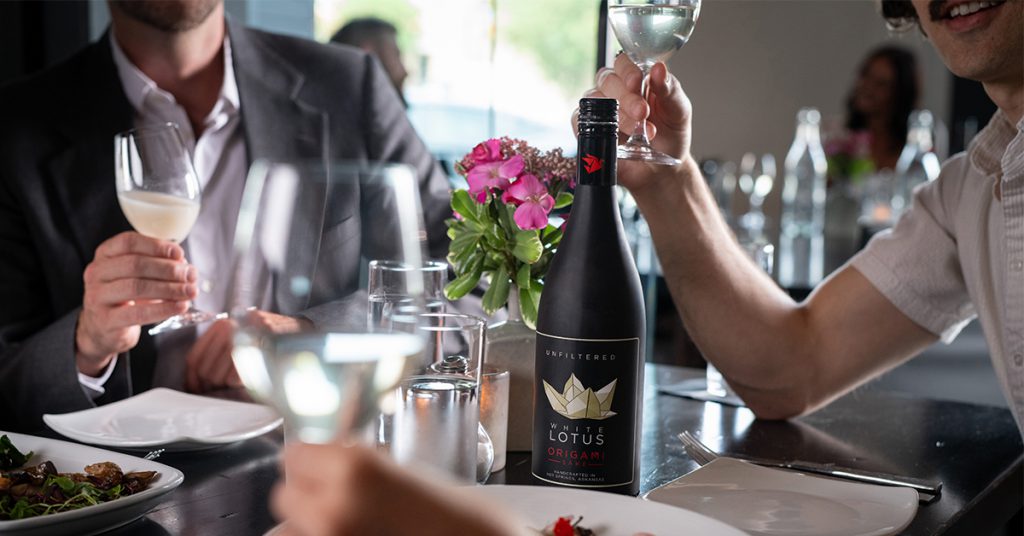
Sake is a staple of drinking culture in Japan, but in the U.S. bringing the category to new consumers takes a variety of approaches.
Arkansas-based Origami Sake is attempting to make the traditional rice wine more approachable to American drinkers by pairing its premium-positioned products with transparent packaging callouts and a new non-alc variety that caters to moderating consumers.
“Back in 2016, my experience with sake as an Arkansan was the same experience that most of my friends had, warm sake that tasted bitter and wasn’t great to drink,” co-founder and president Matt Bell said. “It was something you did at a hibachi or sushi restaurant once a year.”
Yet, when Bell met wine expert Matt Bell (no relation) and tried premium sake, “it was an epiphany,” he said.
The two Bells partnered to establish Origami in their home state, the heart of American rice country. The brewery began producing its first batches of sake in October 2022, with sales starting in the middle of 2023. Origami is the largest U.S.-owned sake producer in the country, but is also one of the few to own and operate a rice polishing facility, a necessary part of sake production.
Although the brand has aligned its identity with a sense of place, Origami has no plans to open a taproom and cater to the regional economy.
“That would have been a big mistake because Arkansas doesn’t have a large sake community,” Bell said. “We looked at this from a national perspective from the start. We knew that we had to go to California and New York to make it a viable business.”
Last month, the company announced a distribution partnership with Republic National Distributing Company to do just that. Origami also received a vote of confidence in the form of a $100,000 investment after winning InvestBev’s Fall 2024 Accelerator pitch competition.
Trajectories To Category Building
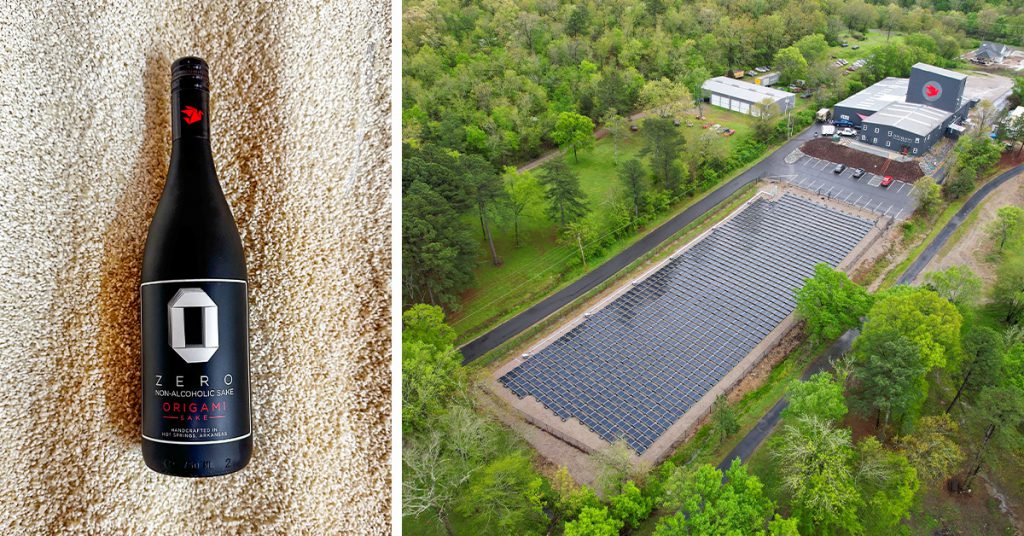
In December, the company also released the first domestically produced non-alcoholic sake, ZERO, as it aims to open the category up to a broader swathe of American consumers who are still educating themselves about rice wine.
ZERO claims to be the first domestic NA sake in the U.S. but the format is not unheard of in Japan. Legacy sake maker Gekkeikan produces a zero-proof daiginjo sake and there is also a fermented rice koji drink called Amakaze considered an alcohol-free alternative to rice wine.
Origami’s ZERO is not a de-alcoholized product, but uses lactic fermentation with rice kogi that does not create alcohol as a brewing byproduct.
“It gives an option for a introductory product,” Bell said. “It’s a good door opener to craft sake. It’s really a probiotic health drink.”
Bell conceded that this first formulation is a work-in-process. He said it lacks some of the complexity of umami flavor that the alcohol brings but is very “sessionable.” The product is currently available in 750ml bottles and sold in Texas retailers like Spec’s, Total Wine and More, and H-E-B.
As a category, sake represents only about 0.2% of overall alcoholic beverage sales in the U.S., according to SipSource data provided by 3 Tier Beverages to the Sake Brewers Association of North America.
Although the category has been steadily growing since 2021, it hasn’t hit exponential growth and “will need a shove to get there,” said 3-Tier Beverages co-founder Joe Sepka.
Reframing sake away from being recognized as the carafe of hot wine ordered at sushi restaurants and into a premium product is key. It’s an approach similar to how tequila and mezcal changed the narrative of agave spirits from being a shot choked down at a bar to becoming a premium liquor intended for sipping like Scotch or bourbon, Sepka said.
Also, brands could align an affinity toward Japanese culture by younger generations.
“It holds a unique and prominent position in American culture, be it restaurants, media, or television shows. All of these things are contributing factors to why sake could take off,” Sepka said.
Like many domestic sake producers, Origami is building around being approachable to American wine consumers. The company intentionally left Japanese terms off its labels and presented itself in a recognizable 750ml bottle format to bridge the “big disconnect between consumers and suppliers,” Bell said.
The company also offers its two alcoholic varieties — unfiltered White Lotus and filtered Thousand Cranes — in cans, which is an increasingly recognizable format for wine that encourages trial.
A Wine-Based Approach
With retailers seeing diminishing returns from wine, “why not take out a couple of these less productive bottles and replace them with something that’s growing,” Sepka said. “Sake presents that opportunity.”
It falls on producers and their distribution partners to convince retailers to build sake sets in stores. One approach is leaning into the growing cohort of domestic producers building up the category, like Origami.
Of the roughly 20 to 25 domestic sake producers operating in the U.S., over a dozen were established in the last 10 years, according to data provided by the Sake Brewers Association of North America. Before that, only about 8 major producers were operating in the U.S. (many being Japanese-owned breweries) since 1979.
“If I’m trying to be the ‘other white wine’ and offering sake as an alternative that’s readily available and has a profile similar to wine, I believe there’s a place for that,” he said.
Part of that strategy is not just targeting Japanese restaurants and the off-premise opportunity, but getting Origami into the hands of cocktail makers as a lower-ABV product that has a unique flavor profile suited to mixed drinks.
Competing with the Japanese imports that have long held dominion over on-premise is no easy task though.
There is a gap between on- and off-premise revenue as it relates to Japanese versus U.S.-produced sakes, said Sake Brewers Association of North America president Weston Konishi. Japanese brands occupy roughly 70% of on-premise sales; whereas it is evenly split in off-premise between U.S. and Japanese sakes, he added.
Origami is trying to carve into the opportunity — both on- and off-premise — by leaning into its story of being a domestic product sourced and produced in Arkansas. The brewery has partnered with a local rice producer Isbell Farms, which grows the sake rice varietals that are used in Origami’s products.
“It’s farm-to-bottle and made using 100% solar power. Our water is ground-sourced from the largest soft water deposit in the U.S., which is ideal for sake,” Bell said.
Origami can produce about 600,000 liters per year and is producing at full capacity currently, but is preparing to expand its production capabilities next year.
“At the end of the day, it’s water and rice,” he said.