
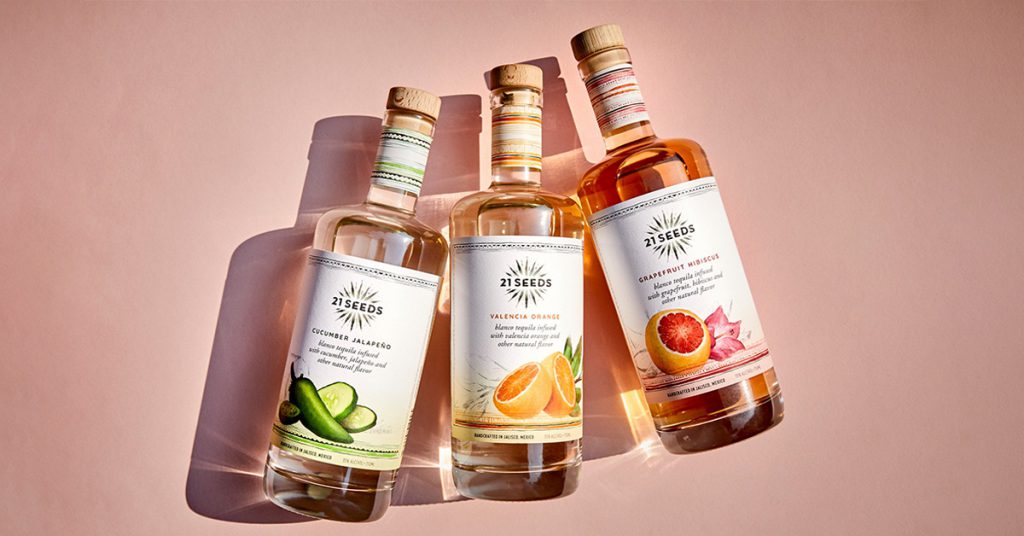
Created by three women in 2019, flavored tequila 21Seeds found a niche in a crowded category by catering to an underserved demographic and to the at-home drinking occasion – fortuitously right before the COVID-19 lockdowns.
Since the brand was acquired by tequila giant Diageo in 2022, Hantas and her co-founders now serve as ambassadors as the brand pushes for more consumer trial.
BevNET spirits editor Ferron Salniker chatted with Hantas about how going after moms was the key to success, why they took an unusual route-to-market for tequila, and what brands should be prepared for if they’re acquired. Answers have been edited for clarity and length.
Can you pinpoint what led to such a quick exit for the brand?
Kat: One [reason] is we were very focused on a particular consumer that we wanted to win: not just women, but moms, and we did that. Acquirers can help with distribution, so it isn’t about reaching far, it’s about having a specific consumer who says, ‘this is my tequila.’ When we sold to Diageo, we had an 80% female consumer, which is really unheard of for spirits, very common in wine. But for hard alcohol, tequila in particular, it was pretty male-dominated prior to that and really being marketed like a Scotch or whiskey to that male consumer– until we got into the aisle.
Second, we won with that easy-at-home, relax-and-unwind occasion. We gave permission for her to bring tequila into the home. We showed her how to use it very easily and we carved out a white space, which was previously the wine occasion. And so it was very clear messaging: drinks as easy as a glass of wine, half the calories.
You can get case numbers through broad distribution, but really, that’s what the buyers can do too, that’s what they’re good at. What you need to be good at as a brand builder in hopes of getting acquired, is being the product for a particular consumer.
So you went for a much different strategy than most spirit brands, many of which still build brands on-premise?
Kat: Moms don’t really discover brands on-premise – they discover brands through their friends online, through Pinterest, through Instagram, through Facebook, through Pure Wow, and Refinery 29, and Pop Sugar. So we were focused on getting it into where she would buy it, and then letting her know about the brand in places she discovers brands. When you have a limited marketing budget, when you’re small and you’re trying to carve out a niche, you have to start somewhere and win there.
We always knew we were going to go on-premise, but our game plan was always to build the brand in the off-premise, win with our consumer, and then utilize our strategic acquirer to go broad and into the on-premise and win. It’s very expensive to do that otherwise, and part of the reason we love Diageo is because they have such a strong presence on-premise.
Because you were so female and mom focused, did you get pushback in the industry, and how did you get through that?
Kat: Our first customer, our actual customer, is our distributor, right? They’re the ones who are buying the product, but our ultimate customer is this mom that we’re trying to reach. We were having to market to two very different consumers, so we definitely got push-back.
But we would say, ‘listen everyone is marketing to men, this is the point of differentiation, and the person who’s controlling the purchasing power in the off-premise is the female consumer.’ We broke down our playbook: we’re not trying to build the brand bar-by-bar, we’re trying to go where she shops. We know how to get in front of her. We had a great background in online media, and we knew how to reach our consumer. We said, ‘we’re going to be able to get to her, now we just need to get it into the stores where she shops.’
It seems like world events rewarded your strategy to reach the consumer at home, was there anything else you did as outsiders of the industry that you think stood out?
Kat: We knew we wanted to drive easy-at-home cocktail solutions for the consumer. So we looked at point-of-sale in a very different way. We just printed the cocktail recipe right on the side of our cases, there was a photo and the recipe that showed the cocktail right on the side of the outer shipper of our cases. And prior to us, no one had been doing that, and so that allowed for a very turnkey solution for our distributors. We also planted our shelf talkers inside the cases, so that was another thing that we did that made it easier to convey certain messaging on the shelf.
What was your company culture like prior to the transition to Diageo?
Kat: We all had very different lanes, and so we all operated very independently. There was this deep level of respect between what everybody did, and so that allowed us to run really fast, because we had a great amount of trust that each person was going to do their job to the best of their ability, and then if they needed help, they would just ask. I find that it works absolutely well when people have autonomy and they’re responsible over their own domain, and they really just ask you for help when they need it.
Are there lessons learned there that you can share with other entrepreneurs about the acquisition process?
Kat: It’s a very stressful process. While you’re getting acquired you can’t sign on new contracts and you can’t make new deals. You also generally have to keep it hush-hush and you can’t talk about the acquisition, not even within your own organization. So you’re having to run your business, and make sure that you’re continuing to grow your business — because at any point the deal could fall apart — and because while the acquisition is happening your buyer wants to see that you’re going to continue growing on the trajectory that you’ve been on. But you can’t grow in the way that you would have grown, because you can’t sign new contracts. You’re now actually creating more work for yourself in a way that you couldn’t have even imagined.
It takes a toll on your family, too. So just before you go into the process, have a convo with your co-founders and be really aligned and figure out how you’re going to deal with the deal flow and the workload.