Search across the BevNET CPG Media network including BevNET, Nosh, Brewbound, Taste Radio, Nombase and CPG Jobs.
Brew Talks Boston 2022 - Taproom Strategy 2.0 Building Brands and Expanding Own-Premise Retail
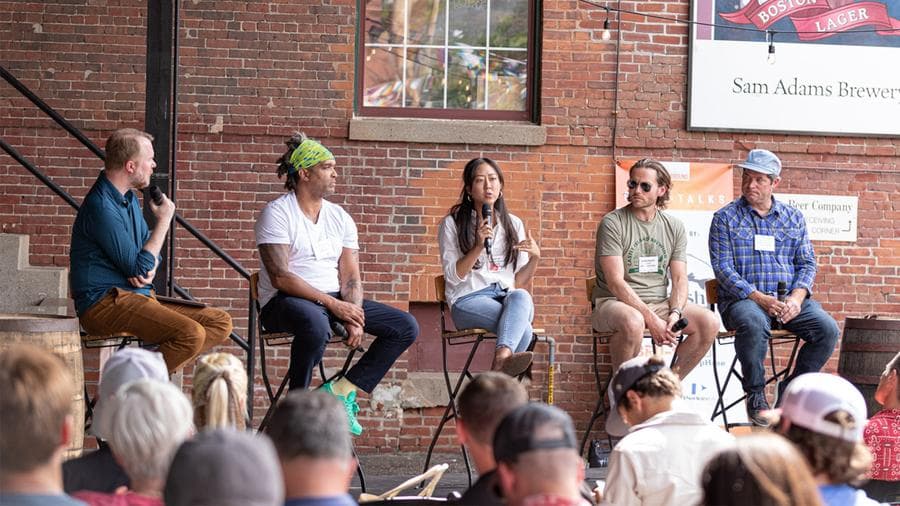
White Lion's Ray Berry, Medusa Brewing's Sarah Less, Boston Beer's Scott Hempstead and Castle Island's Adam Romanow break down strategies for expanding taproom and retail space during Brewbound's Brew Talks meetup on July 27, 2022.
Transcript
Note: Transcripts are automatically generated and may contain inaccuracies and spelling errors.
Speaker 1 [00:16] So we're gonna jump right into our next panel here and call out our next panelists Price is Right Style it seems. Uh, so everybody's expanding in some way it seems like in the state and we want to sort of focus on the strategies behind that. So let's get some of the folks who are doing the, the work up here. Uh, Ray Barry, the founder of White Lion Brewing in Springfield, come on down. You're gonna spin the Perkin, uh, Elmer will too when we're done here. So, uh, Sarah Lee, the director of brewing operations at Medusa Brewing in Hudson, come on down. Adam Romanow, the founder of Castle Island Brewing in Norwood. Looking like a fighter pilot. And also Scott Hempstead, senior director of local brands and taprooms for Boston Beer Company. Come on down. So we are psyched to have all 4 of you here. Uh, we're gonna plug our text line. If you have questions for these guys, text 617-336-8560. Thank you very much. Uh, let's get going here. So this is gonna sound like an obvious question, but I think it's one that has a lot of purpose. It's Why are you expanding and, uh, Sarah, you really dove into the something deeper on this, which is, you know, it's important to look beyond just the here and now of these expansions. It's, you know, what's, what's it going to look like in 5, 1015 years down the road. So you, can you dive a little deeper into that?
Speaker 2 [02:09] Yeah, I think any time a brewery talks about expansion or a second location or any type of new kind of business venture, it's really important to think out some of those clear objectives as to why you're doing so. Um, is it filling a cash flow situation? Is it a hiring situation? Is it a demand for more inventory situation? And have you exhausted all your means within your current structure to do so? And if not, Um, then what does that benefit that second location do for your benefit because those questions and sometimes the answers to those questions while they do change, um, if you don't have those first set of clear objectives, you don't have buy-in, you don't have communication, you don't have transparency, you don't have a lot of the fundamental things that you need in order to feel like when you are moving forward and that ball is rolling and you cannot stop it. Um, something to kind of anchor yourself down in and say this is why we opened, let's go back to kind of our shared core values, what that looks like, and make sure that those are all in check so that in 10 years, in 15, in however long your objective, you know, goal is, it stays relevant to your cause and what you're trying to do. So I just don't think that that is talked about enough, so I just wanted to really talk about that.
Speaker 1 [03:20] Yeah, I see you nodding your head, Adam. Give us your take for Castle Island and why it's important for you to expand in that way.
Speaker 3 [03:29] Uh, I mean, we opened a second location in South Boston recently, um, got tired of answering the question, Why is Castle Island in Norwood not Southie? Uh, no, in seriousness though, our customers are already living, uh, and eating and drinking and going out to party in an urban environment and we're physically located, or we were physically located 20 miles outside of that environment in the burbs. Uh, Norwood's been a great place to call home for the last 6.5 years, but we wanted to build awareness for the brand. Uh, we wanted a bigger megaphone. We wanted to put an outpost in our core consumers' backyard, um, and we had a phenomenal opportunity to do that with a great storytelling element that really allowed us to kind of double down on the brand without cannibalizing existing business. So for us it was purely about growth and visibility.
Speaker 1 [04:19] Ray, you've got a 2nd location coming to Amherst. Give us the decision tree for you on that.
Speaker 4 [04:25] So originally when we went from a beer brand to a brick and mortar location in downtown Springfield, the framework of the business model included resources for us to either expand outside the state or look for a second location. So as we got through the first round of the brick and mortar right in the heart of downtown Springfield. Um, there was an opportunity, an ongoing conversation by officials in the town of Amherst while we were building out Springfield. They were very much interested in what we were doing from a brand perspective, from a community engagement perspective, uh, and from a cultural perspective. And, uh, so once we realized that realization downtown, it just accelerated the conversation, uh, and then internally we decided to, um, take those resources that were parked. And, uh, look at a second brick and mortar, uh, and there's a lot of similarities and we'll get to that later on in the questioning. There's a lot of similarities between the, uh, footprint of downtown Amherst and the footprint that we currently reside in in downtown Springfield.
Speaker 1 [05:35] Hempy, uh, Boston Beer is a little bit bigger than these guys, just, uh, just a little. Uh, so how do you make decisions, uh, for, for the brands because I'm curious because you've, you've got a lot of different things you're playing with. You've got a Dogfish Head location in Miami, you've got a Truly Seltzeria in Los Angeles. So when you're looking at, you know, the forecast of 25, 10, uh, years down the road for these locations, how do you sort of view that?
Speaker 5 [06:04] Well, you know, our, our view on it and sort of our strategy is to kind of go to where the drinkers are going and finding these places where we can create immersive experiences for our brands. Um, our, our, our sites are really kind of targeted. They're, they're uh A major part of our development in terms of what's next. So kind of the why on how we make that decision is a lot based on sort of the consumer experience and going where it's easy for people to go. So that kind of drives the way we think about it.
Speaker 1 [06:36] So Adam, I want to circle back to you. Um, when you're looking to add another location, what are the top factors in your decision tree and on the places and spaces that you're looking to go?
Speaker 3 [06:50] Uh, geography for us was number one, as I mentioned earlier, getting closer to where our consumers actually live, work and play was, was the top priority. Um, but we were also looking for a space with authenticity. We were looking for a space with some runway. Um, for anyone who's been to our location right now it's on a little bit of an island right in the middle of the city, but there's a really awesome plan that our landlord and a couple other developers have built out that really is going to transform that neighborhood over the next several years, and we're kind of a key building block in that. So for us it was about a spot that felt right, a spot that really fit what we're looking for today, but also sets us on a nice sustainable path going forward.
Speaker 1 [07:31] Ray, you, we talked about that Amherst space. Tell me about the decisions there as far as what you're looking for in a place and a space, and I think there's something special too to that with, you know, the partnership that you have with Marcus Camby with, you know, NBA legend, UMass legend.
Speaker 4 [07:48] It sounds kind of cliche, but it really does come down for us to location, location, location. Uh, we built our brewery and brand on being in the downtown or being part of a downtown business district environment. Um, whether it's corporate, nonprofit, philanthropic, um, educational institutions, so by having that aspect right in the middle of downtown, it gives us an opportunity to touch not only the Springfield community but because we're a gateway city it allows folks from outside the area to come in and experience what we do. So when we were looking at the second location it was important for that to be in place. It was important for. For the city or town to have a strong downtown environment, um, both cities or both towns have a strong business improvement district. The role and goal of the business improvement district is to encourage business development, economic development, uh, creative programming, and we witnessed that in downtown Springfield and we knew that the leadership in Amherst, the town leadership, the business improvement district leadership, uh, the restaurant row that we were part of, there was. Somewhat of a renaissance taking place similar to what was taking place several years ago in the city of Springfield, a new beginning, a new cleansing, and we wanted to be part of that conversation and
Speaker 1 [09:05] they were really coming after you, right,
Speaker 4 [09:07] for several years. So again all through the pandemic we were building out our brick and mortar in downtown and they were in our ear every step of the way and getting back to the strategic partnership with Marcus Camby that helps. Marcus is a branded. Himself, uh, he put the University of Massachusetts on it's on the map relative to Division One basketball, and he continues to want a wants, wants to make an impact in the UMass Amherst community. So it was a it was a good strategic partnership.
Speaker 1 [09:40] Sarah, you've had quite a bit of experience with opening locations across your career. Tell us about the decisions that sort of go into that for that you've seen throughout that experience.
Speaker 2 [09:52] Um, I think the most I think it's easier almost to answer that question with the things that I don't see, um, because I think there's a lot of things that people expect like, oh, this location's really great, we've done the data, the demographics are there, the income bracket is there, etc. etc. I think the thing that people underestimate probably the most is quantifying what your culture means. Um, I really sometimes hate that word because I really do think it's become this kind of meaning. List buzzword at this point but whatever that means for you, make sure you kind of have that down operationally um that's a lot of things, um, operations in my mind I am the director of operations so I might be a little biased here, um, but operations provide strategic flexibility. You can't be flexible you can't make those spontaneous decisions if you don't have, you know, a system and a process down and I think quantifying culture. To that and what that means to you, what are your shared values is, um, and making sure you're transparent about that because that transparency goes not only to your employees, it goes to sponsorship, it goes to brand ambassadors, it goes to your retailers, your distributors, um, knowing what you're doing, what that plan means for you, who you are, um, I think people kind of lose sight of that because you get busy, you get bogged down in the details you. Get bogged down in the day to day and all of a sudden your budget's much higher and production slower it's so easy to get caught on that but as long as you have that foundational kind of this is my strategy, this is my operation, this is what this means for my team and make sure that everyone has that buy in, um, especially your team because they are the ones who are gonna carry you across that finish line and forward. Um, making sure that that is quantified and built into your operations in a very strategic way, um, and I feel like I am using a lot of like just buzzwords right now, but it really does come down to just making sure you have that buy-in, um, transparency, um, within your team, um, and just making sure that everyone knows what's going on, how we're gonna do it, so you have everyone on board that really gets lost, um, a lot of times when another location pops up, so.
Speaker 1 [11:58] Hempe, you made the switch from sales to operations and Sarah just sort of broke down her view of operations and the changes there. Now that you've got eyes on that different part of the business, what are your key learnings for that, uh, on opening these spaces?
Speaker 5 [12:15] Well, first off, um, after 20 some odd years in sales, um, I, I've noticed how fucking hard it is to run these places. I have an incredible amount of respect for all of, uh, my, um, co-panelists over here. Um, it's, it's, it's been eye-opening for me, um, to get on the other side of the fence and sort of understand what it's like to sell, um, you know, brands directly out of our, our breweries. We have Coney Island, we have Dogfish Head. Um, you know, we have Angel City, obviously Sam Adams, and you know, one of the things that's kind of blown me away is just how important it is to know who you are and what you're looking to do with your brand and where you want to be. And you know, when you go to a wholesaler, um, after years of working for Boston Beer. Sales, we have some big mega brands where you go ask for some big things from you know Truly and other brands that we have, but we also have segments of our business that are so important to really just be really thoughtful about you know what you asked for and where you want it to go, and that's, that's sort of like been a big headline for me.
Speaker 1 [13:26] Ray, when you're choosing a location, how do you weigh the price paid for being in a more densely populated area versus one that may be in a cheaper outlier place, less populated place?
Speaker 4 [13:40] I, I know there's a couple of Amherst folks in the audience and Western Mass folks in the audience that are familiar with the Greater Amherst area. Uh, Amherst is basically a 1011 month community because of the institutions Amherst College, UMass, Hampshire, Mount Holyoke, and Smith. Uh, it was important for us to be part of that downtown environment. I, I can't stress that enough. We wanted to be part of the foot traffic, the vehicle traffic. And one of the other key decision maker points was our brewer cut his teeth in Amherst. He, he brewed at Amherst Brewing. The location that we're going in is a location that once housed Amherst and another beer brand, and he had an opportunity to brew out of that space. So he's very, he's very much familiar with the greater Amherst, Northampton community. Obviously numbers always come into play. We go back and look internally on what the best approach is, and We follow our own internal guidelines whether or not we're going to pull the, pull the, pull the trigger or not and uh we felt that based off of the environment that we were going in, based off of what we knew, um, that it was the best deal for us.
Speaker 1 [14:52] Adam, uh, I'm guessing South Boston isn't very cheap. You talked at the top of the show about uh going where the people are. So tell us a little bit about that, that decision.
Speaker 3 [15:03] Yeah, I mean, so we were already in a less expensive market with our Norwood location. Um, we did that deliberately because we launched as a wholesale-only brand. We opened without a taproom in 2015, 1 of the dumbest things we've done, but we fixed that problem. Uh, so at the time pairing a manufacturing operation with a low rent market made sense. Going into selfie was the complete opposite side of the coin. It was all about the experience. It was all about on premise. It was all about bringing consumers into our space, so. We basically built the model knowing upfront that it was going to be a ridiculously expensive market for us to get into. We negotiated the best possible lease we could with our landlord. I think we did all right, but it's still crazy expensive, especially when you hold our Norwood rent check in one hand and the Southie rent check in the other hand, you're like, wait, but it's less space. That doesn't make sense. Uh, but it was deliberate on our part. It was baked into our plan from day one, so it, it's working.
Speaker 1 [15:59] Sarah, when you're working with brewery owners through these decisions, how do you just advise them when there, there's a higher priced, high, higher population place versus lower price, lower population place, or higher pop
Speaker 2 [16:15] I think you get it, yeah, I got you. Um, I think being in between Ray and Adam right now is like a great example just kind of seeing the different, it's all subjective at the end of the day and it really ultimately came down to what were their fundamentals, what was kind of what they were searching for, you know, Adam said like they've always been looking for that space they always knew they wanted to go into kind of the city and Ray has talked about what Amber has brought to his company. And it's still it's very much in line with kind of his core values for what he was looking for and that kind of forecasts how they have made the decisions to be in the locations they're at like Medusa Brewing we just opened a second sort of Belgian beer, uh, oak fooder, you know, barrel conditioning taproom, and that was for a complete different set of reasons. We're just right down the road from our old brewery so we get. That question a lot of why right down the road um and it captures a whole different market and it's a whole different kind of beer and it's a completely different consumer experience and what does that mean for our brand and it ultimately came down to who like what we believed which is ultimately in making great beer and providing a like a safe space of fellowship and so I think it really just comes down to there's no real right reason. To necessarily go into a more or densely populate or not as dense populated densely populated area, um, it ultimately comes down to what are you looking for as your brand, what is your company looking for? what are your core values? How do you make that into an operational decision so that again you can have that flexibility to decide do we want to move into Amherst or do we want to move into Boston so.
Speaker 1 [17:54] When, uh, these announcements come, they're, they're not always uh well received by wholesalers or retailers. So Hempe, how do you sell your wholesalers and retailers when you're, uh, opening up a new space?
Speaker 5 [18:09] You know, honestly, the whole, the most recent one was uh truly LA and, uh, our wholesaler there, um, Reyes Beverage is out at Reyes Beer Division. We're very supportive. Um, you know, we're really kind of, our, our sites just help propel the brand and bring in an immersive experience for our drinkers to try new things. And really, there's no way that the wholesalers often gonna be able to Work with some of the styles that we sell. So we, we, we don't use any like costs as guardrails as we innovate. We just, we do crazy things inside of our, our, our sites that the distributor is never going to see. We have a pickle beer at Boston Taproom right now. You either love it or you hate it. But you know, I don't see us going to the wholesaler to go try it out. Um, we have a beer called Covered in Nugs, which is a IPA that we brew in Delaware. Brian Seder's worked with Sam Calcione on this, this beer. It is our number one seller every month in and out. There is no way we can distribute that beer. The economics don't work. So I'd say generally speaking, the wholesalers are, are, are, are supportive of our efforts and see the value in the brand. And what they get from a marketing standpoint out out of the out of the sites.
Speaker 1 [19:27] Sarah, can you share a little bit about your experience on this, on, you know, proving that it's a brand building opportunity.
Speaker 2 [19:35] One of our, I think our biggest, uh, retailer in the state of Massachusetts is maybe 2 miles down the road from our brewery, um, which is crazy because the brewery is right there. I think that is just kind of a great example. Thankfully we have an incredible director of sales, Katrina Schabo over there who just does a great job, um, but a big part of that. That is just showing people you know this is what we're about this is what our brand is about um and just being transparent and keeping those retailers and distributors in that conversation and just letting them know like this is what our intent is this is what we wanna do keeping that line of communication open so that people understand that you're just trying to help the brand you're not trying to take away from their business you're keeping that conversation open about what they might need. Versus what you might need and how you can figure out where those two things align. So again, you're, you're, it's less about selling your beer because your beer now at this point is one of hundreds on the shelf. It's about selling who you are and what you are trying to achieve and making sure you have as much buy-in as possible. And again, um, that's just, it's just more of those strategies that I think people miss out on.
Speaker 1 [20:44] Adam, how do you make the case to your wholesalers and retailers on this?
Speaker 3 [20:49] Yeah, I think adding to what's already been said, we really lean on the data to help us tell the story, and we did it in Norwood when we opened our taproom in 2017. We've done it in Southie when we opened our taproom last September. We give our wholesalers our depletion data. We give our retailers the rate of sale data and we say, look, you guys are getting lift out of this. We're getting lift out of this. The point was to grow the brand. Here's the data to show you that it's working. It's really easy to overcome objections when you have data to back it up.
Speaker 1 [21:17] Yeah, that seems to help a little bit. Ray, have you experienced this with White Lion?
Speaker 4 [21:22] Our model's a little bit different than my three co-panelists. We, we self-distro.
Speaker 1 [21:29] That's an easy conversation with your wholesaler.
Speaker 4 [21:32] So we have that mind game with ourselves, but no, I mean, but it's important for us to Be looked at as a partner in our community, not a competitor so it's all about moving the needle in the right direction for the greater good and when we have those conversations, especially with the on or off premises uh locations near us, it's about how can we all work collectively to bring more people in to the downtown area, the Amherst area, the Greater Springfield area for a better experience, and that's the approach that we take.
Speaker 1 [22:07] So speaking about, you know, building relationships in your community, you, you've done a good job of building relationships with local leaders. Talk a little bit about how important that is, Ray?
Speaker 4 [22:20] Uh, super important, um, I come from outside the space, so I come from the nonprofit quasi public space, and my teeth were cut on the importance of engaging the community. So when I made the transition to the craft beer space, that's really all that I, that was, that's all that I knew that was the experience that I had over the many moons around the or many, many suns around the moon, but um. Yeah, I mean, when it comes time to, to engage and have serious conversation or have decisions made or stakeholders believe in what you're trying to do, sometimes those relationships come into play. And I would never ever discount the importance of going out and meeting your local legislators, your local, um, educators, uh, your nonprofit leaders, uh, other corporate leaders, because at the end of the day when you look at the entire experience of your taproom or your brewery they're the ones that are gonna come in and support you so we try to create that connectivity we try to build that bridge on an ongoing basis and it's benefited our brand so far.
Speaker 1 [23:32] When you were going into South Boston, how, you know, how important was it for you, Adam, to make those connections with local leaders?
Speaker 3 [23:40] Uh, this is going to be shocking to hear. Boston's a pretty old school city. Uh, nothing gets done without those relationships. You, you absolutely need to get to know the local electeds. You need to get to know the community leaders. You get to, need to know the neighborhood groups, uh, and present your case the best you can. We were actually really fortunate going into Southie. Um, I had pre-existing relationships with a lot of those individuals. I've lived in Southie for 12 years now, so that's part of it, um, but we also need to show them. And this was a, a, a point of resistance we ran into in the city that you're not just another bar. Like that's the number one concern is, well, we don't want another bar. We have enough of those. There's a lot of trouble. Like, all right, brewery taprooms are not bars like we're stroller city on Sundays, we close at midnight. We're not doing liquor, we're not doing shots. Um, those kinds of things will help build stronger relationships when you give people a sense of what you're looking to do and what your story is and why you're interested in coming to the neighborhood. And that it's not just a, you know, it's not just party HQ.
Speaker 1 [24:41] Sarah, adding a location can definitely add complexity to the business. Can you dive in a little bit on, you know, your experience on what it does when you jump from one space to two spaces and what, what that does to operations that people may not be taking into consideration?
Speaker 2 [25:01] You will never have enough time like that is just like please do not. I think there is just this assumption that like I have the right people, they're really motivated, they're like ready to go and it feels great you will never have enough time um so I think one thing that people might underestimate is like be prepared to like export some basic tasks. Get the buy-in from your team find the people within your teams that are motivated. This is a great DEI practice just in general as well, just finding the people on your team that you, you know, even if they're a part-timer, what could you be adding? What value could you be adding, um, that would benefit both you and me in this field, um, I think just. That is just huge. You will never have enough time, so make sure you use your people, make sure you look to them for not just help but also support. They are your brand ambassadors on the ground. They are the people that really care and are gonna be living the lifestyle or the brand or the story that. You're trying to tell, so let's just make sure that like they understand what's happening that we're, you know, that as owners or as brewery leaders people are being transparent to the team, um, beneath them and just making sure that that is what carries because again like you every time you think you have time you don't have time.
Speaker 1 [26:21] Hempy, uh, for Boston Beer, when you're doing this, how do you prepare for that added complexity?
Speaker 5 [26:28] You know, it, it's, um, it's all about the, the people and, and the culture of the sites and the brand and so it's so important when you're, when you're expanding your, your, if you're going from 1 to 2 or 1 to 3 sites, finding that synergy from uh from location to location and making sure you don't. Undertrain and under educate all your coworkers, that is a, a, a very dangerous trap and because the, the, the consumer and your guest and your drinker, they, they just view it all as one brand. So if your team is not on board and your team is not, uh, lined up with the strategy for the brand and the DNA of the, of the culture of the brand, um, it, it could be a big watch out. So we put a lot of time in the training and, and education.
Speaker 1 [27:14] Adam, what's your biggest takeaway on going from you basically doubling your size, but, you know, quadrupling your complexity?
Speaker 3 [27:24] Yeah, um, we definitely got caught a little flat-footed, frankly, on some of this. Um, we've always been a small scrappy company. I think we performed pretty well as a small scrappy company, but what that as what that resulted in is we'd never really codified or like articulated our like mission or values or like what we really care about. It was always in the company and it was organic and it was authentic, but you learned it by being part of the team. You learned it by being exposed to everything. You open a second location that's 20 miles away with a predominantly new staff. I mean, we had, I think, 5 people transfer over from our Norwood location to the Southie location out of 40 that work at the Southie location and The best you can hope for is that some of that bleeds over, but we really had to grow up pretty quickly and learn how to put a lot of that into language, share it with our people, train our people, and that's on top of the operational and the administrative, you know, complexity that it adds. We had to buy a truck because we're shipping beer up to ourselves. We went from a part-time outsource bookkeeper. We just hired our first full-time staff accountant. We have proper HR now because we went from 35 employees to almost 80 employees, and this stuff happens literally overnight. And like Sarah said, you can't possibly prepare enough. There's just not enough time. Um, but I can tell you for sure I wish that I was sitting listening to this panel before we opened selfie. That would have been helpful.
Speaker 1 [28:48] Well, I'm glad that we're at least doing a service. So you're, you're sitting here listening to this, Ray. You've got Amherst coming online. What's your big takeaway and what are you doing to sort of prepare?
Speaker 4 [28:59] I'll be calling the three of them.
Speaker 1 [29:00] Yeah, there you go. Perfect.
Speaker 4 [29:03] No, to to Adam's point though, you really do have to sharpen the pencil. I mean you want to put your practices and policies and protocols in place all in alignment with your, your culture, um. You know, the key for us is, or at least the key for the, the, the core team, you know, you can't, you, you can't always lead from the front you can lead from the back, you can lead from the side, you gotta entrust the people that are in place, uh, so I think if you build and frame out the right team and give them the right guidance, uh, know that there will be hiccups along the way, but learn together and trust in each other, I think that will make the, uh, the road ahead of you a little bit smoother.
Speaker 1 [29:44] We've got about 10 minutes left, so if you've got questions, send them to our text line at 617-336-8560. Uh, this question came in for you, Adam. Uh, what's it like to, to partner with a permanent third-party food vendor that is also trying to build a brand, uh, of its own inside of your space? This is something that we talked about or we're going to talk about so it dovetails nicely and leveraging partnerships.
Speaker 3 [30:12] Yeah, um, it's awesome and it's weird, so we're, we are still learning, you know, 9 months in exactly how this partnership works, exactly how our brands are aligned, exactly how they're not aligned, and sort of the operational efficiencies to it, but really this idea was born out of we do beer and we do a great job at it. Um, we work with a lot of restaurants and they do a great job at it, but we're not about to go and do what they do. Let's partner with someone who does an exceptional job with food to help build an exceptional food program, something that complements the beer really well, executes our vision, while allowing us to really focus on our strengths without essentially biting off more than we can chew.
Speaker 1 [30:52] So, uh, Ray, you've got a big partnership with Marcus Camby. What What's the opportunity there? What does that give? What cachet does that give White Lion that maybe it didn't have before or what, what's it do? What do you do for him that he didn't have before?
Speaker 4 [31:07] Well, it's what we do for each other. It truly is a partnership. I think that uh As soon as we announced the uh the partnership, it opened up some doors. Obviously the University of Massachusetts is big on Marcus. Marcus is big on the University of Massachusetts, so we see an opportunity there. It strengthened the communication and conversation with the Downtown Business Improvement District. Uh, we do have a beer labeled after Marcus Camby, New England IPA. At this point in time. It's our leading seller from the top of the year. So you know, Marcus is from Connecticut. We, we just entered the state of Connecticut, and some of that was due to Marcus' engagement and his familiarity in Connecticut. It so you know we'll we'll work collectively strategically, um, you know, we don't know where the road will take us. We don't want to bite off more than what we can chew. There's a long road ahead, but we're looking forward to what that journey looks like and he's looking forward to working with us collectively and we'll see where the road takes us.
Speaker 1 [32:07] I'd like to hear from you all around the horn on this one. You know, how do you feel about going into an area and being like the pioneer brewer versus being a part of like a collective of breweries? Like how do you view that decision? Anybody jump in.
Speaker 4 [32:27] Well, I guess I can start real quick because we were a beer brand and the city of Springfield is the 3rd largest city in the Commonwealth and at that time there really wasn't too much conversation going on despite all of the outlying, uh, conversation in other towns and cities so I had an opportunity to volunteer and sit on the local license commission and it allowed me to go out and really see a lot of uh on premise and off premise locations wanting to have something local. And, uh, having just the entrepreneurial spirit and uh the the true appreciation of craft beer, I said why not? Why not have a conversation with key stakeholders to see what can take place so you know we started as the city's first craft beer brand um we ended up being the second brick and mortar, uh, but the first tap room to open so it's helped us, uh, it's always good to be able to pave the way and start the conversation. Um, but as long as you're in a position to work collectively with other breweries, that's the key aspect for us. How about you, Adam?
Speaker 3 [33:27] Uh, so that's essentially what we did in Norwood. We were the first brewery in the town's history. Um, and if, if that's something you're considering or looking at, be prepared to educate a lot. Um, the, the first objection we got from the town was that they were worried about the smell, um, because someone once went to Ipswich Brewery and it wasn't even that they found the smell unpleasant, they found it pleasant, but. Uh, we're in a manufacturing zone next to a factory that makes meatballs, and their smell is not desirable to some, so that was something that we were going up against, but it really took a lot of that relationship building with the people in, in town hall to say, hey, look, here's what we're here to do. We're not just another bar. We're not going to be stinking up. Neighborhood we're going to be creating jobs in a community gathering place that you're going to be glad you had. And now the town's got 2 breweries, and there are probably 6 dozen breweries within a 15 minute drive of us. I won't say because of us, but because I think you know the towns around have said, Hey, this is something that I think we could get behind.
Speaker 1 [34:25] How, how about you, Sarah?
Speaker 2 [34:27] I think it's, I don't think competition's ever really a bad thing, um, especially, you know, Medusa, when we first started in Hudson 7 years ago, we were, Hudson was a very different place. Um, we're a big part of the kind of Hudson revitalization. Um, Hudson Main Street was recently voted best Main Street in America, which I didn't know there was a contest for that, but pretty cool, um, but yeah, it's just been like a part of a revitalization, and now we have a bunch of breweries, and it gives us a really great opportunity to work with other breweries which I think is just great for everybody. We like Medusa hosts a block party every year and we invite our friends like Lau and Amory. And anyone who's kind of in our central Massachusetts area, so it provides a lot of opportunity for collaboration with other spaces, um, a chance to promote your brand, but if you're also the first person there, like it's the same either way. Make sure you know what you stand for, why you want to do it, make sure you just keep carrying that through.
Speaker 1 [35:26] How does Boston Beer sort of factor that in, whether there are already breweries in a location or not? Happy.
Speaker 5 [35:33] We, um, you know, that the, the origination of our of Coney Island and Angel City was centered around centered around a mission to expand craft beer drinker base. So the way we thought about it was, let's go to major markets that have very low craft beer as a percentage of total beer sales. And if you look at that, It's like LA, Manhattan, Miami, and so that just lines up with kind of how we thought about it and that was, you know, over the last 10 years. I would say today we probably, I don't know if we really have a strategy on it now, like for the next site, but I would say overall that was, that was the mission and I would say it was probably pretty successful if you go to Manhattan now compared to 10 years ago. There is a lot of craft beer on. Of course, you got neighborhoods in Brooklyn and, and other areas and in LA you're down in San Diego and you go a little north to San Francisco, you got huge beer, uh, craft beer index, but LA is still low. So we kind of look at like, where's the, where's the white space? Where can we get new people into the category that'll drink all of our beers?
Speaker 1 [36:42] So I think we've got time for one more question. We've got an audience question here and it's from somebody who said that they built out a 36,000 square foot facility with a previous company. Uh, they are curious, what did the panelists get wrong in their expansion that they wish they could change? So, uh, let's start with you, Hampe.
Speaker 2 [37:05] This is how much time do we have?
Speaker 1 [37:06] You want to go first, Ham,
Speaker 5 [37:08] make sure I understand the question. So if
Speaker 1 [37:11] you could do anything over, what would you do over basically?
Speaker 5 [37:15] Oh boy. Um, you know, I think, um, I, I think about, um, you know, our sites and kind of, uh, I think about Miami is a, is a, is a big brewery, um, with a smaller footprint for our, our, our space. So we probably, probably would have went a little smaller there. Um, you know, LA is, is getting to, to a good place where it's very, you know, there's a lot of places to sit. I think you got to understand what you're looking to do. Are you, are you looking to have a, uh, a brewery and a taproom, or are you looking to have a mostly brewery and a little bit of a tap room? And that would be my advice is just or the vice or the opposite like what we have at Boston Taproom in Faniel Hall. We have a very small brewing production there but a large area to sit and drink, and I think that's the thing anybody getting into it should probably be thinking about.
Speaker 1 [38:07] Adam, what would you redo if you could
Speaker 3 [38:09] redo anything? So this isn't something that we didn't do, but it's something that I think we could have done differently or done better or more of, um, just because, you know, in our case we're in an urban market and, you know, arguably the most popular neighborhood in Boston right now it doesn't mean that people are going to find you. We're in a corner of the city that isn't fully built out yet. We're not on Broadway, um, which is the actual Broadway for those who aren't familiar with the neighborhood, um, and I think we, we probably could have put a little more energy into Figuring out how we're gonna get people to walk the extra 6 blocks to our location. In our heads, it's like 6 blocks, that's nothing. It's 5 minutes. But, uh, it's actually a real challenge. Um, so that's something I think we could have figured out better.
Speaker 1 [38:54] How about you, Sarah?
Speaker 2 [38:56] I think we, I think something we could have done a little bit better was kind of being more transparent with the people around us as to what was happening. Um, I think a big part of it, we were starting this new concept what we just opened a restaurant called Wild Hair. It's kind of a cafe brew, uh, Belgian beer cafe Oak Age fooder kind of vibe, um, but again that wasn't really clear when we first opened the space, so there was a lot of questions about like, oh it's just a second taproom, so what are you doing with the old one? Oh, this place has food. Like I didn't know that. So, um, just kind of being more like. Transparent about what we wanted to be completely frank, that was also a result of us trying to figure out what we wanted and what that space was going to look like. But as soon as we kind of align that and figure that out, it just becomes, it became way more clear. But I think that was definitely an uphill battle
Speaker 1 [39:49] at first. And Ray, we got to wrap it up. Last word real quick
Speaker 4 [39:53] on that, real quick, more space. Um, we have a self-distribution model. I wish that our dry and refrigerated space was a little bit larger than what it is. We're in the process of looking at that right now. So, you know, if we were to change something 4 or 5 years ago or 2 years ago, that's, that's what it would be. All
Speaker 1 [40:11] right, give it up for these guys. They did awesome. We're going to take a networking break here in Boston. Stay tuned.