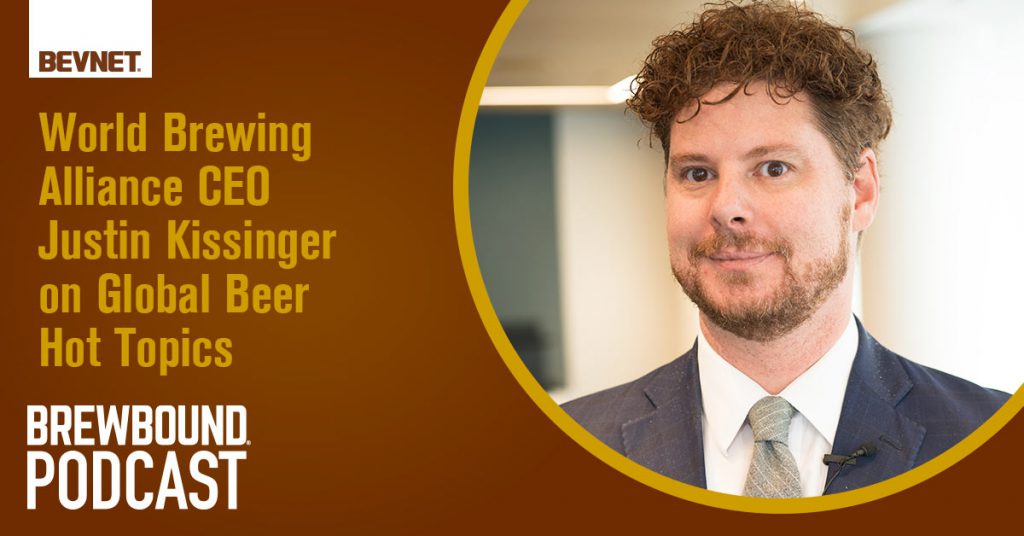
[00:00:00] Justin Kendall: Next on the Brewbound podcast, earning season is back and we have a monster impairment charge. Hello and welcome to the Brewbound podcast. I'm Justin Kendall.
[00:00:21] Jessica Infante: I'm Jessica Infante. And I'm Zoe Licata.
[00:00:24] Justin Kendall: And you all did an excellent job hosting this podcast while I was out.
[00:00:28] Jessica Infante: Yeah, we replaced our designated dude voice.
[00:00:34] Justin Kendall: Our designated dude voice. Designated or just a token dude voice?
[00:00:40] World Brewing: Yeah. I mean, Marty pointed out that he was really just another guy in a hat and a hoodie. Yeah.
[00:00:45] Justin Kendall: I mean, he fits right in.
[00:00:48] World Brewing: No, Marty's a great guest. Yeah. Should do that more often.
[00:00:52] Justin Kendall: I listened to your podcast while I was on my way back.
[00:00:56] World Brewing: From Turks and Caicos.
[00:00:57] Justin Kendall: From Turks and Caicos, yes. How was it? It was beautiful. This will shock you that I had never been to a tropical environment before.
[00:01:07] World Brewing: Really?
[00:01:07] Justin Kendall: Yeah. This was the first time.
[00:01:09] World Brewing: It's not that shocking because it's not like your favorite thing to do.
[00:01:12] Justin Kendall: Yeah. Somehow I'm like the only person to ever come back from Turks and Caicos without a tan.
[00:01:19] World Brewing: You don't really have a burn. I don't have a burn.
[00:01:23] Justin Kendall: I fully anticipated being burned, but I think it went well. I represented us at the Michigan Beer and Wine Wholesalers Association's meeting, gave a 40 minute talk. So I don't usually do these things.
[00:01:37] World Brewing: Your deck was great.
[00:01:40] Justin Kendall: Yeah, I tried to make it fun. As fun as it can be when you're telling people that we got a lot of struggles out here.
[00:01:46] World Brewing: I mean, I saw one hermit crab, one spirit Halloween.
[00:01:51] Justin Kendall: You did.
[00:01:52] World Brewing: I believe I saw an otter actually.
[00:01:54] Justin Kendall: You saw two otters.
[00:01:55] World Brewing: Two otters. Adorable. So yeah, not bad.
[00:01:59] Justin Kendall: Playing it up everything that we talk about here on this podcast. Love it. So this is going to be more of Jess and Zoe this week as they both have an interview with World Brewing Alliance President and CEO, Justin Kissinger. We promised this maybe a week or two ago. The time has finally come for this interview to go live.
[00:02:19] World Brewing: Yeah, we had a couple of schedule shuffles on our end. Apologies to Justin and the WBA crew, but it's a great conversation and I'm excited for you to finally hear it.
[00:02:27] Justin Kendall: It's the perfect time to do this, too, as apparently tariffs might happen this week.
[00:02:35] Jessica Infante: Yeah, as you're listening, they might already be in effect if they do happen, as Trump has said they're going to happen this week. But who knows at this point? But we did talk to Justin a little bit about the impact of everything that's going on in the U.S., how globally people are reacting to it. So definitely a timely conversation.
[00:02:55] Justin Kendall: Well, I think that is a good segue into how people are reacting to it because we each got an earnings call this week. And let's start with Boston Beer because there's a lot going on there.
[00:03:10] World Brewing: There is a lot going on there. So Boston Beer reported Q4 of 2024 and then full year 2024, as did all the other companies that reported this week. So these are big ones, but Boston Beer is, they say they're going to sharpen their execution and really focus and hone in and buckle down. They say that, and honestly, their plan for 2025, if you were to compare it to say a Boston Beer brand plan from 10 years ago, for sure, absolutely more dialed in and buckled down, fewer rotating products, fewer super complicated campaigns. They went through every brand by its product priority and then marketing efforts that they're doing. So that was kind of how I shaped the story. And Another was obviously no surprise, a ton of talk about Twisted Tea, a ton of talk about Suncruiser, which is their vodka-based hard tea, a little bit on Truly, a little bit on Sam Adams, and a little bit on Dogfish Head. Maybe a whisper of Hard Mountain Dew and Angry Orchard got mentioned once, maybe. So they've got big plans for this year. They're hoping to bring Suncruiser nationwide in the first half of the year. Suncruiser is obviously their challenger to Surfside, which definitely got the early shake on that. They are hoping to triple points of distribution on Suncruiser between now and the summer selling season. we'll see what happens. Zoe, you and I really looked at Suncruiser's Instagram profile the other day, and it really is such a lifetime brand. More though than a product, like there was barely... Because I was hunting to see when they had announced or debuted this new lemonade variety pack that's coming out. Because I was like, okay, it was probably on their Instagram. It's really not. Their Instagram is like beautiful lifestyle photography with mostly very attractive looking people.
[00:05:00] Jessica Infante: You know, they're definitely targeting Gen Z because it is a lot of young folks in different social environments holding on to Suncruiser cans with whatever this filter is that they've chosen for everything. Everything is a bit like blurred and sunny Shauna Golden.
[00:05:15] Justin Kendall: It's that California. Yeah.
[00:05:18] Jessica Infante: Yeah.
[00:05:19] Justin Kendall: It's like perma golden hour.
[00:05:20] World Brewing: Yeah. The thing that struck me was like, oh, these people all look so young. That's because now I'm old. So a really interesting point from the call, you don't really ever hear this happen, but CEO Michael Spillane and founder and chairman Jim Cook. had a little difference of opinion on whether or not Twisted Tea and Suncruiser are cannibalizing each other. And Michael said, no, we don't see that. And Jim said, well, frankly, we have to see something. So we'll see if that bears out. But Jim's reasoning is we might not know about it right now because they're very different products, premium price points, placed at different spots in the stores. So we're not really sure, but we think that's probably going to happen. Big step for Twisted Tea, they're really looking at both ends of the ABV spectrum. Twisted Tea Light, they're expecting to make a big push with. And then Twisted Tea Extreme, which is 8% ABV, also getting a lot of support this year. Twisted Tea Core, momentum is really starting to slow. But that's to be expected. You can't grow double digits forever, even though it seems like Twisted Tea was going to.
[00:06:22] Jessica Infante: I don't know if glad's the right word, but we finally have reached the point where we were like, when is Twisted Tea going to finally hit its max? And okay, now we're seeing kind of lower single digit growth versus they were pretty consistently putting up double digit numbers for a while there.
[00:06:40] World Brewing: Yeah. And a friend of the pod, Nadine Sarwat from Bernstein. Bernstein, thank you. Sometimes it's hard to keep all of them straight by their locations. There's a lot of them. But Nadine had asked like, what's really going on here because we're seeing declines in the scan data on Twisted Tea. And Jim, I'm just going to quote because the thing about Jim is that you really can never say any better than he says it himself. So I'm sure we'll do this a few more times in this conversation. But Jim said, past performance is not an indicator of future performance. We're basically saying that time period is over. And when he says that time period, he means the time in which Twisted Tea just grew forever and ever and ever.
[00:07:15] Jessica Infante: Yeah. I think it's also important to note that a lot of that growth too was them just expanding where Twisted Tea was available. They made a point of saying, you know, Twisted Tea is not everywhere. We have tons of markets where we could go a lot deeper. So that growth wasn't just, oh my gosh, suddenly tons more people are drinking Twisted Tea. They've found this brand. They were actually adding to the amount of places you could buy it.
[00:07:38] World Brewing: Yeah, exactly. I mean, Twisted Teeth, historically strong markets are places that you maybe wouldn't have expected. It's always states that start with M's, Maine, Michigan, Massachusetts, and they really, the brand, few can find this. in several different conversations. But when they launched the brand, they were thinking it was gonna go with the younger LDA women. And it really ended up somehow appealing to blue collar, middle-aged men. And that is 20 some odd years ago. And now they've really been able to evolve the brand to get it to where it is now, where it does appeal to like the younger LDA drinkers. And they've finally been able to crack the nut on markets like California and Texas. So that's really, I think what fueled tea's growth for the past, like call it a decade. And now they've kind of reached a critical mass of distribution And now they're in a new phase. So that's what's up with tea. Sam Adams is, number one priority is Sam Adams American Light. Jim had some interesting thoughts here, and I'm not sure that I agree, but...
[00:08:36] Justin Kendall: I don't think I agree either. That quote where he said, there's really no trade up from light beer. There's no high end light beer. How many other people have tried this at this point? And you've got Michelob Ultra dominating super premium.
[00:08:52] World Brewing: Yeah, Jim was saying that that Michelob Ultra is not too much of a trade up from Bud Light because they're priced pretty similarly. Jim went into ancient history and brought up Amstel Light and how Heineken de-prioritized it for Heineken Light, which was entirely de-prioritized. And then Heineken Silver came out and unsure what happened to that.
[00:09:10] Justin Kendall: Was he using hieroglyphics to talk about Amstel Light? Yeah, maybe he took out a scroll.
[00:09:17] World Brewing: So American Light's getting a big boost in Q1 with an on-premise campaign centered around March Madness.
[00:09:23] Jessica Infante: something I've worked on many years. if that is working or not, if the people who are drinking that, looking for that type of beer, are going to want to pay more because it's the Samuel Adams version.
[00:09:56] Justin Kendall: Yeah. With the amount of challengers in that space, and it's only growing, we see new light lager brands launch from craft breweries all the time. I just don't see it. But hey, Jim's a billionaire, so.
[00:10:11] World Brewing: Yeah, and he is extremely wise, which is why a couple of the analysts wanted to get his thoughts on what's up with Bev Alk right now. And Jim had a few things that he pointed to that might indicate that we may be in a different era. Because as you've heard Lester Jones say at a million conferences, the Americans' per capita consumption of alcohol is really extremely steady. It doesn't change much and it hasn't since prohibition. But Jim pointed out a few things. He brought up THC intoxicating hemp beverages as being a differentiating factor. I believe he called them a different animal just because the regulatory landscape here is so vast and varied and ranges from state to state. And in some states you can sell them. I believe he said in Minnesota you could buy them in a Toys R Us.
[00:10:59] Justin Kendall: That's the quote of this earnings season, is the Toys R Us. At least he picked a state in which there is actually a Toys R Us still open. Impressive.
[00:11:10] World Brewing: I mean, they're on their way back, I believe.
[00:11:13] Justin Kendall: Yeah. We don't have to get too far in it, but.
[00:11:15] World Brewing: No, but then he brought up health concerns, which like is just reaching people at a broader level than it ever has. And he also brought up GLP-1s.
[00:11:24] Justin Kendall: I've heard mixed things from distributors after my trip where they believe it's having an effect. We've heard different from CEOs such as Bill Newlands at Constellation. Varied opinions out there on those, but you can read both of Jess's earning stories on Boston Beer as well as her story on the Teamsters in Cincinnati filing an unfair labor practice complaint. against the company and so much more. But let's talk a little bit about Anheuser-Busch. And I think you described this to me, Zoe, as surprisingly all right or something like that?
[00:12:01] Jessica Infante: Surprisingly positive. Yeah. AB had a relatively strong Q4, at least compared to, you know, recent history for them, I should say, caveat that. For the U.S. business, the revenue was was actually positive. It was plus 0.8%, so just above flat versus Q4 2023. And, you know, they're saying a lot of that is as we expect from the growth of make a little ultra and Bush light. But during the earnings call, they pointed out, um, CO Michelle Dukaris pointed out the U S business for AB is really at this inflection point is what he called it. They've kind of gotten past dealing with the effects of the boycott from 2023. the dealing of switching up the priorities within their portfolio to account for that. Bud Light has taken a back burner to focusing on growing Michelob Ultra, Bush Light, some of their RTDs, and they've refocused how they're marketing Bud Light a ton. And so now they're like, okay, we've been through this recovery period. What's this next step? How are we going to go into continuing this momentum? given they're still not super great positive numbers there. I should caveat, just because it was positive in revenue, their shipments and depletions were pretty negative for the quarter. US shipments were down 3.9%, depletions down 5% for the full year. And so that could have been higher if Q4 wasn't as positive as it was. The rest of the year was not as great as that. So they're still figuring out how the US works. Also, we say this all the time, AB is not just a US business, they are a global business. The US is only about 20, I think it was like 22% of their total EBITDA. So they are more focused on a lot of other things in the international markets as well. Super Bowl was a hot topic, of course, because they were talking about all of their Super Bowl ads. And Michelle was saying, you know, we had great reception. We had a great, it seemed like an actual return on investment from our Super Bowl ads, pointing out that they had the number one and two brands on draft. That's according to beer board data. They also were able to grow the majority of their brand shares within both the on premise and the off premise, which is something they said they haven't done in a while. seemed to be like it was worth the investment worth, you know, not necessarily dominating the Super Bowl like they used to, but still having these select advertisements. So they were happy with that and they're continuing to have this focus on sporting related advertising across all of their brands. They've been doing this stuff with WWE and they've been doing stuff with the UFC as with all the championships we have coming up and World Cups and things. So they have a lot on their plate there. NBA, which they have done a lot with Michelob Ultra. they are really focused on that marketing and continuing to invest in that marketing. Nothing was said about the term American beer. Unfortunately, I was looking forward to maybe some comments there, but nothing on the U.S. CEO, Brendan Whitworth's push to rebrand domestic beer as American beer. But that has been also a part of that U.S. strategy a little bit. Also, we talked about the stuff going on with tariffs and everything. They did touch on it very briefly and said, you know, most of our business that's in the US is happening all internally. Their supply is inside of the US. Their production is like 99% within the US for the US market. So they are not super concerned about what is happening. They're monitoring tariffs and things, but it doesn't seem like they're going to have a huge impact. What I did find interesting that they said was Michelle called it the migration issue is how he categorized it. I can only infer he was talking about some of the things happening with ice, but he noted that there are certain regions where Hispanic consumers are getting impacted by some of these political issues, and that is impacting beer sales. So that might be something to monitor, is there is actually an impact on beer from some of these other political situations.
[00:16:17] Justin Kendall: We should chat real quick about Monster. I mentioned this at the top. Monster Beverage Company reported a $130.7 million impairment charge on its alcohol brands in Q4, and that's the bulk of the impairment that they took in 2024. Overall, it was $138.7 million. Largely they're pinning this on the financial performance of these brands and as we know they spent $330 million in cash to buy the Canarchy Craft Brewery Collective back in January 2022. That seems not that far away. And I mean, this is not anything new to anybody that's followed large-scale M&A in the craft brewing industry. We just saw this with Sapporo and Stone. Sapporo taking a $91 million impairment on that brand. I would argue that they still got bi-coastal brewing facilities and they're gonna be producing Sapporo in the U.S., and that's really been the main objective there. We all know too, the three of us talk about it, Monster's acquisition of CanArchie was to get the alcohol infrastructure to do things like The Beast and Nasty Beast and any offshoots of those brands.
[00:17:40] World Brewing: Yeah, and they were pretty upfront about it back then too. They were not so much interested in acquiring a family of craft brands.
[00:17:48] Justin Kendall: Yeah. Monster also reported a $4.1 million excess inventory charge on alcohol brands. So basically saying in the quarter, they had $4.1 million in excess inventory and $14.73 million for the full year. Net sales over the year, and they don't break these out. So I did the Justin Fonte thing where I got my notepad out and I started writing down their net sales from each quarter for the last two years. And this year, Monsters Alcohol sales topped $172.4 million, and that's down from $184.9 million in 2023. When I was doing the Jess and Fontaine math, well, I mean, I personally am concerned when I'm doing the Justin Kendall math. So, you know, if I've got something off here, I'll let y'all know. But there were some fat numbers that they were getting in the early days, you know, once they launched the Beast and all that. And of course, that's a lot of, you know, new selling in that we're seeing. And clearly, some things have fallen off in the years since.
[00:19:00] World Brewing: Yeah, I think products like The Beast, nay, The Beast Unleashed, and stuff like Hard Mountain Dew, to me, that's more of a, I tried it and I can say I tried it and I might not buy it again. I think those are kind of novelty products almost. I mean, I'm sure they have data that shows them why it was smart to make products like that, but their sophomore and beyond sales are not really bearing out the theory.
[00:19:27] Justin Kendall: The only thing I really want to touch on Elton Monster is that they've gotten through some leadership changes for their BevAlc division. They've appointed Ray LaRue as president. That was, you know, a quarter ago or so. They've restructured their senior management team. But the thing that stuck out to me was that Rodney Axe said, Monster will be implementing further adjustments in the coming months with the intent to optimize our personnel and facilities to support the current demands of our portfolio and innovation pipeline. I hate jargon like this, but that sounds super ominous given that Monster has already shuttered two facilities in Texas. They've turned the Cigar City Brewery into an R&D facility and it just does not have a good ring to what's to come. And they have proven that they are willing to make some major moves.
[00:20:27] World Brewing: Yeah. And we know they've let go of some people and we'll see. Foreboding.
[00:20:35] Justin Kendall: Well, before we get to our interview, let's do a quick another round of Tabbing Out. And something that came in on Friday, but apparently happened in December, and as you all know, we're really busy in December with Brewbound Live, so this may have fallen a little bit by the wayside, but SPB Hospitality sold off the Gordon Biersch, Rock Bottom, Denver Chop House, and Seven Bridges Brewpub restaurant concepts to Kelly Operations Group. And what came out on Friday was an announcement from Kelly that they are very excited to add domestic and import beer on tap, including Coors Light, Modelo, Michelob Ultra, and more. And also promoting things like $5 Wednesdays, where you can get a great midweek deal on White Claw, PBR Tallboys, and Select Shots. And I know it's hard out there for brewpubs, but I am so Tabbing Out on this because this is the antithesis of everything that was brewpub life. Am I wrong?
[00:21:45] World Brewing: No, you're not wrong. I found this a little alarming because we talk about this internally a lot. Brew pubs really created the environment to develop craft beer tap rooms to get to where they are. They introduced the general public to the idea of beer as an artisanal product and seeing where the beer gets made and the idea that beer isn't just something yellow fizzy you get in a can at the gas station. and that they're so willing to bring in all of these mass domestic products to me is, I think it's a first step to them not making beer anymore.
[00:22:23] SPEAKER_??: Yeah.
[00:22:24] Jessica Infante: I'm mixed on this because I feel like the issue here goes beyond just what's happening with like craft and brew pubs. I think the Gordon Beers and Rock Bottom and things have had a marketing problem for a while. And I feel like a lot of consumers, or at least like younger consumers, don't really know what they're supposed to be, don't know that these are like brew pubs or what they do. And so they expect them, they just see them as this kind of like chain on-premise establishment. And you expect them to have the things that you can get anywhere else, like any of these domestic offerings. And so I think a lot of those, they probably are seeing consumers coming in, wondering why they don't have them, and so they're going somewhere else. So to me, it made a lot of sense that of course these corporate companies essentially are going to bring on domestic beers. That totally makes sense. So I think, yeah, there's just was this weird issue where as they're trying to appeal to everyone, they kind of got rid of the messaging of what these brands were, what you're going to when you visit them. And so now they have to lean further into appealing to everyone.
[00:23:31] World Brewing: Yeah. I mean, there's only so many times you can hear somebody come in and say, like, I want a Coors Light. Well, we have this instead where you just decide, let's just give them the fucking Coors Light. But I mean, there's a rock bottom basically on campus. Zoe and I shared alma mater. I think I went once. Was it a thing for like the undergrads?
[00:23:47] Jessica Infante: It was kind of a thing, we just called it Robo, we're heading to Robo. But I can tell you most of the folks, if we were going there, were not getting beer. We were getting margarita pitchers or something like that. So it wasn't like, oh, we're going there because it's got a bunch of different beers we can try. It was, they have a lot of big screens and big tables and pretty affordable pitchers of spirits-based beverages.
[00:24:12] World Brewing: So this is a long time coming.
[00:24:13] Jessica Infante: Yeah, for sure.
[00:24:15] Justin Kendall: Yeah, I mean, I know the market realities and this is just...
[00:24:20] World Brewing: It's depressing. The thing that will be interesting, and I think the market is maybe at a different place now where it's not necessary, but if you go back 10, 20 years, a lot of people who became craft brewers at breweries got their start at brew pubs like this. Fortunately, there's like 10,000 breweries now. Just a few. Probably have some job openings.
[00:24:43] Justin Kendall: A few, yeah. And you can find out about those on our job board.
[00:24:46] World Brewing: Yes, you can. What a perfect plug. Yeah. Great job.
[00:24:49] Justin Kendall: Well, with that, let's get to Jess and Zoe's interview with Justin Kissinger from the World Brewing Alliance.
[00:24:58] World Brewing: Our guest today is Justin Kissinger, president and CEO of the World Brewing Alliance, which is a trade group advocating for the brewing industry at the global level. Justin, it's so good to see you. How are you doing?
[00:25:09] Justin Kissinger: Do well. It's been it's it's cold here in Washington, D.C., but other than that, you know, I'm looking forward to to beer season. We've got pitchers And Another coming back this month. That's always like my first inkling that the good weather, the good the good season is on its way. So just a deep breath now.
[00:25:27] World Brewing: So how do cherry blossoms align with that? Are they part of the harbingers of beer time?
[00:25:32] Justin Kissinger: Yeah, that's, I mean, it's all like a rollout, right? You get pitchers And Another. That's the beginning. That's like Florida and Arizona. And that reminds me that summer is on the way. And then we start to get the cherry blossoms depending on how warm it is in like March or early April. which is I guess the best month in Washington for like, other than the traffic and the tourism, it's fantastic, it's beautiful if you can find the right moment to sneak in without either of those two things dominating the scene.
[00:25:57] World Brewing: I have been, it was, I mean a long time ago now, but it was after like a really gnarly winter in Boston and I had gone down to DC to visit a girlfriend who was living there and like the cherry blossoms had popped and it was much warmer than where I lived and it was just a delightful weekend.
[00:26:13] Justin Kissinger: Let me give you a little secret for you and your listeners. There is a phenomenal cherry blossom display in Newark, New Jersey at Branchbrook Park. If not the largest, this is like the second largest collection of cherry blossoms in the country. And it's a beautiful park just outside of Washington, D.C. I grew up not far from there. And it is all of the beauty of Washington, D.C. with none of the attendant traffic and headaches.
[00:26:39] World Brewing: and not too far from the Newark Museum, which is a great take.
[00:26:42] Justin Kissinger: There you go. I'm from West Orange, which is... West Orange, oh, we're neighbors. I'm from Verona.
[00:26:47] World Brewing: Look at this.
[00:26:49] Justin Kissinger: I mean, it's the best state in the country. So, like, how could you not name check it?
[00:26:53] World Brewing: Exactly. So... All right, well, let's move on from the fact that New Jersey, my entire personality, despite not living there for 15 years.
[00:27:04] Justin Kissinger: It never leaves you. You never leave New Jersey.
[00:27:06] World Brewing: Never.
[00:27:06] Justin Kissinger: It doesn't matter how far you go. I was a Jersey booster when I lived in Europe, when I lived in Central America. It's the best place wherever I am.
[00:27:14] World Brewing: Well, thank you for spreading the good word.
[00:27:16] Justin Kissinger: You got it.
[00:27:17] World Brewing: So I love talking to you because you have such a higher level view of beer than we tend to. And we obviously have a higher level view of beer than most consumers in the U.S. because we can talk about the whole country, but you get to see the whole world. So what's something that employees in the U.S. beer business either don't know or don't realize about the industry worldwide?
[00:27:42] Justin Kissinger: The structure of the U.S. beer business is very different from what you see in a lot of different parts of the world. We have some benefits in the U.S. in terms of ease of getting product around, in terms of, you know, the distribution system provides a real platform for smaller brewers to get into places where they might have more difficulty in countries where you don't have the same distribution platform, which I know is not always how people think of the relationship between brewers and distributors and retail. But, you know, the independent tier does make it so that a lot of different players get to scale up, at least in some form or fashion in various regions. So the structure in the U.S. is really unique. In a lot of parts of the world, we see relationships at the retail level with like bars and restaurants between brewers and producers. We have a really dynamic, unique situation in the United States. We have a lot of freedom in terms of how we can communicate about our brands. in terms of the reach and the time, place, and manner of those communications. I've always thought of the U.S. beer industry as one of the most dynamic in the world, and certainly one where you see a lot of changes over time in terms of what brands are popular, how the industry has grown, a huge craft brewing sector, which is really the envy of a lot of different countries. And we see it growing in a lot of places similar to what happened in the U.S., but obviously on a big delay, that culture has really penetrated the rest of the world. Like in many aspects, the U.S. is a cultural leader on this and just a little bit iconoclastic relative to the rest of the world.
[00:29:21] Jessica Infante: Would you consider, then, when we're looking at some of these global trends, is a lot of folks looking at what's going to be happening next at the U.S. first, or is the U.S. looking anywhere to see what might be coming?
[00:29:32] Justin Kissinger: It's like a lot of things, right? We trade back and forth. I think the trend that we're going to see here in the U.S. relative to the rest of the world is the rise of non-alcoholic and low alcohol beer. We are very far behind in the U.S. in terms of the potential for that market. And a lot of that has to do with just the way that our businesses are structured and, you know, the history of the product in the United States, the way that it was marketed. I think we're starting to turn the corner. I think U.S. culture is like custom made for NA beer in particular to be a fantastic tool for consumers and an opportunity for them to make choices that keep them as beer drinkers, but help them have occasions in places or in ways where trickier to drink alcohol. We obviously have a big car culture. You know, this is a tool for like keeping people in bars and restaurants or getting them out to bars and restaurants where they can drink. But, you know, maintain themselves so that they can get back in the car and drive home or get up early and do whatever the thing is the next day. I think in the U S it's maybe a little bit more than 1% of the market at this stage of the game. You contrast that with like a Spain or a Germany where it's seven to 10% of the market, depending on the year, like there's huge running room there. And if you think about the cultures in places like Spain or Germany, you have a lot of people sitting in the, you know, in the on-premise having drinks at the beach or having drinks at the local pub or brewhouse. There's no reason that we can't continue to develop that in the U.S. and sort of post-COVID as we start really ramping up this push to get people back into hospitality, reinvigorate downtowns and nightlife, people are coming back to the office. I think this is one of those trends that's gonna continue to build and supported by demographics where it seems like the most likely people to go to those places and do those things. So younger drinkers in that 20 to 35 range are really going to start picking up those products and integrating them into the way that they drink.
[00:31:29] World Brewing: So you mentioned how the non-alcoholic segment has a much bigger toehold in countries like Spain and Germany. How long did it take that segment to develop?
[00:31:39] Justin Kissinger: I mean, a reasonably long time, the products were more early adopted and part of the drinking culture for a much longer time. I mean, decades in, in, in the case of Spain and Germany, I guess I don't, I couldn't give you like the start date for when the growth happened, but I've been in the business for 12 years now. They've always been the biggest markets for the product. Now they have grown incrementally from what they were when I started in the business. 10 years ago, Spain was at probably five to 7% and now it's closer to seven to 10 Germany, somewhere similar. They're growing quickly, even on their larger base of product, but you know, in a smaller country. So it takes time, you know, people have to change the way that they, they drink and let's not kid ourselves, right? Non-alcoholic beer. Didn't always have the greatest reputation in the United States in terms of its likeness and experience to. You know, regular strength beer that has fundamentally changed. I mean, the, the similarity between a non-alcoholic version of a branded product and the alcoholic version of a branded product. Pretty close to indistinguishable at this point in terms of taste profile. You have great products that are fully non-alcoholic from start to finish that are starting to hit the market. It's kind of a revolution in terms of innovation in the industry. I make the joke that there are brands that were produced in the late 70s that were basically the only brands for 30 years. And those early runs are probably still sitting dusty on a shelf somewhere in America, right? That's how popular they were. I think, you know, you look at Whole Foods, like the velocity of non-alcoholic beer is tops in the category in the, you know, at retail for them. Like those are trends that I couldn't have imagined. 10 years ago and now they're dominating the conversation and dominating how retail is planning about bringing people into the category. That is like a complete reversal in the way that the product is being merchandised and the way that buyers and consumers are thinking about it in their life.
[00:33:46] World Brewing: in countries, you know, in Europe, like the ones we're talking about, where there's a more developed NA scene, what are the players like? Here we have Athletic, which has, you know, they've got a few flagships, but they're big on innovation. They always have something new coming. They've got lots of different styles and flavors and different options for people to choose from. If I'm out in Europe and I want a non-alcohol beer, do I have a bunch of options or is it basically just all non-alcoholicers?
[00:34:11] Justin Kissinger: Yeah, I mean, more and more, you'll see it. I think athletic. Unlocked a lot of opportunity in Europe, right? I think that was a pure play that not a lot of people saw coming either in the United States or in, in Europe beer is such a game of scale in terms of getting to profitability, you know, credit to those guys. I think they saw the opportunity and they went for it with a great product. I suspect we will see similar initiatives in Europe. And my understanding is you're starting to have it. Those companies are starting to be born in different countries. The European scene is dominated by the same brands that dominate the American market. The split is probably pretty similar. Craft beer is becoming a bigger part of the mix in Europe and it's becoming a bigger Opportunity for innovation and experimentation things like that we will see i think a similar way of playing out maybe at a slightly different scale in europe versus the united states and that innovation is coming from all over the place but. You know, Heineken, Anheuser-Busch, InBev, Carlsberg, those are three big companies with big European footprints. Obviously, they have a lot of different styles of beer within their portfolios there. A lot of those, more and more of those have zero alcohol varieties. And those are starting to become like scaled across the continents and even beyond the continents into. the emerging markets like Africa or Latin America, Southeast Asia. They are all seeing this as an opportunity to give consumers more options, but also for incremental growth into new occasions or into expanding occasion. And, you know, those brands travel really well. The brand identity is really strong. People know what they're getting when they buy those products. So it'll be the same sort of top and bottom. push into the market and people will sort based on the styles that they like and the opportunity to try them.
[00:36:05] Jessica Infante: So NA beer has been a bit of a bright spot for the beer category in the US and otherwise there's been a lot of challenges and we're constantly talking on this podcast about what beer is up against, whether it's health guidelines or people drinking less or drinking other categories. But can you give us some insight on a more global scale of what some of the challenges beer is facing? Are they similar or are we seeing some different things in other places?
[00:36:31] Justin Kissinger: I think, you know, by and large it's similar. I guess it's, let's start here. It's really easy to get caught up in the latest quarter or the latest years data on this. And a lot of this stuff comes from surveys or it comes from polls. All of these things have like margins of error built into them at various scales. The beer industry has been super resilient. Um, for all of the talk about craft beer and the headwinds that it's saying, I mean, the number of breweries in the United States has stayed relatively stable over a fairly substantial period of time. So that's a tough business. And Another's a lot of churn within that stable number, I'm sure. But, you know, the desire for people to interact with the product and to crack open a cold beer at the appropriate moment is still there. So, you know, anything that I say about trends, like Let's recognize that these kind of go up and down within a certain margin. And, and I don't see anything at the moment that would be terrifying in terms of the long, the long-term prospects of the, of the product. That said, we're in a moment where there's been some headwinds. Certainly, we had data that showed slightly higher levels of consumption before and during COVID, and that those are coming down. Some of the data seems to show that the younger people are consuming less ethanol. But I look across the pond at Europe, where we've had fairly significant decreases of alcohol consumption over the last 10 years. You know, on the side of the portfolio that is alcoholic products, beer, wine, and spirits have lost more or less the same amount of share over that window. But beer has actually eked out volume growth because we've added a whole new part of the business to the business. That's filling a lot of those moments where people are swapping in a non-alcoholic product for an alcoholic product. You know, the bright spot for the industry globally is more emerging markets. So Latin America in Africa, Southeast Asia. I mean, these are countries where you have growing middle class. You have a huge opportunity to move people from. Like informal economies, country liquor or illicit products, uh, things that come, you know, that, that maybe have real serious health side effects or the potential for real serious outside effects and bringing people into the regulated formal market are all big opportunities for growth. And I think we see that in the industry. Um, and it's, it's, you know, it's not just the big companies that are moving in. In Kenya, there's a fairly robust group of craft brewers that are starting to emerge in Nigeria. We're seeing it. Brazil has their own association for craft brewers. You know, we see it in Argentina, South Africa, Southeast Asia, like Australia and New Zealand. Like there's a lot of places where you're starting to see the, the American model of the brewing And people are getting excited about it and starting to break in. Raw materials are more easily available. Argentina has become like a really big barley hub. We've been seeing the use of alternative grains in Africa. Carlsberg's done a big thing with Fonio that I'm sure you guys have caught, which is a fantastic product and super interesting because it's a really great tasting beer that like seemingly came from nowhere in terms of this African grain. The innovation in the industry doesn't just support the big players. We're seeing innovation all across the industry, and it's bringing new and different types of beer to different parts of the world. And I think that really starts to resonate. And, uh, and it creates new opportunities for experimentation. I'm excited for craft brewers to start showing off products made from sorghum or made from maize or made from Fonio. Because, uh, you know, at a certain point you've made the third or fourth double Imperial IPA that you're going to make. People are going to start getting interested in different ways of experimenting with the product and, and, and creating things. Beer is a story of innovation. It's a, it's a big industry. We did our, our economic impact study, put it out last week. You know, it's almost $900 billion of gross value added across the world. It's like one in every 100 jobs. It's a huge supporter of agricultural jobs, hospitality jobs, but it's also a super local business. So, you know, 86% of the economic activity from the beer industry stays in the country where the product is produced. You know, it takes time under those circumstances for things to jump borders and to jump cultures, but I'm confident that we're going to start seeing some of that. And I'm really excited for it. Like the next wave. of experimentation is like right over the horizon for some of this stuff.
[00:41:16] World Brewing: I'm so glad you brought up the study because I mean, that's part of what's, you know, our driver for having this conversation today. You partnered with Oxford Economics on it. And something that really struck me in the reading materials that accompanied it was that in countries with emerging economies, the beer industry is able to boost jobs and GDP contribution by over 20% on both of those factors. So what do you think is driving that?
[00:41:40] Justin Kissinger: So I mentioned formalization earlier, and I think it's related to this phenomenon. When you think of an emerging market, right, one of the things that we know about societies all across the world over history is that there's some level of alcohol consumption. basically everywhere. And when the brewing sector makes a commitment to a new market and you move in, you move in and the first thing that you have to do is you have to build a fairly substantial manufacturing facility, right? Beer is a game of scale. We sell them six at a time or 12 at a time or 24 at a time. It's relatively low margin. It's relatively high cost to produce. Like you gotta make a lot of it in order to make it a viable business. Then you need to distribute it and you need to distribute it on roads with electricity and access to cold storage and with trucks that can get to where you need them to go without running through potholes or falling into ditches or whatever. So the infrastructure investment that makes a brewery possible is fairly substantial. The areas that we touch on are areas that contribute to lots of sectors of the economy. So, you know, we're a boost to agriculture because we're an offtake for a whole bunch of crops. And as we move into more like local crops, I mentioned Fonio or sorghum, like there's more opportunity to engage the local agricultural system. Well, then you get the crops, you need to be able to malt them, right. And turn them into useful ingredients for beer. That's a whole step in the process that needs to be developed if it isn't already there. All of those things need to be transported from one place to another. That's when you get to the factory that we've already built. Then you make delicious beer, you pack it up into bottles and cans, you put it on a truck, you got to drive it in cold to the place where it's going to be sold. Not even the place where it's going to be consumed, the place where it's going to be sold. Right. That's a whole retail distribution chain that needs to happen. And, you know, those folks are adding the profits of beer to the profits of, you know, whatever else it is that they're selling in their shop or the food that they're selling in their restaurant, you know, and then you finally get to the consumer at that point. So during all of these elements, you have a lot of value that's being added incrementally by the sector. And all of these different elements of the business touch different parts of the economy. Cold storage is great for brewers, but if you want to ship soda or you want to ship pharmaceuticals or you want to ship food, all of those things require similar cold storage. So our presence in the market defrays the cost for other players, but is also additive to the total profit pool that they're participating in. Same thing for agriculture. If you're growing one crop and you have space and you can add cereals that are useful World Brewing. That's incremental revenue that you can bring in the trucks that get the barley or the sorghum or whatever it might be from agriculture to the man, like that carries all the crops. It's not just beer crops that are going to monsters. It's food crops that are going to market or going to other processors to turn it into. To food. So you see this really wonderful additive nature of the business and we slot into all of these other areas and that's got a huge multiplier effect. And then you look out for the longer tail. All of the people that are coming into the business are learning how to manage complexity because you can't sell beer through one retail outlet. You need hundreds of them or thousands of them. So when you start as a salesperson for a brewing company, you have to figure out, okay, not only how am I going to manage my route, but like, there's someone working with you. Who's going to get the product to those places when you say you're going to get there. As you're adding that complexity, you're adding to the amount of value those people spin out into other industries over time. And it's this really wonderful self-reinforcing process that beer can catalyze in these types of markets. We don't always think about it like that, right? It's really easy to look at the product in the bottle and think that it just pops up out of the ground out of magic. It's this incredibly complex chain of value with all sorts of different people involved in it at all different levels of the economy. And they're building things that sustain other leaps forward in the development of wherever it is we're doing business. We are like a, a base level, really excellent contributor to national economies.
[00:46:03] Jessica Infante: It's definitely easy to forget about it when we're used to beer in the US for so long now. We're not seeing some of that developmental stage of it as much in the economies anymore. But like you mentioned Fonio, just seeing the one aspect of having a crop come from one area. We talked a lot to Garrett Oliver from Brooklyn Brewery, who's been a huge advocate for Fonio. Communities in Africa that are growing this fonio are seeing so much economic growth because they are able to now supply so many breweries across the world at this point now with this crop and have this whole new economic system because of it. And the added benefit of it's created this really cool beer and people are starting to just experiment with it now. It's been really fascinating to see.
[00:46:50] Justin Kissinger: It's like magic, right? I mean, this is a thing that I had never even heard of. And now it's making this delicious beer that I get to try and to tell my friends about. I can only imagine that for the people who grow it, it must actually feel like magic. Like this whole market that I didn't even know existed. is now a huge opportunity for me. And not just to push it in, but they're like pulling it out of the place to try and get more of it and to do more experimentation. So we can do that with lots of different cereal crops when we apply the innovative mindset of the brewer to the product.
[00:47:27] World Brewing: So we've covered Fonio. In terms of hops, where are like new up and coming hop growth regions that maybe we don't know about? Like, obviously I know about Australia and New Zealand, but anywhere else in the Southern Hemisphere?
[00:47:38] Justin Kissinger: I think we could see it in Argentina. I mean, some of the colder climates, right? We don't think of the, I mean, at least for me, right? I'm such a North American. Even having lived in Central America, you often think of anything South of you as hot. But when you get to the other side of the equator, I mean, you get really nice, territory for hops and colder weather crops. There's tons of innovation being done on hop varieties as well to make them more sort of small as sustainable, more resilient to different climatological patterns, different weather patterns. The farmers who deal with that crop do pretty amazing things. We've seen what they can do with taste profiles over the last 20, 30 years. I think what you're going to see is that we will get more innovation into hop varieties that can be grown in more places so that maybe it's not just the like Northern North America, Canada, Scandinavia belt. but you start to see it in Argentina, in Australia, maybe even southern parts of Africa in the highlands. I think you'll see those products come online as demand for them increases and we're dealing with different weather patterns that we have to adapt to.
[00:48:52] World Brewing: Justin, unrelated to beer, how many continents have you been to?
[00:48:57] Justin Kissinger: I have been to... All of them except Australia, and I don't know if my Australian member is listening to this, but I'm sorry, John, and I know I owe you one.
[00:49:07] World Brewing: John, invite him down.
[00:49:08] Justin Kissinger: It's not from lack of invitations. It's really, you have no idea how shockingly far away Australia is.
[00:49:14] Jessica Infante: It's real. It's real far. Really far. Yeah. I'd spent a few weeks in New Zealand a few years ago, and that was like, I think our total travel time was probably 19 hours.
[00:49:26] Justin Kissinger: That's actually pretty good. You don't realize that like Australia feels really far away. And then it's an eight hour flight from Australia to New Zealand. I work quite a bit with our Australian and New Zealand groups. Like that's a, that's a dream trip for, for me and, uh, and something I got to make happen, but I've, I've been to all of them at this, at this point, at least in Antarctica. I guess that one, no, but there's not a lot of beer in Antarctica. Although now that we've said it, I'm waiting for someone to like jump on one of the cruise ships and collect Antarctic water for a specialty run. I'm sure we'll see that in a supermarket near you someday.
[00:50:03] World Brewing: Oh, definitely. If you need a press companion for that trip. Arctic brew.
[00:50:06] Justin Kissinger: I think for the coldest I've been, Alaskan brewery is probably the most inconvenient brewery I've been to, at least relative to where I live.
[00:50:14] World Brewing: It's my dream to meet an emperor penguin. So if you, uh, if you're ever going to Antarctica for beer purposes.
[00:50:21] Justin Kissinger: I know that there are cruises down to Antarctica. My, my father-in-law did one. And, uh, it's apparently quite the experience. You like go down through Argentina and out to, uh, out to Antarctica on an ice breaking ship. It sounds very intense.
[00:50:36] World Brewing: Very intense. Well, so sorry for this tangent, but let's get back to beer. Something that has been dominating headlines in our lives for a couple of months now has been the dietary guidelines process. And I know something that has been informing a lot of people's thinking about this is that the World Health Organization in last year or the year before, they put out language that there's no safe level of alcohol consumption. And that pronouncement here could have a lot of implications, but what's at stake if the U.S. adopts that thinking?
[00:51:10] Justin Kissinger: Well, let's say it this way. I think that for anyone who's wondering about the relationship between alcohol and your health, it's very personal, right? The first conversation to make sense of all of the information that's out there is with your doctor or your health professional. We all have our own unique health situation and alcohol can impact that. And you should be aware of what your individualized risks are. The dietary guidelines are gonna pull together a bunch of information that has been developed by the United States government. And they're gonna notionally take a pretty broad look for new science since the last time they put out the guidelines. So what does that mean? Well, in 2023, the US Congress asked the National Academy of Sciences to answer a series of questions for Congress specifically to inform the dietary guidelines process. And that report came out in December. It's an independent report pulled together by the National Academy of Sciences with public input on the panel that was reviewing it. And I won't bore everyone. One, I'm not a scientist, but two, I'm sure no one wants a scientific lecture on your podcast. They might, though. At the end of the day, what they confirmed was what we thought we knew about the risk distribution of alcohol appears to be the case, that there is a J-shaped curve In terms of the health outcomes associated with the consumption of alcohol, but put more succinctly, people who drink moderately tend to have better lifetime health outcomes than people who drink too much and those who don't drink at all. And drinking too much is slightly amorphous, but it's somewhere between two and three drinks a day for men or two and four drinks a day for men. and one in three drinks a day for women. And the National Academy of Sciences appears to have confirmed that And Another that there's no new science that would disprove that. We know that there hasn't been a change in the science. So anything that goes to something like no safe level is really a statement of risk and how people view risks associated with things. And I think that for a very long time, it's been understood that You know, most things have some level of risk attached to them, right? Putting on sunscreen, putting, uh, things like red meat, uh, there's conversations around processed foods. Like there's nothing, there's no free lunch in terms of risk. And the dietary guidelines are designed to put that risk in context for consumers. I think that the odds-on outcome is that we see a similar run in terms of what the recommendations are, but there's a lot of uncertainty in the process. There's a whole new administration coming in, a whole new regime in Health and Human Services and the U.S. Department of Agriculture, which run the process. And we'll see where they land. This is a conversation that's ongoing. It's obviously of intense interest to people in the industry. But I think we need to see where they land. And heading into it, the most authoritative look on the science seems to be suggesting that not much has changed in our understanding of those risks and where they lie and how they're distributed. But it's for the US government to make those final determinations. And we'll see where they land.
[00:54:36] Jessica Infante: Do you have any gauge based on what you're hearing of when we might get the latest updates on new guidelines or anything here?
[00:54:44] Justin Kissinger: I think that it is foolhardy to predict timing with this administration at this stage of the game. They are typically slightly delayed, particularly when there's a change in administration and you're getting new bodies in seats and rolling out new political appointees oftentimes. that will change the timing of these things. Expect to see them towards the end of 2025, if they don't slip into early next year. There's no like date that they are scheduled for, so we'll sort of see and we'll start to hear rumblings that they're moving forward on it. I would be surprised if they have started the work. at this stage of the game. We just finished sort of the pulling together of the evidentiary background, and that's not just alcohol, right? That's all the things. These guidelines deal with much broader, more significant issues around food and food consumption than lower stringing guidelines. So it's quite the process that they have to go through in order to get to the end.
[00:55:49] World Brewing: So when this episode airs, we will be about a month in on this new administration. Generally, they are very hard to predict anything, but what should your industry members be keeping in mind with regard to having a new team in charge in Washington? How is this going to affect their lives?
[00:56:08] Justin Kissinger: I'll give you the unsatisfying answer. I'm not totally sure just yet. I mean, there are some macroeconomic issues that are obviously percolating that are going to affect brewers, but really whole sections of the economy in, in different ways. It's, I think too early to tell how they would affect individual industries in particular. You know, we saw. tariffs on aluminum and steel. Obviously, we use a lot of aluminum in cans in the country, but that's not a beer issue, right? That's a can issue. And Another's like a huge cohort of industries that leverage cans as part of their packaging or their building, right? Cars, airplanes, all of these things go very far beyond just the beer industry. So we will get folded in with a lot of those macroeconomic effects for better or for worse. And it's really about, I think, paying attention to what is actually happening and what the policies actually say, rather than getting spun up over speculation over what they might be or might say in the future. I tend to approach government action as As you know, there's a political component to it And Another's a policy component to it. And when you're trying to figure out what business impacts are, the policy component is really the thing that that matters. And that's usually the part that's buried in the details and not in the in the first run of the press release. So when you see the breathless coverage of various things in the media, and I say this with love, Jess and Zoe, take some time to see how it's going to going to really unfold and and what the particulars might be to the beer industry, rather than jumping to, to a conclusion that this is, you know, the greatest thing ever or the worst thing ever. It's almost always somewhere in between. We have incredibly resilient businesses in general. They're super local. There's a lot of, uh, innovation, not just in terms of the product, but in terms of like the business acumen of people in the industry. Um, I have a lot of faith that beer is resilient and adaptable to whatever. those macroeconomic moves might be in long-term. I'm not particularly worried about the industry and its ability to thrive over the medium and long-term. We got a lot of really smart people who are in the brewing industry at all different levels. A lot. And I think American drinkers can have faith that they'll make sure that there's delicious beer available to them at a fair price, whatever the circumstance.
[00:58:44] World Brewing: Perfect. Well, as we've discussed, you've been literally all over the place. I want to end this on a fun note. What is one of your favorite beer moment memories from all of your travels?
[00:58:58] Justin Kissinger: So I have one that's like etched into my soul. My wife is from an island in Honduras. There is a local beer called Salva Vida. My happy place is sitting on a hammock on the beach where she grew up drinking a Salva Vida, listening to the waves and some, I'll date myself here, but some Jimmy Buffet. which is a classic American in the Caribbean soundtrack. But I mean, just talking to you about it, I can hear the sound of the wind. I can hear the waves. I can feel the breeze blowing over me and see the palm trees waving. That is my ultimate beer memory. Another one is I love baseball. I have an eight-year-old son. Cold beer at a Yankee game is about as good as it gets in terms of a father-son moment and something that I look forward to like 100% of the time. From the coldest March early season day to a cold September or God-willing October day, beer at baseball is about as good as a beer moment gets in my mind. How about for you guys? You gotta share back now.
[01:00:08] Jessica Infante: I mean, I love a beer at a Red Sox game at Fenway.
[01:00:13] Justin Kissinger: Right, you're Boston. Walked into that one.
[01:00:19] Jessica Infante: Or at home watching Aaron Judge totally crap the bed, but I'm serious.
[01:00:26] West African: Well deserved, Zoey. Well deserved.
[01:00:29] Jessica Infante: Seriously, I mean the beach image is beautiful and I just spent a week last summer in the Bahamas with my family on like a very remote little island and we drank a lot of clicks and it was The, it was kind of a bonding moment with me and like my dad and my boyfriend too of just start trying some of the different ones and collecting them on the beach. And it was, it was a great time. Like that is gonna be, those beers are going to be a part of that, that trip and that memory forever.
[01:01:05] Justin Kissinger: Someday you'll find them in a supermarket or at some little spot where you'd never expect them, and it'll transport you back to that moment. That's the coolest part of it. How about you, Jeff?
[01:01:15] World Brewing: Well, you mentioned various New York sporting venues, and Zoe, I'm so sorry to do this to you, but it has nothing to do with actual sports. But my dad and I went to see Bruce Springsteen and the E Street Band on the very last night of the Rising Tour at the old Shea Stadium. And I won't tell you how old I was, but I will tell, we'll let you know that it was a very big deal that he bought a beer for us to share.
[01:01:37] Justin Kissinger: And we shared, I want- So really 21 then, right? Totally. Because you were both getting used to the idea of you being able to drink.
[01:01:44] World Brewing: Exactly, exactly.
[01:01:45] Justin Kissinger: I want to say it was a Heineken.
[01:01:47] World Brewing: And we shared a Heineken and a wax paper cup and a pizza. And we just like had the best time. And I think about that day a lot.
[01:01:58] Justin Kissinger: That's great. That's a, I love that. That's my favorite part of being in the business is like, I hear those stories all the time, right? The. Everywhere you go and you can introduce people to a new product, like you bring over a six pack And Another's always a story behind it. It's like the best part of bringing something over is, oh, I brought this so you could try it because I had it when, or I had it with, and that's the magic of the, of the industry to me is that it's the first step in a great story. And I just, I really love that. I get to, I am privileged to get to hear those great stories from like all sorts of different national contexts and from different places. But it is the universal part of the industry, right? It's a global industry, but a local business. And the localness of it imbues it with this magic that is really special. And, you know, I mean, I drink soda, I drink soft drinks. you don't really go somewhere and talk about the fantastic soda that you had that one time. But everyone wants to hear about your great beer moments and where they were and what you were having and what made it special and what made it different. And it's a story in a box or in a six pack. And I just, I love that. It's made for sharing and you can go anywhere in the world, sit down at the local pub and be a local for an hour. And that's a really special thing.
[01:03:24] World Brewing: That's beautiful. Well, perfect place to leave it. Thank you so much for being with us, Justin. I always love our chats, so always great to touch base. Hopefully we'll see you somewhere soon on the road. Zoe, thank you for joining me on this audio adventure. And of course, thank you as always to the wonderful Brewbound BevNET technical crew who makes all of this possible. If you enjoyed this podcast, please like, rate, and review our show on any platform that you choose. It really helps boost the show and you know, get it into more people's feeds. And we will see you next week with a fresh episode.