[00:00:00] Jessica Infante: Heading to CBC? Kick things off the day before at Brewbound's meetup at Love City Brewing in Philly, Sunday, April 19th from 5 to 7 p.m. Connect with beer industry leaders, grab a drink, and catch up with the Brewbound team. It's free to attend and walking distance from the convention center. Head to Brewbound.com slash lovecity.rsvp. And don't forget to catch the Brewbound team at booth 956 during CBC.
[00:00:28] Zoe Licata: How much alcohol should you be having for breakfast? We're going to talk about it on the Brewbound Podcast. Welcome back to the Brewbound Podcast. I'm one of your co-hosts, Jessica Infante.
[00:00:50] Christopher Shepard: And I'm your other co-host, Zoe Licata.
[00:00:52] Zoe Licata: Zoe, how are you doing?
[00:00:54] Christopher Shepard: I'm doing all right. Harry Styles is kind of giving us fans a little bit of a heart attack right now, and I'm a little on edge about that, but there are rumblings. There are internet rumblings and in-person rumblings with mysterious posters suggesting a return. This has nothing to do with this podcast, but I feel like I had to share. It's on my mind.
[00:01:15] Dietary Guidelines: It matters to you, and so it matters to me. Thank you. Wait, a return to...
[00:01:20] Christopher Shepard: We don't know the return to music somehow. We don't know what it's like. There is rumors that he has a residency already lined up again at MSG. We don't know if that means new music, if he's going to pull one of these things that a lot of folks are doing right now, which is like a, let's go through all the music I've done the past however many years thing. It has us on edge. Interesting. Like, did he say he was retiring from music? No, he's just been gone for so long. Didn't you go see him like a year ago? It was like three years ago.
[00:01:50] SPEAKER_??: What?
[00:01:51] Zoe Licata: I know, right? No, it wasn't.
[00:01:52] Christopher Shepard: Yes.
[00:01:54] Zoe Licata: Well, so you heard it here first. Something's happening with Harry Styles. We hope all is all right with him. So that's a lot happening in beer. There's a lot happening in beer. I did want to ask you something. Have you been watching the Traders? No.
[00:02:08] Christopher Shepard: That's like one of the few Peacock Bravo things that I haven't quite jumped on yet.
[00:02:13] Zoe Licata: So we're on season four, three episodes just dropped, and the actor, if he still acts, Michael Rapaport, to me he's like Phoebe's ex-boyfriend from like two episodes of Friends.
[00:02:28] Christopher Shepard: Just an awful human being.
[00:02:30] Zoe Licata: Yeah, well, so he's on the show. He's in the castle. If you don't watch The Traitors, you really should. It's phenomenal television. Takes place at a castle in the Scottish Highlands, supposedly owned by Alan Cumming, who is the host, and he's Just a delight. And I bring all this up because the energy that Michael Rapaport is bringing as a very big fan of the show, but also a big fan of Bravo and Housewives. He's there, he's playing, he's very bad at it. It's like watching when homebrewers try to talk to professional brewers and act like they're the same. This is the thought I've had during all of these episodes. Because I've seen that interaction happen a lot and it's real awkward. all involved. I think that's a very fair analogy.
[00:03:13] Christopher Shepard: Right? Yeah. Have all this knowledge about what they do, but not quite at the level where you can really say you're, you're the same. Yeah, exactly. Not the same. Lots of enthusiasm, for sure. But he's very bad at the game. And well, apparently he's also debating running for mayor in New York in some amount of years, so. Sure.
[00:03:39] Zoe Licata: Gary, Phoebe's cop ex-boyfriend. I remember. Anyway, let's get to some beer. How about that? That's your pop culture update for today. Pop culture update. This is probably the last episode you will hear with just the two of us. Justin is planning on returning from parental leave next week. Sounds like the report's coming out of Iowa. Is that all is good with the fam? Sophie's adjusting to being a big sis, baby Daphne settling in, and we miss him, but we're glad he's taking this time. It's very important to do. Big news happened this morning.
[00:04:14] Christopher Shepard: So how did our day start? I was making my coffee and I realized I have a voice memo from Jessica and Vontae sharing that we have some big distributor news coming towards us. And that is that Ray's is in talks, or their words specifically were in active discussions with RNDC, which is Republic National Distributing Company, to acquire their business in seven different markets. So six states plus Washington, DC. Which is pretty big news. Huge news. Yeah.
[00:04:49] Zoe Licata: Voice memos are like my love language. They're like my favorite thing.
[00:04:53] Christopher Shepard: They're great. You can get out everything you need in a quick manner.
[00:04:56] Zoe Licata: And yeah, efficient. I like them. Right. And you know, more tone than a text message anyway. So yeah, I told you this is happening. We got to go. And we went and you did an awesome job knocking it all out of the park. But if you've been following along the story of RNDC for the past year, this shouldn't surprise you. RNDC was one of the country's largest wine and spirits distributors, but there started to be some holes in the armor. And in California in particular, they lost a lot of major suppliers, huge spirits brands like Tito's. And in many cases, the spirits that left RNDC were going to the Reyes Beverage Group. So that all kind of reached a boiling point earlier in the summer, May, June-ish, and RNDC announced they would be pulling out of California entirely, which is enormous. That just doesn't happen. That's the biggest spirits market in the country. So they left in September. And this latest news, it just makes sense. And what we're being told is that this deal is not just for the brands, it's for everything. It's for their facilities, their trucks, the brands too, employees. These R&DC operations in those markets will be going to the Reyes Beverage Group, if all goes according to plan, which would be big.
[00:06:14] Christopher Shepard: Yeah. And those markets include Florida, Hawaii, Illinois, Maryland, South Carolina, Virginia, and DC. So those are all places that Reyes currently has operations in. It's suggested through some memo that has been going around on Reddit, so that has not been confirmed by Reyes yet. But allegedly, there's this internal memo went out saying that this business that they'll pick up in these states will be operated separately from Reyes's existing operations. So we'll see what that looks like. There's also still things that need to happen for this to actually officially go through. So it's not finalized yet. There still has to be a few steps before we get there.
[00:06:54] Zoe Licata: Yeah. And these are all existing Reyes markets I think is interesting to me because for a while Reyes was adding one or two new markets a year and that has really stopped for the last couple of years. So interesting to see that they do still want to grow but within the footprint that they have. And once this deal goes through, if it does go through, RNDC is not going to be tiny. They'll still be in like 31 states. There's nothing to sneeze at. I know everybody kind of is breathlessly reporting like the death of RNDC, but that's not quite it. Yeah.
[00:07:24] Christopher Shepard: I think what the bigger news here is that it's Ray has really becoming this bigger total beverage distributor. They have added so many spirits companies through these various moves since RNDC has lost some folks. So they are really going way beyond just beer these days.
[00:07:45] Zoe Licata: Yeah, exactly. We will keep an eye on this and continue reporting news as it happens.
[00:07:51] Beer Marketer: This episode is brought to you by the Craft Brewers Conference, where big ideas, bold beers, and brutally honest shop talk collide. Join thousands of industry pros leveling up their game. Don't miss it. Register now at craftbrewersconference.com.
[00:08:11] Zoe Licata: You also had the scoop on another big story last week, another acquisition in the cider world. What happened in the Pac Northwest?
[00:08:18] Christopher Shepard: Yeah, our kind of like first official deal of 2026, I guess, is coming from cider, which is fun. Two Towns Ciderhouse House out of Oregon is going to acquire the Seattle Cider brand. So this is one of the largest cideries in the country acquiring another pretty large cider brand. The deal is not yet finalized, but this would be moving all of the production of Seattle Cider to Two Towns facility in Corvallis, Oregon. It would also result, we learned a few days after the initial news dropped, that Seattle's own operations, their tap room and their production facility in Seattle will close. So, really just bringing on that brand, making sure that brand stays alive. Seattle's numbers aren't really that bad. It doesn't seem like this was a situation where like, we've seen a couple of times with brands, you're picking up something that you're just trying to make it live on in some way, shape or form. This seemed like it was more of, to be financially responsible, Seattle had to change something in two towns and picked them up.
[00:09:26] Zoe Licata: Yeah. Interesting story. I mean, Seattle itself was acquired a few years after it was founded by Agriol, a French agricultural company acquired it from its founder. And did Agriol also acquire Two Beers? Yep. Yeah. So the founder of Seattle founded Seattle Cider and also Two Beers Brewing. Two Beers might've been first. And Two Beers did announce it was shutting down a year or two ago.
[00:09:52] Christopher Shepard: At the time of that deal, Agriol had said, you know, we want to make Seattle Cider this big national brand. And that didn't really come to fruition. They had some legal issues too, not long after this deal, where they filed a lawsuit against one of the founders saying that they kind of inflated numbers. So didn't pan out how anyone expected in that situation.
[00:10:17] Zoe Licata: I feel you have a better grasp on cider than I do. Is being a nationally distributed craft cider brand a thing? Is that the goal of say like a Two Towns or a Schilling or Blake's? I feel like these guys are all doing really well as regionals and big regionals, but is there appetite for coast to coast expansion?
[00:10:39] Christopher Shepard: Yes and no, and much slower than I think you would have seen in the past. I think it's very similar to Kraft where there are just a handful of the much larger, quote unquote, regional Kraft cider folks. And they have been eyeing new markets, but they're making sure they're going very deep in the markets they're in first, and then potentially expanding into some other core areas. So you do see a lot of these folks have you know, an East Coast representation, some Central US representation and West Coast. So they want to be in all these areas, but they're not necessarily having a full national map. And then again, that's just a handful of folks. There are so many, just like Kraft, so many more. The majority of these businesses are very super regionally focused.
[00:11:24] Zoe Licata: Got it. And we're less than a month out, just a couple of weeks really from CyderCon 2026.
[00:11:28] Christopher Shepard: Yeah, headed down to Providence, Rhode Island in a few weeks to catch up with folks. It's going to be really interesting because Cider's in a spot where we've had a bunch of different news items break involving Cider recently when it comes to these sorts of deals, expansion, some legal troubles. So we're curious to see what the vibe of everyone is like and the environment of everyone is like at that. And cider has been one of the very few super positive segments when it comes to just looking at beer data. So we'll see how people are hoping to take advantage of that or what is really causing that. I know some of that is due to a bounce back of Angry Orchard from Boston Beer, so it's not entirely a regional cider thing. But I feel like the energy will be quite buzzy at this year's event.
[00:12:15] Dietary Guidelines: Awesome. I can't wait to... Shit, maybe I'll come. Yeah. It's just like a 45-minute train ride.
[00:12:22] Zoe Licata: 30 minutes to Boston and then, you know. But yeah, I can't wait to hear more. Other news that we have been keeping an eye on this week, so much data. Data, data, what do you say? I always say data. You say data? I say data. There's been a lot of it. And, you know, you covered this week's Circana Weekly Report in which Scott Scanlon, who publishes these week in and week out, I felt as though Scott was excited and happy for the first time in a while, right?
[00:12:54] Christopher Shepard: Yes. Whenever his subject line has an exclamation point, you know, he's really, really happy with the results. Yeah. And for a valid reason, it was pretty positive to kick off the first scans of 2026. So there should be the added context that these numbers do include, you know, New Year's and that kind of end of the year holiday celebration. So that could also be having an impact on things. But total bed valk was up five and a half percent for dollar sales and volume was up 2.2% through January 4th. So again, this is just one week data. So take with that what you will. But nice to start off the year with some positive results. Right? It's something. Yeah. And all three major bed valk categories were also up. So that is not something we have seen too often in the past year. Good for wine.
[00:13:50] Zoe Licata: Yeah. Wine did really well. In any conversation I have with, I don't know, I feel like there's always like the, well, at least we're not wine vibe. So you know what? Wine, welcome. Welcome to the party. I guess. It's not all sunshine and roses over here in beer, but...
[00:14:10] Christopher Shepard: It's fun sometimes.
[00:14:11] Zoe Licata: Sometimes.
[00:14:12] Christopher Shepard: Yeah. Should note too that like these sales were down week over week for total bivalve down double digits actually, but take that with a grain of salt. Yeah. It's because Christmas happened the week before. Those sales are always significantly larger.
[00:14:27] Zoe Licata: So many things to celebrate. Yeah. So you covered that. I covered Circana's last monthly report of 2025, which covered data through data. Sorry, this is- Now you're going to be in your head about it. I am totally in my head about it. Covered the numbers through December 28th. So this is as good as it's going to get for us in terms of full year picture. And I went really deep on the top 30 craft brands. And I think there's some positive news. There were five brands with negative year-to-date sales. So, you know, dollars were down in the dumps for, you know, the year. But in the last four weeks, so basically for the month of December, they actually turned positive. which is a turnaround you don't see too often. And good for those brands. They include Line and Kugel Shandy, Lagunitas IPA, Voodoo Ranger Fruit Force, the Sam Adams Variety Pack. The Sam Adams Variety Pack, did we talk about this last month? Because this is the second time in a row I've noticed this. Went from being down, year-to-date dollar sales are down 1.9%, which isn't too bad, volume down 3.4%. But in the last four months, turned to up 37.4% in dollars and 34.2% in volume. That's nuts. But again, this is a pack that changes throughout the year, it's seasonal. And the variety pack that should have been available during this period should include Old Fezzywig, which is really what Sam Adams should be leading with as its lead winter seasonal, I say as a person who loves that beer very, very much. Free advice. Maybe that's why the people were buying the pack. I don't know. And, you know, the last brand on this list of was negative turned positive in four weeks also cracked the top 30 Circana brands list of craft for, I think the first time this month was a Sierra Nevada seasonal, which is celebration. So the people are loving them. Some seasonal beers in December is what I have taken away here. Love it. We also saw of the brands that are positive throughout the whole year, six of them recorded accelerating sales throughout December. So December got better for them. December was just better for Kraft pretty much all the way around. Kraft was still in decline in like Mulo Plus C, which is the multi outlet grocery mass retail convenience stores. It's basically everything that Circon attracts. Kraft was down 3.6% in dollars and 4.7% in volume. in grocery stores, which is huge for Kraft and the numbers have been ugly all year. They actually got a little bit better in December. Kraft was down $7.5%, 7.6% in volume, which hurts still. But the best news here I think is that Kraft turned positive in both metrics in C-stores. So up 3.7% in dollars, up 1.8% in volume to close out December. So congrats to all involved.
[00:17:26] Christopher Shepard: And it helped push Kraft to be just slightly above flat for dollars year to date. Yeah, in C-stores.
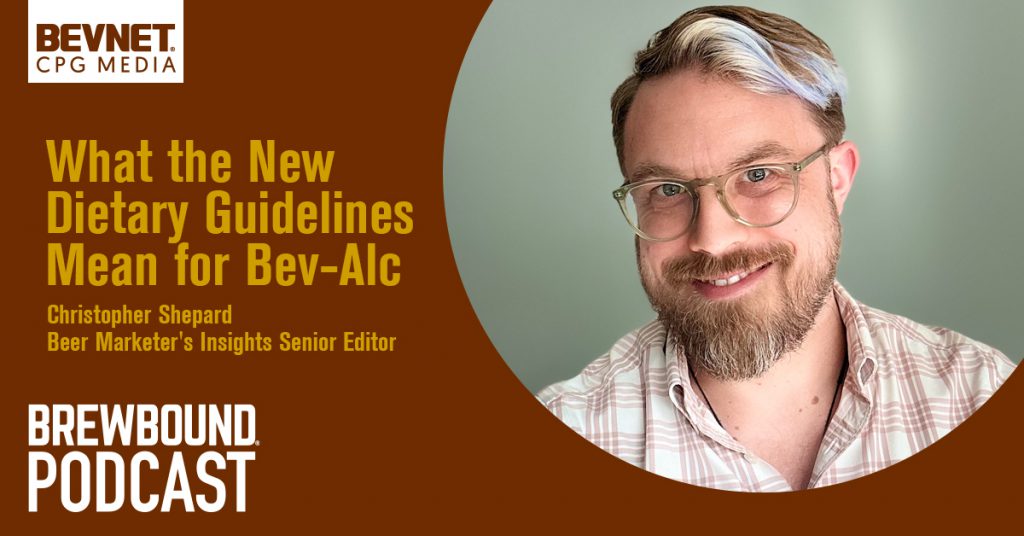
[00:17:33] Zoe Licata: Those 19.2 ounce cans, their back should hurt. They're really carrying the team. Really? Well, that's the news. The other very, very big news story that we actually didn't get into in the intro because you're going to hear all about in the featured interview is the 2025 to 2030 Dietary Guidelines for Americans dropped last week via a White House press briefing on Wednesday. So we hit up the person who we know to be the foremost expert on what that means for the industry, our good buddy, Christopher Shepard, who is a senior editor at Beer Marketer Insights. I guess it's two weeks in a row of our BMI buddies, but there was literally nobody more appropriate than Chris to have this conversation with. And we just like him a lot. So without further ado, here is our featured interview with our friend, Christopher Shepard. The 2025-2030 Dietary Guidelines for Americans are finally here, and they say very little, but actually a lot, about alcohol consumption. So we brought on the best possible person I could think of to have this conversation with. Here to join us is Christopher Shepard, Senior Editor at Beer Marketer Insights, where he focuses on the craft brew news and alcohol issues, verticals, among many other things. Chris, how you doing?
[00:18:49] Brewbound Podcast: I'm doing great. I'm real ready for this week to be over, but you know, it's cool. It's been a busy couple days for my fingers, but cooling off now, hopefully that'll last for a little bit.
[00:19:03] Zoe Licata: This has been in the works for so long. So I guess we should really back up for a second. So a major story of last year, the year before, the past couple of years really is the fact that every five years through a joint effort between the Departments of Health and Human Services and the Department of Agriculture, USDA, these two federal government bureaus get together and develop the Dietary Guidelines for Americans. So basically the food pyramid that you remember of yore, which was not used for a long time, but now is back, sort of, kind of demonized, flipped. Lots of stuff going on. And you might think, what does this have to do with alcohol? And the answer is actually a lot. So six years ago now, and it gets redone every five years. So in the 2020 batch, there was some chatter. Could the guidelines drop their recommendation for alcohol consumption, which back then was two drinks a day for men, one drink a day for women. And a lot happened in between there that happened outside of the US, which is that in the intervening years, both Canada and the World Health Organization adopted language that says there's no safe level of alcohol consumption for health. Christy, you know this inside and out, backwards and forwards. Do I have this right?
[00:20:13] Brewbound Podcast: I mean, sort of. Okay, correct me. And I would dispute the inclusion of Canada. And that's sort of part of the whole thing is that there's this assumption that Canada, in fact, officially did lower their guidelines. But that's not true.
[00:20:27] Zoe Licata: What happens with our neighbours to the north?
[00:20:31] Brewbound Podcast: And Health Canada's website, their official government guidelines are actually really fascinating. And I will not bore you with my take on it, but they're significantly more detailed than the US ones and actually have an allowance for on special occasions or if you want to party a little bit. They don't use that language, but that's the implication of some of it. But anyways, no, it was a separate report from a substance use and addiction focused organization that does get government funding, but anyways, that published a recommended, they recommended that Health Canada lower its drinking guidelines. That went everywhere. That was the two drinks a week thing that made headlines in 23. And, you know, if you ask AI, it will tell you that those are Canada's guidelines. And if you ask, there are many major news outlets that will tell you, that will refuse to print retractions from saying that those are Canada's official guidelines, when in fact, they're not. Wow. Well, thank you. So sorry to get all technical and correct you.
[00:21:40] Zoe Licata: Literally, that's why you're here. I mean, you're here because I also just like you as a human being.
[00:21:46] Brewbound Podcast: Oh, that's silly.
[00:21:50] Zoe Licata: Well, so the new news here is that on Wednesday, January 7th, our Health and Human Services Secretary, Robert F. Kennedy Jr., announced the new guidelines, which are basically no guidelines. They removed those two drinks for men, one drink for women per day. That's gone now and it's all basically just, hey, practice moderation, which this was leaked earlier this year or earlier last year.
[00:22:17] Brewbound Podcast: Yeah, it was June when Reuters was like, this is what it's going to be. then that's in fact what it was, right? And, you know, back in June of last year, the sort of scientific reports that were supposed to underlie the whole Dietary Guidelines, and to be clear, since the Dietary Guidelines started in the early 80s, You know, the vast majority of them are not about alcohol, right? Like, it is what to eat and drink, but mostly eat, in order to be the healthiest you can be. And it's ballooned and grown and gotten longer and longer and longer and longer. But alcohol was always a pretty small piece of it, because, surprise, everybody, alcohol should be a relatively small piece of, you know, your total caloric intake. What? I know, Zoe, I'm so sorry. Shit. beginning there's been this like one to one a day to a day for women and men recommendation. things around that have sort of shifted a little bit. the 2020 version included a little bit more specific language around like yes it is possible that like higher levels can cause other health effects. there is this possible cancer threat that we're getting more data about. and there could be a bit of a threat at even lower levels of consumption. And so you should be aware of that. And last year, you know, RFK was like, yeah, forget all these hundreds of pages, it's going to be four pages, and you're going to get it by July. And we were like, oh, okay, cool. That didn't happen. Things got more complicated. They did sort of find a way to have this like, uber simplified version that's just 10 pages long. Like the whole thing is like boiled down to 10 pages. And part of the goal was to have a document that was just a little bit more accessible for the average person to not want to pick up a literal 300 or 400 page document and be like, what should I eat? So they did figure out a way to do that. Alcohol has like a couple of bullet points in that 10 page document. then there are much longer hundred page, multi-hundred page, it sort of ends up being around 500 pages of supporting documents, which are actually sort of statutorily required in some ways, turns out. But alcohol doesn't play a role like in those essentially at all, like it's just not even really mentioned, or barely. And so yeah, where it basically says drink less. There's a couple of things that just off the bat on this notion of taking out that specific guidance and just leaving it at drink less, drinking less is better. It's actually that major headline, that major bullet point is actually the same as it's been. Even the older version, even the 2020, the primary guidance there was drinking less is better than drinking more. if you're going to drink, here's some amounts." But everyone ignored that drink less piece of it and just focused on, okay, one a day, got it, cool, because people like to have that hard number. The overall guidance didn't really change, they just decided to take the specifics away. It was last June when the Reuters report came out that that could happen where I was sitting around the office and talking to some of the people here and I was like, you know, the weird thing about it is that's probably a good idea because the thing about alcohol and you know I read a ton of research papers and studies about alcohol's impact on health and like I'm not a scientist and I am certainly not a doctor and so this is by no means any kind of recommendation for anyone else but like the thing that I have gleaned from doing all of that reading is like it really depends it depends The level of alcohol consumption that is safe for any particular individual really depends on so, so, so many things that are going on with you and your life, your genetic background, your family background, like, literally what's sort of going on in your mental health world at the time. Like, there are so many things that it depends that, like, actually pulling away from providing, like, no, one drink a day, you're good. Well, there are plenty of people that wandering a day, actually, that wouldn't be great. That would be bad. There are other people that could have two or three and would probably not end up seeing any negative health impact. It's this weird, strange irony that frankly can be applied to the whole new Dietary Guidelines in general, where there are some parts of it that's like, actually, that's probably a pretty good thing, and then other parts of it that are really fully bonkers.
[00:27:00] Christopher Shepard: Here we are. It is kind of interesting that because they removed these limits, it's been touted Reyes Beverage alcohol folks as, all right, this is a win. We didn't get these new limits. But really, it could be kind of giving stricter limits to folks because it's not giving you this threshold that you can go to and still feel quote unquote healthy.
[00:27:22] Brewbound Podcast: Precisely. One of the reasons it's been viewed as a win by the industry writ large and by a sort of coalition of industry trade organizations that came together is that they came together because there was the very real threat that the Dietary Guidelines were going to tilt towards or embrace a no safe level rhetoric. That threat was in fact real and that was another part of the news this week is that like, yes, that is what was being shot for by a bunch of anti-industry public health advocates. So it's being framed as a win because it doesn't say all drinking is bad for you. The more sort of subtle piece of it is that different portions of the industry probably view the removal of that specific guidance in different ways. So for instance, the distillers have advocated for decades towards embracing the standard drink language, right? And so having a drink one, drink two, and here's a little graphic where 12 ounces of 5% beer and five ounces of 12% wine and one ounce or one and a half ounces of liquor are was sort of a win for distillers. And so the loss of that, there are probably some folks in the distilling world that are not so pleased that that's gone. There are probably some folks in the brewing world that are kind of a little bit happier that that's no longer on the books. But for the industry, the loss of that one and two, that sort of specific language that says, hey, yeah, drinking one or two drinks a day is actually probably gonna be okay for you. that became an easy shorthand, a sort of easy tool for moderation, right? It was a shorthand for moderation and a tool that could be used and spoken about to the public or especially to stakeholders, to legislators to say, hey, we have this government document. It says one or two drinks a day. So you can't just tell us that it's all bad. There is a little bit, I think, of a loss there as well for the industry in terms of having that specificity. But when the alternative is all drinking is bad, the industry will take it every day.
[00:29:39] Christopher Shepard: Right. My interpretation of why this was the result of things is there's kind of two factors here. There was a lot of these anti-alcohol reports and studies that we'll talk about more deeply, but those were kind of put off to the side and weren't as much a part of the final decision at the end of the day. And the other part is this particular administration and the folks leading these health decisions are much more focused on things that don't have to do with alcohol. Was that actually a factor? Was it folks just like, we can't really worry about alcohol right now because they're prioritizing, you know, vaccines and different food stuff? Or was alcohol still a decent part of these conversations?
[00:30:21] Brewbound Podcast: I can't tell you definitively what was going on within HHS and USDA and the White House. I wasn't there and I don't know precisely what those conversations were. My sense is, as you say, the latter was really sort of the driving force here. The Dietary Guidelines and sort of RFK Jr. coming in as HHS secretary, it became really clear that the Maha, the Make America Healthy Again sort of movement, was like the driving force. And alcohol doesn't really play a big role in those conversations. It just doesn't and hasn't for whatever reasons. And my guess is some of the reasons is it's kind of complicated, turns out. I mean, there's not a unified view among that sort of base. And so my sense is that that was sort of the driving force around why they could basically say, okay, we're coming into this, like we as an administration are being brought in to a controversy around alcohol, right? We've got these two dueling reports and all sorts of weird press and two sets of advocates that are vehemently opposed to each other. Well, let's just take that out and just not worry about this, right? It wouldn't surprise me if part of it is like, Yeah, I don't want to have anything to do with that nonsense. Let's just leave that, all of that behind us, take the easy answer, realize that this isn't an important issue to the people that we are trying to reach, right, to this base. You know, the Maha moms are not screaming about alcohol, they're screaming about other things. So to hand our base the win that we are looking for here, we don't have to worry about alcohol.
[00:32:08] Zoe Licata: I am not expecting you guys to come on this journey with me. To be clear, these are just my own personal thoughts. But what I really started thinking about watching this press conference was, do you remember in Succession where they're talking about all their crimes and Tom Wamskins is assuming that everybody's just gonna pin all the wrong things that they've done onto him and he's gonna be dressed up like a Christmas tree? So I was like, that's in a way what they're doing with the guidelines here. Like all the various industries that have been hurt by various policies of this administration, say pork farmers, because of the tariffs, China didn't want to buy from them anymore, which was a huge customer of theirs. And I feel like I heard RFK Jr. recommend that people eat ground pork more times than I've ever heard in my life in like 20 minutes. It was basically like, we're just going to use these guidelines to suggest people consume all of these things and spend money on all of these things to like, make amends to all the various industries that we have harmed in the past 11 months. That's kind of what I walked away thinking. And I know across the board Bev-Alc beer, wine, and spirits have all been hurt by tariffs in some way. So I don't think that that was really a part of this. I think the various other farmers were hurt much more, but okay. This is clearly like how we're going to make up to some people that we have hurt.
[00:33:26] Brewbound Podcast: You know, it's really interesting that you say that, and I know that you're not meaning to do this.
[00:33:31] Zoe Licata: Sound like a lunatic?
[00:33:33] Brewbound Podcast: No. No, I mean, I am, though. I know that you're not meaning to do this, right? But like, you also heard a bunch of rhetoric around, oh, it was corporate ties and corporate lobbying that has made all those terrible choices in the past. Part of the Maha movement is this rejection of we are following what industry wants us to do. And so to the extent that that theory is true, it would deeply undermine the talking point.
[00:34:02] Dietary Guidelines: Well, here's the thing, though. Everything's got an industry.
[00:34:05] Christopher Shepard: Yeah, it's also very funny when the part of that press conference that did talk about alcohol was saying a lot of talking points that we've heard from other places about socializing and the benefits of, you know, having a drink so you can hang out with friends. Those are all things that we've heard before. So I don't think that industry influence from folks is gone anyway.
[00:34:32] Brewbound Podcast: That string of comments from Dr. Oz was really, really fascinating. We're just gonna set aside that it was Dr. Oz. And because, and one of the things that I focused on as I wrote about it in the last couple days was that he played both sides. Because wrapped up in those comments were, as you said Zoe, the kinds of things that we hear from industry all the time. Like, socializing is good for us, and if alcohol helps you socialize, which by the way it does, then that's fine. Don't have it for breakfast. Yeah. As he said famously, as became very much the poll quote, because it's kind of hilarious, you know, don't go too hard. Don't drink too much. But like, yeah, drinking with your friends like that's socializing with friends is, as he said, one of the healthiest things you can do. On the flip side, he also included all of these statements that are very much aligned with the public health advocates who push for no safe level. Best case scenario, you don't drink alcohol. He also said all of those research that were underlying the one and two drink recommendations of the past, he said that data probably wasn't good and was probably linked to the social benefits in the first place. textbook public health advocacy that says all of the studies that were used to say that moderate drinking has heart benefits, it's not the alcohol, it's not the alcohol, it's other things. There are other lifestyle factors that were causing that data. He literally gave both sides talking points. Then you could dig deeper and be like, okay, so why? Here's the thing though, which is the for me but one of the sort of weirdest things of all again coming out of this administration that you know I don't mean to shock you I know I'm not shocking you too but I don't mean to shock your listeners like I am not a maha mom that's not me that's not where I come from and so seeing a frankly pretty rational set of comments about alcohol that I can't argue with. And having done all of the research and work that I've done over my career on this is like a little bit of a head scratcher. It's like, yes, I agree.
[00:37:01] Christopher Shepard: Dr. Oz. That's the headline of this podcast.
[00:37:07] Zoe Licata: Oprah needs so much more smoke for having foisted this man upon us.
[00:37:13] Christopher Shepard: So related to what we were just talking about with these talks about socializing and moderation, when we got all the statements from a lot of the trade groups right after this came out, that was immediately their focus is we're going to continue to push specifically beer as the drink of moderation. How much influence do you think this change is going to have on some of that Beer Marketer Reyes Beverage alcohol marketing? Is it that influential or is this something that beer was already going to be really leaning into anyway with the state of beverage alcohol?
[00:37:44] Brewbound Podcast: I mean, this is the wild thing about the amount of hours of my life that I have given to covering this topic in the last couple of years is that ultimately, not super important. Sorry about it. really important if the Dietary Guidelines like if a government document says there's no safe level of drinking that would be very huge the fact that it says what it says like this goes back to being a non-issue until the industry has to start all of the lobbying and advocacy for the 2030 to 2035 guidelines which would come much sooner than we all wanted to well for me at least the industry has already been really trying to figure out how to sort of counteract all of these sort of negative narratives that are out there about alcohol, which, to be clear, have been a bit overblown. And so this push towards moderation and this push towards the industry speaking more directly about sociability and the benefits of going out with friends and socializing, ideally over beer, was going to be happening anyway. And, you know, it's been a big part of the Be Your First initiative that the MBWA spearheaded and turned into this sort of, you know, all the marketers in the industry coming together and talking about, can we do anything here? But, you know, as I know you folks saw this week, like, it's essentially the basis of the Miller Lite campaign this year with Christopher Walken. Heineken has been playing this for a little while now. There are various other brands that have been trying to figure out how to leverage, as I see it, how to leverage a frankly pretty intuitive sense that we all have that like, yeah, going out and socializing and seeing my friends, that's legitimately good for me. even if I do it with a drink or two. And this is one of the reasons why I think, and Heineken has leveraged this in particular, like why the rise of NA beer is such a game changer for the industry. because they don't even have to say, do it with alcohol. They can say do it with beer and have it not necessarily mean, yeah, have like a literal alcoholic drink or two. And that is powerful, right? To be able to say, socialize with beer, whether you want to be consuming alcohol or not.
[00:40:00] Zoe Licata: One thing that really kind of shocked me when it all came... So, I'll back up a second because we made reference to two different studies, but I don't really think we dug in too hard on either of them. At this point, I don't know that it matters, but there were two studies involved in the process by which the guidelines were going to be developed. One of them was coming from the National Academies of Science, Engineering and Medicine, NASEM.
[00:40:26] Brewbound Podcast: I always say NASM, but I'm pretty sure NASM is more commonly used in the government.
[00:40:31] Zoe Licata: Well, okay, nerds.
[00:40:33] Brewbound Podcast: You're going to go for the other one, acronym? I'm going to try.
[00:40:37] Zoe Licata: Full disclosure, we had a comment. You can't read it.
[00:40:39] Brewbound Podcast: I need to see your eyes and you can't be reading it. Okay. I don't even have it up anywhere.
[00:40:43] Zoe Licata: But we got a comment that we use so many acronyms on our podcast and we never explain what they are. So we might put you through the acronym challenge at the end of this conversation.
[00:40:52] SPEAKER_??: Bring it.
[00:40:53] Zoe Licata: All right, the Interagency Coordinating Council for Intervention and Prevention of Underage Drinking.
[00:41:02] Brewbound Podcast: Interagency Coordinating Committee on the Prevention of Underage Drinking. I know I can say that faster than any human in the world. Do it again. I know I can.
[00:41:10] Zoe Licata: Can you say it three times before a match goes out?
[00:41:15] Brewbound Podcast: Maybe, but I haven't tried. Okay, one more time. The Interagency Coordinating Committee on the Prevention of Underage Drinking.
[00:41:22] Zoe Licata: Amazing. Why did I think I said council?
[00:41:24] Brewbound Podcast: You said council, and then there was another extra word in there, I think.
[00:41:27] Zoe Licata: I think I put in another I.
[00:41:29] Brewbound Podcast: Yeah.
[00:41:30] Zoe Licata: Maybe it needs that.
[00:41:31] Brewbound Podcast: Maybe it could sound better than it could. All terrible. It feels so good.
[00:41:38] Zoe Licata: Awful. Well, so a little over a year ago, both of these agencies released their studies. I know one came out right around my birthday and one came out not too long after, which just happened. That's smart.
[00:41:49] Brewbound Podcast: It was December and then early January.
[00:41:51] Zoe Licata: Yeah. And Nassim Nassim. The National Academies went first and the front page basically seemed to say that, hey, we don't really see much difference in life outcomes for people who are moderate drinkers versus people who don't drink. Cool, people were celebrating that. If you went beyond the first page, they did notice that there was a higher risk of breast cancer for women who consumed alcohol. So that was one of those things that stuck out to me as being like, hey, everybody's celebrating, this is great news, but again, not if you have boobs. And then the ICPUD study, when that came out, had an even stronger evidence of connection.
[00:42:33] Brewbound Podcast: You're totally gonna die.
[00:42:35] Zoe Licata: Yeah. If you drink, you will die. It was basically that scene in Mean Girls. Yeah. So particularly the breast cancer thing was nothing I had ever seen anywhere, which to me was slightly alarming because I've been in alcohol forever. And similarly, I also have boobs.
[00:42:51] Dietary Guidelines: Have boobs forever?
[00:42:52] Zoe Licata: Not forever, but for too long. But yeah, like did these studies do anything to drive conversations or was it just me being alarmed? Like did anybody care at the end of the day when these studies came out?
[00:43:04] Brewbound Podcast: Oh, I mean, I cared a whole lot. And I think they did start conversations. There were less headlines about that. They were very much overshadowed by the Surgeon General's advisory on alcohol and cancer, which, to be clear, repeated that finding on breast cancer. And I want to take that and focus on that for a hot second, because I think it is really important. We have known about links between alcohol and cancer generally and especially breast cancer for a long time. The vast majority of alcohol-related cancer, even though it's not talked about, but as the Surgeon General's advisory does explain, the vast majority of alcohol-related cancer does come from consumption levels that are far above any recommended level. It comes at, when you're drinking, very heavily. But breast cancer is different. And it has been shown for quite some time that those links can, for certain individuals, begin at a lower level. And one of the reasons why it doesn't surprise me that you had that reaction, Jess, and something that I think is a problem is that the people in the industry don't talk about that enough.
[00:44:18] Zoe Licata: I mean, is it because the industry is so dominated by men?
[00:44:23] Brewbound Podcast: That could be. I hadn't sort of thought about it that way. I mean, surprise, surprise. But there's certainly that possibility. I think there is also generally a reticence within the industry to really engage with some of the downsides. We don't like doing it a whole lot. It's uncomfortable. It is uncomfortable. And when people a couple years ago started really talking about mental health within the industry, that was like a big moment where it's like oh yeah we're actually not gonna like hide from this anymore that's good and i don't know that we are fully out in the open about those things really still but it is very clear to me that there is a lot of growth to be had within the industry in terms of being comfortable talking about some of the hard stuff And it's one of my missions in Alcohol Issues Insights is to give people facts and data and context to allow them to engage in those discussions, especially with their teams, right, with their colleagues, with other industry members, about how to understand and how to talk about that stuff. It's interesting though, on breast cancer specifically, if you talk to or if you read stuff from scientists or researchers that come from the cancer side and not like the alcohol side. One of the things that I've appreciated recognizing is that when people talk about, when those folks talk about cancer, they often talk about sort of the compounding effects of risk factors, right? Like there are multiple risk factors for all different kinds of cancers. And so once they start piling on top of each other, they really multiply each other. And so when you're talking about the risk of breast cancer, when it relates to alcohol, that starts getting right if you are an individual who has some other risk factors whether those are dietary or lifestyle or especially if they're genetic and family related that's when you should maybe really be thinking about like maybe I shouldn't get to that one drink a day, right? Like maybe it should be far less than that, right? And that's where, as I said earlier, that one drink a day for women sounds reasonable and is relatively moderate drinking if you're really paying attention to what that drink is. But if you have a family history of breast cancer, like that's maybe not a safe level. for you. but it's hard to make that determination without a medical professional to like go through all of those other risk factors for you. whereas another person who is a really healthy eater, exercising all the time, does not smoke, does not have a family history of breast cancer, does not have any genetic predispositions, one drink a day is probably fine and two might even be okay. and so for for women getting to two like that's a every day is probably not a good thing. But again, it depends. The other thing that happened this week, in the hours before the Dietary Guidelines were released, is that a report from the majority staff of the House Oversight Committee was published early Wednesday, and it was on the ICPUD efforts. It was specifically on ICPUD study, where it came from. Let's be clear, this is from Congress. Let's be clear, it's from the majority staff. So it's coming out of Congress already. It's going to be a political document. It's coming from just the majority staff. It's not like it's some joint study. And so there is a ton of very, very political rhetoric in there. Lots of anti-Biden administration language just over and over and over and over again, sort of hammering that home. Unsurprising. pull all of that away, dig underneath that. And what the report does is it uses some, it was eventually able to get to basically some meeting notes from ICPUD, from sort of committee members at ICPUD that go back to early 2023 to understand the origins of why that study happened and why that study happened the way that it happened. And those meeting notes do in fact confirm that it is exactly what it appeared to be and what industry trade associations feared that it was. And the way that I have sort of phrased it in writing this week is that, you know, it was essentially an effort by anti-industry public health advocates to leverage their connections that they already had within ICPUD to push the Dietary Guidelines toward that no safe level stance. using a methodology based on, frankly, the Canadian report that I referenced at the very start of this podcast. What a full circle moment.
[00:49:12] SPEAKER_??: Ta-da.
[00:49:12] Brewbound Podcast: Ta-da. I didn't even do that on purpose, by the way. But here we are, right? Like that Canadian report was the model. The Canadian report basically says there is no safe level of drinking, and if you're gonna have the lowest risk, limit to two drinks a week. So essentially, the top government contractor, because it's an interagency coordinating committee. So it's not like it is, administrated by SAMHSA, which is part of HHS, which is part of Health and Human Services, but it links together a bunch of other agencies. It's an interagency committee, so it doesn't have really, it didn't have a staff of its own. Most of its work was completed by an outside contractor. We sometimes forget that a huge amount of the work that our government does is done by contractors who don't work for the government. They get contracts and grants from the government. And so the key government contractor at ICPUD was this woman, Dr. Alicia Sparks. Dr. Alicia Sparks was also on the board of, and at the time, I believe, certainly in the past, and I think at the time of this being decided, was the chair of the U.S. Alcohol Policy Alliance. The U.S. Alcohol Policy Alliance is the leading anti-industry advocacy group in the country. And they are all very connected. They were connected to the scientists who ran the Canadian report. And so what these meeting notes show is that Alicia was like, hey, she proposed doing the Dietary Guidelines research at ICPID, quote unquote, following the Canadian model. And that's sort of where it began. It began with folks connected to USAPA who have connections at ICPUD, who are paid through ICPUD, to say, hey, we can influence the Dietary Guidelines. We can do it by replicating this study that we did up in Canada. and let's go. It's a weird thing to sort of see that, I mean, that's how I've been reporting on it all along, because as soon as I recognized, like as soon as some of the documents around ICPUD pointed to Alicia Sparks and some of the panelists who were on that committee, Kevin Shield, Dr. Kevin Shield and Dr. Tim Naimi, who ran the Canadian study, it was sort of like, oh, well, okay, we're, okay, so this is what we're doing. But this week it was sort of, confirmed in a heavily politicized document that yes, in fact, that's what happens.
[00:51:43] Christopher Shepard: Right. Is there a consequence for that now being revealed? Like what happens now that we officially have that confirmation? Does anything really happen?
[00:51:52] Brewbound Podcast: I think it makes it more difficult for the same thing to happen again, right? I think it creates a more difficult pathway for the same play to be run a second time for the 2030 to 2035 guidelines. That being said, the other thing that happened is HHS was gutted last year. Right. Which you can't ignore and you can't really separate. 10,000 people laid off or fired. The public health infrastructure in the country was decimated, depending on who you talk to, or severely hindered if you're trying to be sort of generous or kind. And people who were focused on alcohol within the government were a part of that. nothing can happen precisely the same, barring an administration that's just like magically reinstates everything, which I think is like, that's unlikely. So even if we see a sort of rebuilding of that infrastructure, the way that things take shape and advocacy takes shape the next time is just gonna look different. So short answer, nothing, nothing happens. We just know that and move on with our lives.
[00:53:11] Christopher Shepard: That next time is not too far away now. Are you so excited for it? It's 2026 now. This was supposed to come out in 2025. Next one 2030. But we really started having conversations about 2025 and 2023 2024. So really only a couple years out. Chris, my final question for you is now that we have gotten to this point, we now have the guidelines. With this being your beat now, what are you paying attention to?
[00:53:41] Brewbound Podcast: There are so many things that I'm interested in working on, but none of them are quite as newsy. And that's the sort of nice thing about alcohol issues is that, frankly, when there isn't something like the Dietary Guidelines coming down, I'm rarely rushing, right? I'm rarely like, gotta get this story out right now in the way that the business stories happen a lot faster. So I usually have time to work on things and as things come out. I am really interested. I'm ideally going to be working on a deep dive into Mendelian randomization and sort of where that came from. Yeah. And that is a lot of the research that has been used to try to erase the notion that moderate drinking has health benefits is this different style. It's this different metric. It's too complicated to get into. But it's about genetics. And it's very interesting. And I don't know enough about it. And so I'm very interested in going sort of doing sort of a deep dive into that sort of family of research to understand what the heck is actually going on there. But I am very, you know, I think a little bit more understandable for the industry writ large, as I'm really interested in continuing to follow changing perceptions around alcohol. It's been clear in just the first week plus of the year that some of the conversations are moderating a little bit. Like there's been this tilt towards, and the DGA is a part of that, this more sort of just rational discussion around alcohol that is not quite so one side or the other. And that's refreshing to me. And I'm really curious to follow whether that really sort of reasonable and intuitive sort of understanding of like, yeah, alcohol comes with some bad stuff. But up to a certain point, it can have a fine place in my life. I would love to see that stance be a little bit more prominent. And so far this year, it looks like it might, but I'm very interested in seeing how that evolves and whether that starts up showing in some of the big surveys that we've been seeing around prevalence, around attitudes about alcohol, attitudes about alcohol and health, and whether any of that plateaus at all, or flattens out a bit.
[00:56:08] Zoe Licata: Well, I can't wait to see what you write. Chris, thank you so much for joining us. We know you're busy, so we really appreciate you taking the time to have this conversation with us, because who better than you? Nobody.
[00:56:17] Brewbound Podcast: Well, thank you for the invite. I really appreciate it. I don't get the opportunity to talk quite so long about these kinds of topics, so it was nice to be able to stretch out with you folks. Thank you. Amazing. Thank you.
[00:56:29] Zoe Licata: And that's our show for this week. Thank you for listening. The Brewbound Podcast is a production of BevNET CPG. Our audio engineer for the Brewbound Podcast is Joe Cracci. Our technical director is Joshua Pratt and our video editor is Ryan Galang. Our social marketing manager is Amanda Smerlinski. Our designer is Amanda Huang. If you enjoyed this episode, please share it with your colleagues and friends and review us on your listening platform of choice. You can find our work at Brewbound.com. And we also welcome feedback and suggestions at podcast at Brewbound.com. On behalf of the entire Brewbound Podcast team, thank you for listening. We'll be back next week.