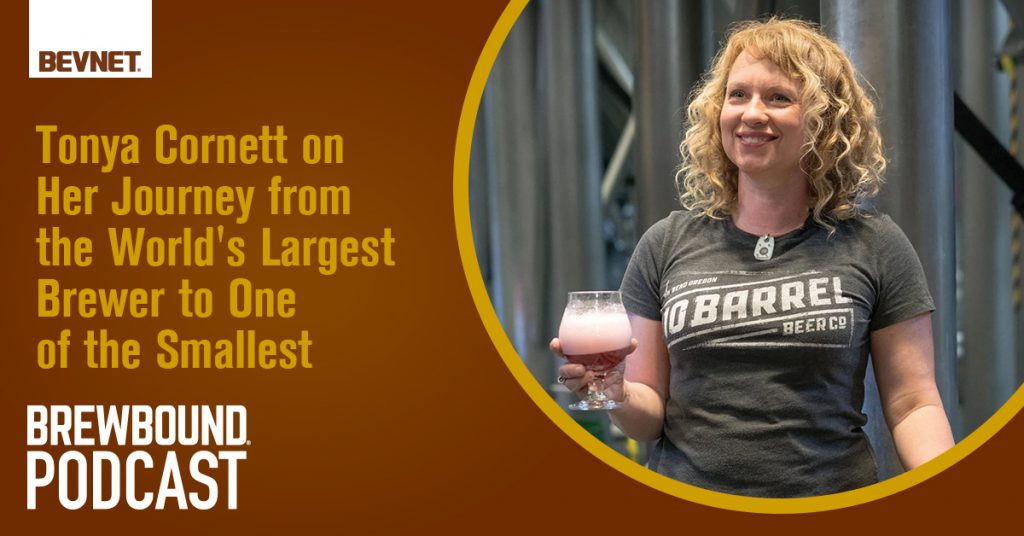
[00:00:00] Justin Kendall: Heading to CBC? Kick things off the day before at Brewbound's meetup at Love City Brewing in Philly, Sunday, April 19th from 5 to 7 p.m. Connect with beer industry leaders, grab a drink, and catch up with the Brewbound team. It's free to attend and walking distance from the convention center. Head to Brewbound.com slash lovecity.rsvp. And don't forget to catch the Brewbound team at booth 956 during CBC. What's it like to go from the largest brewer in the world to one of the smallest? Tonya Cornett joins us to share her story next on The Brewbound Podcast. Hello and welcome to The Brewbound Podcast. I'm Justin Kendall.
[00:00:51] Jessica Infante: I'm Jessica Infante. And I'm Zoe Licata.
[00:00:54] Justin Kendall: How y'all doing this fine week before GABF?
[00:01:03] Zoe Licata: Yours is an interesting question.
[00:01:06] Justin Kendall: Yeah. Deep sighs.
[00:01:07] Zoe Licata: We're good. I think the news is bonkers. I feel like we say that every week.
[00:01:14] Jessica Infante: I know. It's just been the year of a lot of bonkers news. But what was last year? Yeah. And the year before. All the time. Just the state of things. Yeah. It is going to be nice though to go to Denver in just a few hours basically from when recording this and see some beer folks and see some non-beer folks this year.
[00:01:37] Zoe Licata: Many non-beer folks.
[00:01:40] Jessica Infante: I feel like normally my prep for GBF is not drinking any beer, because I'm prepping to only drink beer for a few days. And that's not going to be the case this year.
[00:01:51] Justin Kendall: But is this like your fourth in a row?
[00:01:52] Jessica Infante: Yeah, I think so. Wow.
[00:01:54] Justin Kendall: Are you at least going to Paird?
[00:01:56] Jessica Infante: Are we going to Paird? Not as of this moment, but I feel like we normally are able to finagle something. That was definitely the highlight of last year.
[00:02:05] Justin Kendall: It was pretty great last year.
[00:02:07] Zoe Licata: Zoe, I wish for you that you could have attended Sabre. Yeah. I'm sorry. Thank you. It's like paired, but it was cooler.
[00:02:16] Justin Kendall: All the fancy lads and their suits and shiny red shoes.
[00:02:20] Zoe Licata: Oh, I used to pour in like a cocktail dress. Oh. Ish.
[00:02:25] Justin Kendall: Yeah. Ish.
[00:02:27] Zoe Licata: It was fancy.
[00:02:28] Justin Kendall: It was that kind of party.
[00:02:30] Zoe Licata: Like I bought this dress. It's the same dress that I wore to pour at Savor and to chaperone the high school prom alongside my husband, the high school teacher.
[00:02:39] Jessica Infante: I was talking to Lawrence yesterday about, I have not packed yet for these two back-to-back trips that we have very shortly. And I was like, the attire for these two trips that we have is very different. Very different. We are going to GABF in Denver. It's going to be a lot of jeans and flannels everywhere. And then we head straight to Vegas for MBWA's annual convention, which is a lot of fun. Navy suits and dresses for us. And then maybe some Vegas night attire. So I'm going to stuff my suitcases, basically what I'm going to have to do.
[00:03:12] Zoe Licata: Brew making moves day. It's like Paris Fashion Week. Everybody looks so good. Everybody looks great. Except for me. I don't know how to wear clothes. Yeah, it's rough, man. It's hard out there for an old mom. since you and I are on this multi-leg journey together, are we committed to carry-ons?
[00:03:34] Jessica Infante: I don't think you have to be.
[00:03:37] Zoe Licata: I mean, I would.
[00:03:37] Jessica Infante: I have not checked anything.
[00:03:40] Zoe Licata: All right, great.
[00:03:40] Jessica Infante: I would be if we were doing exclusively JetBlue, shout out JetBlue Rewards, that gets me that free check bag, but we're not. So I'm not checking one. Great. As of this moment, who knows if the final leg home, I'm finally over it.
[00:03:55] Zoe Licata: I went out and topped up my mini toiletry collection over the weekend. So very nice. I'm prepared. I love how this is now part of this podcast. You and me carry on bags.
[00:04:07] Jessica Infante: This is what goes into us traveling to events. Also, before we move on to actual real relevant information, I need to give a sorry, not sorry to podcast listener and previous podcast guest Kevin McGee. We beat your bills.
[00:04:24] Zoe Licata: Oh, did you?
[00:04:27] Jessica Infante: Go Bills, my ass.
[00:04:29] Justin Kendall: You did. You made that baby sad that they kept putting on the screen.
[00:04:33] Jessica Infante: Baby shouldn't be a Bills fan. Shout out New England Patriots. We're back. And that's my piece. Sorry, Kevin. Congratulations. Thank you.
[00:04:45] Justin Kendall: Well, maybe we should continue the theme of our fall travel and talk a little bit about Brewbound Live. It's coming up December 10th and 11th. You can get tickets now. Join us in Los Angeles. We'll be at the Marina Del Rey Marriott. Brewbound Live is a checked bag occasion. Yeah, it definitely is.
[00:05:04] Jessica Infante: Well, we, we gotta be on stage for those bright lights. Gotta look good for the people. We do gotta look good for the people.
[00:05:12] Justin Kendall: I gotta go see my guy.
[00:05:14] Jessica Infante: Yeah, gotta match the level of content. Great content, gotta have great clothes. Though in the audience, you really could wear what makes you feel happy. That's true. Very low pressure for everyone attending.
[00:05:29] Justin Kendall: Well, let's give them a speaker while we're at it. Somebody that we haven't announced announced. So we will have Whitney Stevenson, the president of Juneshine. They're doing the Willie's Bottle THC brand, which is crushing it now. And we're going to talk a lot about that.
[00:05:47] Zoe Licata: Yeah, we are. You know what I was just thinking of today based on a conversation I had with a friend and former colleague this morning? The... I don't want to say aging, but the brands that appeal to hippies of a certain age are just killing it this year. Right? Yeah. Like Willie's Elixir and Dogfish Head, Grateful Dead. Yeah. Good point. Thank you.
[00:06:15] Justin Kendall: Boomers got the money to spend, although us Gen Xers are, you know, making our move.
[00:06:22] Jessica Infante: For now, yeah.
[00:06:25] Justin Kendall: For as Sean pointed out, all six months before millennials overtake us in spending power.
[00:06:33] Jessica Infante: Now, the Junestine collab with Willys has been surprisingly going really well. I don't think when they first announced it, we were like, oh, this is definitely going to be huge. But I mean, just in the conversations we've had with some of the Junestine folks, it's exceeded their expectations and just connected that brand with so many new consumers. And they have quite a portfolio now of different beverages. So that's just opening up a lot of opportunities for them. So Whitney's going to be really great to have on stage.
[00:07:03] Justin Kendall: Well, stick around for our featured interview with Tonya Cornett from UpLiquids. They took over the immersion space in Bend, Oregon. She and I will talk about her journey from Anheuser-Busch to Tilray to doing her own thing now. So stay tuned for that. But let's get into the news and let's quickly hit on Constellation Brands Q2 earnings report. You both have covered this. It was a lot of red, which wasn't unexpected. And I think I'd just mostly like to hear a little bit about what they're saying about the macroeconomic environment they're facing, because clearly their biggest consumer base is very pressured right now.
[00:07:47] Jessica Infante: Yeah, both in the shared remarks that Constellation put out on Monday ahead of their earnings call, and then in the actual call with investors on Tuesday or today as we're recording, it really emphasized that there continues to be a significant impact on consumers, primarily Hispanic consumers, when it comes to what's happening with the economy, as well as with immigration enforcement and ICE raids. And they're still, as you can see by the numbers, seeing a huge impact from that. particularly in places like California, where there is a very large Hispanic population and a very significant chunk of Constellation sales. That is not really anywhere near being over, but they are seeing in some other markets, primarily places that have a larger base of mainstream consumers for Tilray Brands, there is growth, there is improvement. So there were suggestions by leadership that, hey, maybe this is kind of reaching the bottom. the worse it's going to get. And potentially there is optimism, although they said numerous times, very, very cautious optimism that things could improve from here. So I think it winds down to the same stuff that's been happening is still happening and will continue to happen. But I don't think it's necessarily going to get worse. And now we're going to have some softer comps. We're going to find other avenues to achieve some growth so we can see some minor improvements.
[00:09:11] Zoe Licata: Yeah, I think another thing that you had noted that they had talked about was they were right sizing inventory levels. There was like a huge decline, or I guess a huge acceleration in declines in shipments from Q1 to Q2, but not so much depletions. I want to say depletions in Q2 were only like two tenths of a percentage point worse than they were in Q1.
[00:09:34] Jessica Infante: Yeah, it's a similar story we've heard a bunch of where just the summer was not what anyone thought it was going to be. And so they had to kind of figure out inventories and make it so it's balanced out for the rest of the year. And so that was going to affect their numbers for Q2 and it should be more evened out through the rest of the year. So we're not going to see, likely not going to see as drastic declines. They're finally starting to lap now. Like this time last year, they were still growing, but it was starting to decelerate. And then by the end of last year is when they started to have kind of flat and decline. So this back half of the year is definitely a lot nicer to them comps wise than the first half.
[00:10:15] Tonya Cornett: This episode is brought to you by the Craft Brewers Conference, where big ideas, World Beer, and brutally honest shop talk collide. Join thousands of industry pros leveling up their game. Don't miss it. Register now at CraftBrewersConference.com.
[00:10:35] Justin Kendall: Let's talk a little bit about Molson Coors and their shakeup of their leadership team and their organizational structure. And they announced this on Monday. New CEO, Raul Goyal, basically a week or so into his tenure is adding folks to the leadership team, dismantling it's America's commercial organization and reorganizing that leadership team, bringing Sophia Colucci, the CMO, Brian Fierro, the president of U.S. sales, Jeff Long, chief strategy and capabilities officer, Darren Vose, chief information officer, and Chantal Butler, president of Canada sales, into the leadership team, which makes a lot of sense. And they're joining a whole host of other folks on that team. And it seems like the CEO is going to have a more direct line of sight into things and hear from people more directly. They're getting expanded roles. But all of this is to say that Chief Commercial Officer Michelle St. Jocks is exiting the company in mid-November. She had been with the company since 2019, fast rise. She was the Chief Marketing Officer, had the nice pedigree of coming from Kraft Heinz and Unilever. And she did some really great things as far as the marketing goes and speaking to a consumer that Molson Coors isn't very good at speaking to.
[00:12:00] Zoe Licata: To me, it makes sense that Raul is new in the role. He wants to be as close to everything as possible, whereas, you know, Gavin was there for decades. So he didn't maybe necessarily need so much hands-on day-to-day visibility. And Michelle's role as the chief commercial officer, she had the CMO and the CSO reporting up to her. So she was, you know, that layer in between. And if you want to be more of a hands-on, tactile in the weeds leader, you don't need that go-between anymore. So, you know, that was what they had said in a memo to distributors that Justin, you got a copy of, that they realized there just wasn't a spot for her in the new org. And that sucks, but I get it.
[00:12:44] Justin Kendall: Yeah. They made the decision of who would be promoted from within. They did talk about doing a search that included internal and external candidates. And with her fast rise, I mean, this is just an assumption, I do not know, but she had to have been one of the internal candidates that they were vetting for this role because she was one of the faces of the company. At the distributor meetings, it was her and Gavin out front, the first two people to speak. And at one time, I think it really felt like she was being groomed for that role. And things clearly have went a different direction.
[00:13:21] Zoe Licata: I think when things are good and you're doing really well, you see the top roles go to people that come from marketing. And I think when the wheels fall off the bus, as they have, not just for Molson Coors's, for everybody, you kind of maybe look elsewhere. Look at Boston Beer. They took Dave Berwick from marketing. He's a marketeer through and through. He left and then they took on Michael who also came from marketing, right? And he left in a big hurry. So I think it just depends. Like Rahul's background is varied. We've talked about this. Strategy, finance, M&A.
[00:14:06] Justin Kendall: They're forever.
[00:14:07] Zoe Licata: Right. Like marketing, it's a big investment and I think it's something you need to be making. But sometimes when stuff feels tough, it's hard to want to make that investment.
[00:14:18] Jessica Infante: Yeah, I think there also is a tiny piece of this that relates to just the state of major big beer marketing right now post all the Bud Light chaos. And it really kind of changed how some of these companies have evaluated what they're doing with their marketing, some of the strategies that they have, some of the type of content that they have. And I think a lot of what Michelle did align more with that kind of pre Bud Light stuff and now with the current state of just society and some of the social stuff going on, it's not in the same place. And so any type of cultural shift like that is going to affect people who are not on that same page.
[00:15:01] Justin Kendall: Absolutely.
[00:15:02] Jessica Infante: I'm trying to really walk around a pretty politically charged thing, but I think there's definitely dynamics there. Because Michelle had some pretty, like, some of the campaigns she worked on were pretty noteworthy of going against some of that traditional beer marketing. And now that beer is going back to that, it's hard to see how those campaigns can fit.
[00:15:22] Justin Kendall: I think of the ad with the woman who comes home from work and she takes off her bra under her shirt and throws it down and has a Coors Light and it's, it's a non-sexual thing. It's, it's completely exhausted. And this is, you know, my relaxation is my time to chill is having this Coors Light.
[00:15:44] Zoe Licata: I don't know if you remember, but when I applied for my job, one of the questions on like the app at yeoldbrewbound.com said, just tell us about something you've noticed in beer lately. And I wrote about that. I was like, this is crazy that this is coming from the twins people.
[00:15:58] Justin Kendall: Yeah. You're going to make a twin angry.
[00:16:03] Zoe Licata: Michelle did a great, great job. And I think she did a lot of good work that she should be proud of. And I've always enjoyed hearing her speak. I think she's super smart and I'm excited to see where she goes next. And if she wants to get out of the dumpster fire that is beer, I salute her.
[00:16:20] Justin Kendall: I would think that she's going to have a lot of suitors outside of beer.
[00:16:24] Jessica Infante: Yeah. I mean, that was what she was doing before Molson Coors, right? Like she was at like Unilever and she's worked with other outside of BRC, BG before. She'll be fine.
[00:16:35] Zoe Licata: I hope she takes a vacation.
[00:16:40] Justin Kendall: Yeah. You need it after going through that six year ringer.
[00:16:43] Barrel Brewing: Yeah.
[00:16:45] Justin Kendall: All right. Let's get to our featured interview with Tonya Cornett. Tonya Cornett is among the most awarded and celebrated brewers in the world. She has led Innovation Brewing at breweries of various sizes, including Barrel Brewing and Ten Barrel Brewing, which was under the ownership of both Anheuser-Busch and later Tilray Brands. In a surprise move last September, Tanya and the Innovation Brewing team at Ten Barrel were let go by Tilray Brands. In May of this year, though, Tanya and her team reemerged. They have formed a partnership with the owners of Immersion Brewing in Bend, Oregon, and they have transformed that location into Upp Liquids, which stands for Uniting People and Places Through Unforgettable Beverages. Tanya is here now to discuss how the new venture is going. So let's jump in. Tanya, when you were sorting out what was next for you, how did you land on UP?
[00:17:46] Tilray Brands: Well, pretty quickly I would say within two weeks, all of us from 10 barrel on the innovation team we realized how much we missed each other and we were just stronger as a team and so working together was the goal. I did get other people that were interested in me across the country, but the goal was always to stay in Bend, if possible. That's where I really wanted to focus my attention. And so when this opportunity came up that we could all stay together, not all of us, but most of us to stay together, we certainly took it. We jumped on it.
[00:18:25] Justin Kendall: So how did that conversation start and how did it evolve into Up?
[00:18:30] Tilray Brands: So, we had already designed the brand that was going to be called up. We knew what we wanted, we had a couple of opportunities here in town that just didn't pencil out. So basically one of our friends who had worked at 10 barrel previously was working for our immersion, was the brewer. And we'd been talking to him about possibly kind of tenant brewing. And so we were in talks with the owners to do that. And basically he quit during that time. So they were in a panic. They had grist that was already milled in, in the grist case. And they're like, can you help? So yeah, of course we can help. So as we started working with them and helping them through this time, they said, why don't you just buy into the company. We love your brand, we love all the things that you're saying, we love your team. Why don't we just join forces? So that's what we did. Basically, we were a group looking for a brewery. They needed help. And it's a big brew pub. There's a lot of square footage. There's a lot of people that work here. It has a restaurant. There's a lot of moving parts. And so to think that they had been doing this by themselves for so long, is kind of unimaginable to me. They were tired. They just needed help just across the board. And we were able to step in with a lot of enthusiasm, which I think just raised everybody. It made everyone feel lighter.
[00:20:06] Justin Kendall: Well, you're four months in at UP. How's it going so far? And what have you learned in that short amount of time?
[00:20:14] Tilray Brands: Oh my God, we've learned so much. There's certainly a different learning curve. We built this brand. One of the nice things is we get to connect with customers. At 10 Barrel, we were a bit removed because we were in the production facility. And so even though there was a pub next door, like it seemed like a million miles away when you're talking about customer connection. And it was a lot of like tourists coming through or families coming through that kind of went out to eat once a month. It wasn't that regular connection. So now we get that again, which is great.
[00:20:50] Justin Kendall: How has it changed the way that you approach beverage creation to be at a place that is obviously a smaller scale than 10 Barrel? You're able to have that consumer connection that you didn't have there. How has that changed your approach to creating beverages?
[00:21:09] Tilray Brands: So one of the things that my old boss would say all the time at 10 Barrel was that if you're not dumping beer, you're not pushing the boundaries. So here as an owner, you know, that kind of changes the perspective a little bit. Our goal is not to dump beer. Our goal was never to dump beer, but certainly it would happen. And certainly if we have to, we will. But we can't do like super obscure styles anymore. One of the luxuries that we had was that we could divide. So we could do an obscure style. We can divide it by a few different pubs. And so it went quicker. It was three kegs here, four kegs here. you know, no big deal to go through on a pub and it's fine if it moves slower. Well, now we have to think about how that fits into our lineup, how it's going to go. If we need to brew a smaller batch, like there's just a lot more considerations.
[00:22:13] Justin Kendall: So take me through some of those considerations and the type of beverages that you're focused on now.
[00:22:18] Tilray Brands: So certainly with the name liquids, we plan on doing lots of different fermentations. We are working on seltzers. We're working on a session meat. I have that in the fermenter right now. We are partnering with the local distillery to do mixed cocktails. We're going to do our own cider at the beginning of the year and likely hop water as well.
[00:22:44] Justin Kendall: So you're playing in a lot of formats.
[00:22:46] Tilray Brands: Yeah. We want to make sure that we have something for everyone when they walk in.
[00:22:52] Justin Kendall: We're in this very different beverage environment where we're seeing moderation trends. We're seeing consumers push for flavor options. We've seen the rise of adult non-alcoholic beverages. When you look at this current beverage landscape, what is it that excites you within it?
[00:23:11] Tilray Brands: I think just the possibilities. It can go any direction. And as I think an innovative average artist, that I appreciate that. I can take it anywhere.
[00:23:25] Justin Kendall: So what kind of flavor trends are you watching at this point?
[00:23:30] Tilray Brands: It's funny, I watch every flavor trend. I deal with flavor houses and they do a really good job about looking at the trends. And unfortunately, they're usually flavor combinations that I've already done, but that's fine. That shows I've been on the right track all of this time. But that's to me is a good indicator of kind of where flavor is going. And it's certainly going, to I think just more flavor overall. If you can do something that's like, let's say a varietal of fruit or something that people haven't had before, that's what they want. They want the experience as well as the flavor.
[00:24:15] Justin Kendall: Are there any type of flavors that you're currently playing with or testing out that you're excited about?
[00:24:22] Tilray Brands: Always, always. I have a list of things over the years that I'm like continually trying to hit. And of course, I work with a lot of fruit. I love to work with fruit. That's kind of my shtick. Cantaloupe is one that I'm just like, all right, I just need to find the right cantaloupe. I need to find the right company that I can get it from that has already done the chopping. You know, all of that is already done. The processing is done. And it's really hard because any kind of melon can become very vegetal. And so I tend to focus on or maybe even obsessed about things that I can't have. And so trying to figure out the best way to go forward with those flavors.
[00:25:09] Justin Kendall: That's got to be a challenge when you're as you said, like the the goal is never to dump beer. But when you're playing with something that is as volatile as that, it's got to be a huge challenge.
[00:25:19] Tilray Brands: Yeah, so going through this whole process, it's been amazing to me that, I mean, there's so many people that open breweries without the comfort of knowing that they can really be successful at making beer. You know, they're just winging it. They just do it. And to me, that's terrifying. And it's even still terrifying, even when I know I can make great beer.
[00:25:44] Justin Kendall: Is there anything else at the moment that you're working on that you're excited about that you really think represents what UP is about?
[00:25:53] Tilray Brands: Well, the session meat is in tank. It is fermenting right now. It's at the very end of fermentation. I love Session Meads. I just think that they showcase the honey varietal better than anything. A full strength of mead, I think, ends up getting a little bit overtaken by the fusils, the alcohol fusils, for me. And I want to be able to taste the delicate notes of the honey. And for me, Session Mead does that. So I am very, very excited for this batch.
[00:26:27] Justin Kendall: How has your view of success changed now that you're at UP?
[00:26:33] Tilray Brands: Wow. My view of success really is an internal dialogue. You know, at the end of the day, I just want to make better beer than I made the day before. That's my goal. I've always measured my success by that. And you know, it doesn't hurt when you do land and you hit a medal at one of the major competitions like that always helps everyone's attitude within the brewery and within whatever restaurant you're working at. But of course, like I would love to have one of the top three to four breweries in Bend that people stop when they're here. I think it's really important to get our name out there, make sure that people know that we're here, and when they're here visiting for a week, if we could be one of those places that is a, I have to stop here, that's going to be my measurement of success, I think, in the next few years.
[00:27:36] Justin Kendall: What do you think are going to be the drivers that help you become that destination within Bend?
[00:27:41] Tilray Brands: You know, it's really hard because there are great breweries here in Bend. And that's what we're trying to figure out right now is how we get there. I think social media can only go so far. We can tempt you to come in here, but it's really hard to get that crossover from viewing an Instagram post that is engaging and fun to actually someone coming in and sitting down. I think probably my team, because we've been so successful in the past, we thought it would be a little easier than it has been, to be honest.
[00:28:19] Justin Kendall: How important are competitions and medals to the overarching goals that you have with the brewery?
[00:28:28] Tilray Brands: You know, it's very interesting that you mentioned that because that's been kind of an internal dialogue between us and so even deciding Whether or not we were going to participate in ga bf there were members of the ownership team that said, I don't think this is a good spend of our money, and I had a jaw drop moment like this is coming from my team this is what we do this is our strong suit. It was a very strange conversation, but I think back to the very first brewmaster I worked with at H.C. Berger, and this is years later when I was working at Barrel Brewing Company, and after I had won my first medal, and he said, once you get that stamp of approval, like you're golden, then everything you do will be exponentially better because you have this stamp of approval. And more and more, I see that, you know, I look at the untapped, people that will review us on untapped, like they may or may not understand the pedigree of this group. And yet some of the beers They rate low, and I'm like, this is a world-class beer. I know this. This is a hair different than what we have done before. It is world-class. I can only hope that going forward, we will get kind of that little stamp of approval. And that's what we need. And I think that people, especially people that are here for vacation, like it's easier to kind of look at, okay, what breweries have been winning, who have been getting kind of the most attention to be able to determine their schedule of who they're going to visit. Another thing I think that it really kind of gives the staff a boost of confidence that they might not have. Cause we've gone through a big transition with the staff, changing focus, getting a lot of attention. All of this has changed for them. And I think that that's something that they have wanted for a really long time was kind of just to have that stamp of approval.
[00:30:46] Justin Kendall: And so are you in the competition?
[00:30:49] Tilray Brands: Of course.
[00:30:52] Justin Kendall: Well, good luck this year.
[00:30:54] Tilray Brands: I'm twisting, but I got it done.
[00:30:58] Justin Kendall: Nice. Well, you've gone from Barrel Brewing to Ten Barrel and you've been under that corporate ownership with Anheuser-Busch and then you kind of went back to craft, but it was a Canadian cannabis firm that has gotten into craft brewing, obviously Tilray there. And now you're at a smaller brewery. So talk to me a little bit about that journey of going from, you know, small brewery to being part of the world's largest brewery and then other ownership to where you are now.
[00:31:30] Tilray Brands: Well, in the early days of 10 Barrel, it was just fun. It was chaos, but it was fun every day. We brought that to work. And then once AD bought us, there was that whole knee-jerk reaction of getting locally ostracized, as well as getting ostracized by the industry, which was really hard for me personally, because nothing changed with me, nothing changed with my brewing, yet all of a sudden, I was losing friends on a mass scale, which was really difficult and having personal confrontations, I had to stop social media because that's all anybody did was blame and Heizer Bush on anything I would post so that kind of stopped that dead in its tracks. When AB first bought us, there were pockets of enthusiasm within Anheuser-Busch that just really blew me away. There were so many people that had this fascination and excitement about what we were doing. There was lots of freedom. So many people said, oh, you have all this access to ingredients that we don't have. It's like, we have the same access. What ingredients? Is there a magic book that I order out of all these ingredients that no one else knows? But I don't think that's really what it was. It was being able to order an ingredient regardless of the price. You know, of course, we weren't making something that was going to be more expensive than what we could sell it for. But we certainly had the ability to order expensive ingredients and not have to think about how are we going to keep the lights on or how are we going to have to pay the employees? Like we didn't have that juggle. And I think anyone in a large company could say the same thing. There were also lots of trips. We felt celebrated. Anheuser-Busch kept all the employees. We all got a pay raise. They had great benefits, great insurance. They honored our hire date from 10 barrels, so we were invested right away. And then really how 10 Barrel ran depended on who was running that craft segment of Anheuser-Busch. So, you know, when we were in the beginning, we were in the honeymoon phase. So we got all those cool opportunities. Then the next person came in and ran the show, was more kind of focused on marketing and lots and lots and lots of money went into feeding the marketing of 10 Barrel. And then at the end, it was more about the bottom line. And I was like, okay, we've given you all this money all this time, but now we need to make sure you're in the black. Well, that's kind of hard. It's a hard turn when all of a sudden you go from all this money being fed into marketing to, hey, stop, now you need to make money. So that was kind of a weird transition.
[00:34:38] Justin Kendall: It's wild to hear too, from somebody who was living it at the time. And I came in here in, I think it was 2016. And I went on one of those trips to visit 10 Barrel and that's where I met you for the first time. But I mean, you could see that Anheuser-Busch was spending on the brand at the time. And it's funny, you mentioned how perceptions of the brand changed under Anheuser-Busch's ownership. And those are conversations that don't even really seem to happen as much, or at least not with the same sort of passion as they did at the time. Because I remember when Stone sold the Sapporo, and I expected sort of more of an uproar. And it was nothing like when, I mean, I remember when Wicked Weed sold Anheuser-Busch, and people were pulling out of Beer Festival and boycotting and that sort of thing. And it was just a completely different industry, it feels like.
[00:35:38] Tilray Brands: Yes, certainly, a lot of things have changed by that time. And I think maybe people had become a little bit desensitized by then as well. But we were one of the first and so that was a real knee jerk reaction. And for me, it was an emotional roller coaster, especially those first couple years because All these people that I had supported and grown up with over the years in craft were shunning me. And that was a really hard pill to swallow. When you're at one of the major competitions, you're judging, and someone confronts you at a judging table about your choices. Meanwhile, you're getting celebrated within this big company. Like, that's a hard thing to navigate.
[00:36:26] Justin Kendall: Well, and it's, as you pointed out, it's not like you've sold the company either.
[00:36:31] Tilray Brands: No, it's not like I was an opener, but I had many people that stopped talking to me for years because of that. And then also now, full circle, coming back into the craft world, now all of a sudden, those people are my best buddies, and they want to do collabs. It's like, how to reconcile that has really been a challenge for me. Wow, are you just jumping on my little bandwagon? Like what's going on? Because you literally would not talk to me for years. And I could never really understand why people felt like they had the right to tell me who I should work for without knowing my situation.
[00:37:20] Justin Kendall: A hundred percent. I mean, you were an employee of the company. They had good benefits. You know, you were bested.
[00:37:27] Tilray Brands: But it's not just that. I had the best job in the company. I could brew whatever I wanted. I had full artistic freedom. I am an artist, a beer artist, who gets paid to do what they love. Of course I'm going to stay there. Of course. Come on.
[00:37:43] Justin Kendall: How did that change when you went from Anheuser-Busch ownership to Tilray ownership?
[00:37:51] Tilray Brands: Well, when we got, I say we, I mean 10 Barrel, when 10 Barrel got bought by Eisenbusch, there was a real focus on the people. It was like, hey, we bought the people. We can build this brewery 10 times over for less money than it's costing us right now. you guys have a synergy that we cannot replicate. We love this. This is what we bought. When Tilray bought the company, I kind of felt internally like I was lucky to have a job. And that was a real, a real thing that I think a lot of us felt. So automatically we were a little bit like on edge. which ended up playing out, right? And it was just a different focus. They had a different business focus than what we had been used to. So it was scary. And I guess in my situation, rightfully so.
[00:38:45] Justin Kendall: And I guess in the way they were changing, was it less of a focus on innovation and creativity or, you know, what did the focus become?
[00:38:55] Tilray Brands: Well, I think it shifted less on innovation and more about the continuation of certain brands and then also consolidation of those brands. Of course, that was after we were gone. I mean, when I think about my department, the focus was always innovation because that's what the department was. However, it kind of shifted more towards assignments. And so our department was assigned pretzels chalk top. We weren't used to necessarily having assignments like that. Our assignments would usually be like, make an amazing IPA that can go to production. Okay, we'll give you five different amazing IPAs and you can figure out which one you like the best. Perfect. So doing something like a pretzel shock top or some kind of gummy IPA wasn't really something we were used to being asked to do. However, we did it. And the nature of this group was like, we're going to tackle any challenge and be happy doing it. So that's what we did.
[00:40:09] Justin Kendall: So you were getting funneled a lot of the innovation products from other brands that were formerly Anheuser-Busch brands like Shock Top or, you know, new offerings for like a Sweetwater with the gummies line.
[00:40:23] Tilray Brands: Yes, exactly. And, you know, we just are a group that likes to take on challenges and see if we can make something better out of it. And that's what we did. And so we kind of made the most of that opportunity.
[00:40:37] Justin Kendall: From an outsider's perspective, when I looked at the Tilray deal and what they did with Ten Barrel, to me, as an outsider, it looked like a lot of the fears when Anheuser-Busch bought the brand was actually came to reality under Tilray's ownership. That's my outsider's perspective.
[00:40:59] Tilray Brands: Yes, I think that that's a good perspective. You know, kind of in hindsight, looking back at all of it, perhaps. I can't really speak to that one way or the other.
[00:41:09] Justin Kendall: I guess by the end of it at Tilray Brands Ten Barrel, were you ready to move on or was it a situation that I guess was surprising to you?
[00:41:22] Tilray Brands: Yeah, it was a shock. It was a shock for sure. I really thought I was going to retire from 10 barrel. I loved my job. I loved what I did. I love the people that I worked with. I still felt challenged on a daily basis. So yeah, it was a bit of a shock for sure, but it was also just a different way of looking at business and I can. look at it in hindsight and say, yeah, well, maybe that was the best move for me. Maybe it was time for me to get out. Maybe I would be really unhappy if I were there now seeing the changes that have been made. So I'm just looking at it as it was time for me to move on and things happened the way they happened.
[00:42:06] Justin Kendall: When you have so much sweat equity in a brand like that, and you've created a lot of the products that they have in market, how do you sort of reconcile that with yourself?
[00:42:21] Tilray Brands: It was hard. I'm not going to lie. It was a roller coaster of emotions. On an industry standpoint, I was the face of 10 Barrel. No one else went to crapper's conference. No one else judged like I judged all the competitions. So people saw me as that direct contact to 10 Barrel. So it was tough. It was tough. I'd been there for 13 years. I was brought on for innovation. I hired on a year before that while I was at Ben Brain Company. So it was devastating.
[00:42:56] Justin Kendall: You were awarded, I believe it was the Russell Shearer award the same year that happened, right?
[00:43:03] Tilray Brands: We'd had the best year. The best.
[00:43:05] Justin Kendall: Yeah.
[00:43:06] Tilray Brands: We had swept the German Sauer category. I won Russell Shearer. And it was, I think, several days after we had sent our JVF entries. And so there was this whole thing like Tonya you should cancel those entries by some of my friends and I'm like, hey, I'm going to grab every single metal I deserve like, no, we worked hard on those beers. They are going to stay in the competition, and we won more medals than we'd ever won in a single competition so. Yeah, that was a little bit bittersweet, but it's all about focus, right? And Tilray did not see the importance of entering competitions. That was irrelevant to them, which is fine. It was just a different way of looking at things. And I think coming from the canvas industry, maybe you would understand that they didn't understand the importance of that stamp of approval.
[00:44:06] Justin Kendall: When you look back at your time at 10 Barrel and what you were able to create there, what are some of the favorite things that you were able to build there that you look back on?
[00:44:18] Tilray Brands: I'm just going to talk to you a little bit about the Crush series. So I had a guy who, this is what he said, 10 years ago, I tried one of the Crush series and my sad black and white world suddenly burst with color. Who gets that? Like, that's amazing.
[00:44:37] Justin Kendall: That is amazing. I remember when that brand came out. I want to say that there were like two varieties when I visited Bend at that time. I mean, you were playing in a space that not a lot of people were playing in at a commercial level with those type of beers.
[00:44:56] Tilray Brands: So it was slated to go to production, cucumber first, then raspberry before the AB buyout, but then afterwards, that's when it went to production. And I don't know if it would have really had the legs that it's had, had it not been for the AB buyout. That's something I'm truly, like, I'm so proud of that series. I have done so many different beers, but all with the same kind of base knowledge as that. I was one of the first brewers in the country, not the first by any means, but one of the very first to kind of adopt that type of brewing, the kettle sours. And I, at the time, got a lot of backlash because that was right when mixed culture was kind of at its peak. People were like, oh, you're trying to pull something over on us because this isn't mixed culture. It's like, I'm not selling it as a mixed culture. It's not that. It's not that at all. But for me, it is a blank canvas that shows fruit so beautifully. And it's very nuanced. And I just love that medium. And for me, I've been able to do so many different beers like that. And I feel like it's one of the beers, this kind of fringe doesn't really taste like a beer. Like I think I can tell a person that doesn't drink beer, like this is a seltzer and they kind of believe it. They wouldn't really know the difference. It kind of plays in that realm. And for me, anything that I can do to get someone. a beer in their hand and expand their horizons just even a little bit is a win.
[00:46:41] Justin Kendall: I've heard Jim Cook talk a lot about the fourth category and what's going on there with flavor and the ability to mask the alcohol taste now. I guess it's opened up the playbook or maybe it's like a blank canvas of where to play now if you have that ability. as opposed to what I grew up on, which was the acquired taste. And so I'm curious to hear your perspective on how we've evolved from that, especially given your experience with the Crush beers.
[00:47:17] Tilray Brands: Well, for me personally, I just like to play in all those spaces, and I can appreciate the nuances of all of them. But really, if we're looking to be that bridge to get people to drink beer, it needs to be things like that, that they're flavorful, and they can bridge that gap. And eventually, someone will order a beer. That's what Crush was. It was just that bridge that yes, okay, like I said, when I first started making them, mixed culture was so prevalent. I always told those brewers, I'm not your competition. I'm the one that's going to get people to order your beer. I'm the first little baby step, and then they'll order yours. That's what I try to do is just create an experience that's hopefully going to lead down the line that someone will order a beer, because that's my ultimate goal.
[00:48:19] Justin Kendall: We've seen a lot of brewers pull back on sour beer production, though. So I guess when you look at the state of where sours have really gone from, you know, a peak of popularity, I want to say in the late 2010s to where we are now, how do you sort of view that?
[00:48:37] Tilray Brands: I view it as an opportunity. I will sell you a sour beer all day long and it will be the best you've ever had.
[00:48:43] Justin Kendall: Awesome. Is there anything else you'd like to cover that I haven't asked about?
[00:48:50] Tilray Brands: One of the things I wanted to hit was kind of the learning curve of now having my own place and having responsibility. You know, it's been quite different. Like I touched on earlier. Being able to brew any style has been a comfort. Because if I was doing this endeavor without that experience, I would be freaking out. But all of this, like this is a big pub. It's a big operation. And just having the learning curve of, oh, now we have to look at labor. It's just a bigger entity. And for me, that's been a cool challenge to kind of, now I'm a business owner. All of that.
[00:49:36] Justin Kendall: That's an interesting perspective to hear too, that you considered a bigger enterprise given where you're coming from, which was one, if not the biggest breweries within Bend. But I guess, you know, the responsibility changes and everything that goes into it.
[00:49:54] Tilray Brands: Exactly. And it's a different focus, like narrow focus and narrow objectives. Whereas now they're much different.
[00:50:06] Justin Kendall: So how do you navigate that? How do you make it work and adjust to that new sort of schedule?
[00:50:13] Tilray Brands: I think for us, like the main thing has been for the whole team has been because there were basically four of us from the innovation team that got let go from 10 barrel, joined forces and bought into immersion. And so there's two founders of immersion. So six of us. So I think communication has just been key, and they have so much to teach us that, you know, we kind of take one day at a time. We're constantly learning. We know we have still a long way to go before we would be ready to kind of take over the whole thing. I mean, like, thank goodness we didn't bite off more than we could chew, because there's a lot.
[00:50:56] Justin Kendall: Do you feel like you've got as much freedom as you potentially had before? Or do you feel like there's a push-pull between, you know, what will work in a smaller environment versus what would have worked at a bigger one?
[00:51:11] Tilray Brands: Yeah, so one of the luxuries we had at 10 Barrel was being able to, like, let's say smoked beers. Smoked beers don't sell. It's very hard to sell them. But at 10 Barrel, we can make one, we can work on one. We're splitting it between a few different pubs. So it's no big deal if they have, you know, four kegs of something, they'll go through it. It might be slow, but they'll go through it. Whereas now there's like a lot more consideration on, is it gonna sell? No use to make it if it's not going to sell. We can't sit on 20 kegs of that for sure. And again, that's part of the reason why I stayed at 10 barrels because I could do those things. And it's such a luxury that most brewers don't have. And I had it.
[00:51:54] Justin Kendall: How big of a focus is distribution and retail sales for you going forward versus the pub?
[00:52:04] Tilray Brands: So right now distribution is going great. We're doing self-distribution in Oregon. We have made a few trips up to Portland, which is great because I have a lot of people that are kind of anticipating trying our beers and really asking for it and wanting it. And certainly have a lot of followers around the state who have seen me kind of progress through all these different breweries and want to see us succeed. But yeah, so we have a couple of salespeople already in place and they're selling their hearts out.
[00:52:34] Justin Kendall: Well, I'm looking forward to checking out the beer at some point, and I'm excited to see where you're going. So thanks for doing this, Tanya.
[00:52:41] Tilray Brands: Thank you. I hope I gave you some good information.
[00:52:44] Justin Kendall: You definitely did. And that's our show for this week. Thanks to Jess and Zoe for being great co-hosts. Thanks to our audio team, Joe especially. And thanks to all of you for listening. We'll be back next week.