[00:00:00] Justin Kendall: Heading to CBC? Kick things off the day before at Brewbound's meetup at Love City Brewing in Philly, Sunday, April 19th from 5 to 7 p.m. Connect with beer industry leaders, grab a drink, and catch up with the Brewbound team. It's free to attend and walking distance from the convention center. Head to Brewbound.com slash lovecity.rsvp. And don't forget to catch the Brewbound team at booth 956 during CBC. Next on the Brewbound Podcast, the life of a 10,000 barrel brewery. Hello and welcome to the Brewbound Podcast. I'm Justin Kendall. I'm Jessica Infante.
[00:00:49] Zoe Licata: And I'm Zoe Licata.
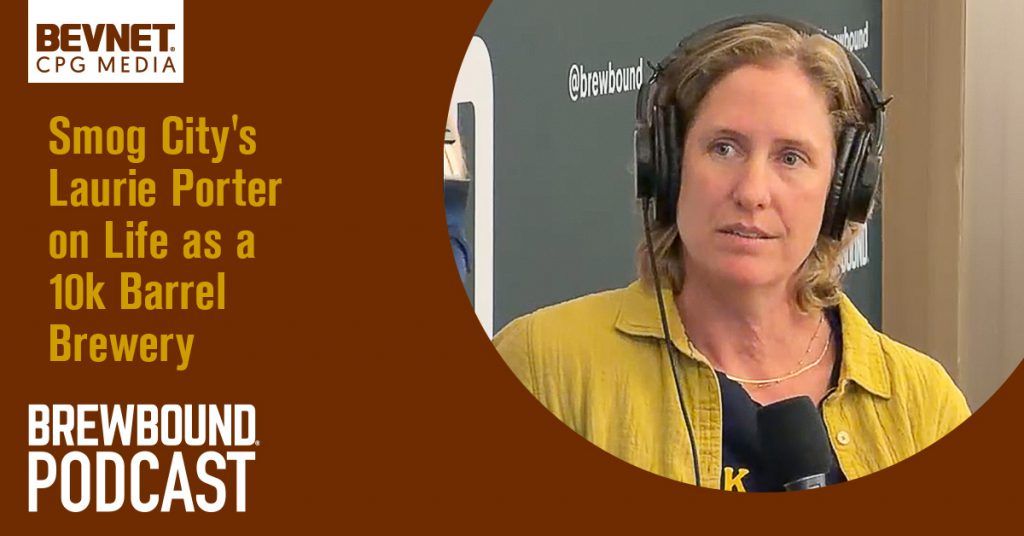
[00:00:50] Justin Kendall: And this week we're bringing you a featured interview with Laurie Porter, the co-founder of Smog City Brewing. I had a conversation with Laurie at the California Craft Beer Summit earlier this month, and she'll talk about the company's plans for a new restaurant, the life of a 10,000 barrel brewery and why they don't want to be much bigger than that. And the challenges facing the taproom business in LA. So stay tuned for that. How are you all doing?
[00:01:20] Laurie Porter: I'm okay.
[00:01:22] Justin Kendall: I am surviving. It's convincing.
[00:01:25] Laurie Porter: Yeah. I think first time ever, we've got a sick ish toddler home in the next room while we record. I mean, like I can see her. She seems fine. Everything's okay. But if I randomly disappear or you hear shouting or toys being thrown at me, I don't know that that's what went on here, but we're, we're all right.
[00:01:45] Justin Kendall: It'll make good podcasting.
[00:01:47] Laurie Porter: Oh, totally.
[00:01:48] Zoe Licata: Yeah. Zoe, how are you? I'm okay. I'm good. Gearing up for Brewbound Live. I always forget how insane this time is right before, but it's all worth it in the end.
[00:02:01] Justin Kendall: Now you have to do the plug.
[00:02:03] Zoe Licata: Yes. Brewbound Live, if you don't know, what are you doing? It's December 10th and 11th in Marina Del Rey, California. So coming up very, very quickly as you're listening to this, it's hopefully you're not listening on Thanksgiving unless you really love us, but it's probably just before Thanksgiving and then it's kind of our last week and then it's Brewbound Live. So it's coming up really quickly. We have a great lineup of speakers as well as just events and spaces to network, to meet with folks, to connect or reconnect. It's the best event of the whole year.
[00:02:38] Justin Kendall: That's true. And you just did a prep call with one of your panels and you said it's going to get spicy.
[00:02:45] Zoe Licata: Yeah, I just did a prep call for our Retail Focus Conversation, which features folks from Bob Williams Consulting, from Columbia Distributing and from Hand Family Companies. And they get pretty real, at least in our prep call they did, and I expect them to do so on stage as well. Kind of talking about the relationship between suppliers and distributors right now, what is necessary to maximize sales at retail for both parties involved, and Yeah, they have a little bit of tough love for folks, but also some really helpful tips on what really works when it comes to that relationship and when it comes to standing out in a very crowded marketplace right now. So I'm very excited about that conversation, which is happening on day two.
[00:03:34] Justin Kendall: Very much looking forward to that. I think a lot of people will be. Get your tickets now at brewboundlive.com. But while we have Jess, let's just dive into the news and get into your story on Siebel leaving the country.
[00:03:47] Laurie Porter: Yeah, this is an enormous deal. So the Siebel Institute of Technology is the oldest brewing school in the United States. It's been in Chicago since shortly after the Civil War. Graduates of the school have gone on to work at pretty much any brewery you can think of, both at the large macro level and the small craft level. And they announced last week that as of January 1st, they will be leaving Chicago to go to Montreal. And they cited a few different factors, including operational costs and industry trends, which sure. But the biggest thing that stood out to me in that announcement was that they cited the difficulty that international students are having in securing visas to come study here. When you look at the political climate that we are in, yeah, that totally makes sense. I dug a little bit more, asked them a few questions. They said international students make up about half of their student population. So that's huge. And one of the perks that they will have in Montreal is they will be on the campus of Lalaman's Baking Institute. That's actually their parent company. So they'll be able to do brewing and baking right there in the same spot, which makes a lot of sense. Those two things are very much aligned and have been for millennia. I like Montreal. I like Chicago. I'm not going to brew school, so my feelings on these cities doesn't matter, but it's a big loss for Chicago. I chatted with some of the crew at Chicago's Dovetail Brewery and many of the staff there have attended, but co-founder Hagen Joost said that He told me that the two pillars of craft beer in Chicago are the Hop Leaf Bar, renowned craft beer bar in Chicago, and Siebel. And he and brewer and marketing and creative director Jenny Faflin, JP, does kind of everything. said that, you know, Siebel students become regulars once they're in town for their programs. They love meeting them. You know, Jenny herself was in the middle of going through the coursework, and it's going to be really hard to do that now that the program's, you know, literally leaving the country. But she talked about how valuable she found the experiences of being able to interact with, you know, fellow classmates who came up through like AB InBev from Brazil, who work on like million barrel batches at a time. And just hearing their perspectives and thoughts are so much different than her own. And a lot of those in-person interactions, while Siebel does offer online coursework for just about everything, it's going to be hard to replicate that stuff.
[00:06:13] Justin Kendall: That's a huge deal.
[00:06:15] Zoe Licata: What really stood out to me from your coverage of it, Jess, was some of the quotes from folks about how that place served as a kind of collaboration space to a way to bounce ideas and knowledge off of different students who had different backgrounds working in different places. That is instrumental to shaping what happens afterwards. So to not have that base tier is definitely going to be a loss.
[00:06:37] Laurie Porter: Honestly, I appreciate how upfront Siebel was about the situation in their press release. Like, hey, we can't get students to come here, so we've got to go.
[00:06:44] Justin Kendall: Yeah. And to have essentially located school for students here in the United States in a city while still pretty expensive, it's not the coast.
[00:06:58] Laurie Porter: Yeah. You know, like your other bigger options for studying brewing and fermentation science are mostly all out west. So Chicago, to your point, Justin, is a nice centrally located option and Montreal is going to be even farther east. So that helps, but it's still a different country completely, which adds another layer of complexity.
[00:07:16] Justin Kendall: Let's shift gears and talk a little bit about Athletic Brewing. They are on pace to cross the 500,000 barrel threshold this year, and that's 500,000 barrels of non-alcoholic beer, which is a statement in 2018, if you ask me. I would have not made the bull case for that, but here we are, and kudos to Bill Shufelt and John Walker on what they've built and what they've invested in. That's going to make them a top six craft brewery by dollars by year's end and possibly even higher on the Brewers Association list. So pretty impressive growth that they've seen and continue to see. And they're going to launch a couple of new products in 2026, which is not something that they've done recently as far as like into distribution products. And they're going to start by line extending athletic light with a lime and salt version. And then they're going to add their cocktail inspired brews, their Moscow mule and Paloma. which will go to select markets, but that's all going to hit in January.
[00:08:27] Zoe Licata: Yeah, I'm really curious to see how those pan out, because something that I think has worked really well for Athletic is while they have a ton of different things that they offer direct to consumer, When it comes to what's at retail, they've kept it super simple, not just with the amount of things, but even the products themselves. You have a designated brand for whatever style of beer you really like. Recently, I was at a Spartan event, and Athletic had a big setup there, and they had their Mexican lager, their Athletic Lights, they had their Golden Ale, and then they had their Hazy. And me and my group each picked a different one because we had a different style that we were drawn to. And we were catered all by having some non-alcoholic option. And after we did physical activity and didn't want to necessarily put alcohol into our system, it made a lot of sense. So I'm curious how, now that they're going to try different things, how folks will respond to that, how it will pan out for them. But I will say from a party of one, Lawrence Falter is very excited about athletic light lime and salt.
[00:09:30] Justin Kendall: I think that's the one I'm most excited about. And just having spoken with Bill about their distribution being one of the top brands yet still having these gaps with others in the category and also seeing new entrants receive in some cases more distribution than athletic, I feel like they wanted to have some new news to give their distributors to sort of win them back because we all like shiny objects.
[00:10:01] Laurie Porter: Your story was really interesting, Justin, because they danced around it, but the celebrity-backed new products, I think, are those shiny objects. And Bill certainly did a great job making the case for why athletic is just a standard barrier for this segment. And really, like, this is who distributors and retailers should be putting their bets on.
[00:10:20] Justin Kendall: It's about not losing sight on what's working and who's really driving the growth. That's the story that they're trying to tell to their distributors and reinforce with them. And I mean, we are seeing a lot of new celebrity entrants into this field, more than I feel like we've seen in craft beer. there was Sammy Hagar and I wouldn't count Hulk Hogan. And I really wouldn't count the Kelsey's because I mean, they're a lager brand, you know?
[00:10:54] Zoe Licata: Yeah, I think it has a lot to do with the current, not just in beverage alcohol, but just overall social state of health and wellness. And a lot of celebrities and influencers have some sort of connection to a health related or wellness related brand. And so this just makes a lot of sense as another option for that.
[00:11:14] Justin Kendall: That's a distinction that they're really trying to make is they're about moderation, because they know their consumer is also buying alcoholic beverages. This isn't about sobriety, which a lot of the celebrity-backed NA brands are pushing a sobriety message. They believe that that is potentially, I wouldn't say damaging, but... Limiting. Limiting for the future of NA beer.
[00:11:40] Laurie Porter: Yeah, because when you look through most of those celebrities, you know, several of them like John Mulaney and Charlie Sheen have had very public, you know, substance abuse struggles.
[00:11:51] Zoe Licata: A lot of these celebrities, they're doing this because they have specifically had a very public facing journey when it comes to sobriety. And so they're tying that journey and that message to the brands that they're working with. And Athletic has made a point of integrating itself with full strength beer in the way that it interacts with other folks in the industry, the way it markets itself, it's very much just a companion rather than a replacement. And so it makes a lot of sense that they're not going towards that messaging that some of these new brands are and are sticking with what their plan has been all along.
[00:12:28] Justin Kendall: And that's very much been the case with Athletic and Heineken in the way that they communicate through their marketing that this is additive. This is not limiting. It's what you can do as opposed to what you can't do.
[00:12:43] Laurie Porter: Right. I mean, Bill will say over and over again that it's about creating new occasions for beer, where it's adding an occasion for beer on a Monday or a Tuesday night when you normally wouldn't have, or, you know, adding an extra round to a session that would have been limited by, you know, you just can't keep consuming full strength beers all night. So it's a difference that makes a difference. And I think it's important. True. Fair.
[00:13:11] Justin Kendall: No. Clearly, if anybody can't hang, it's me.
[00:13:16] Laurie Porter: I just saw an Instagram reel that was like some woman who looked about the same way that I do right now, speaking directly into the camera and was like, I think my life as a party girl really prepared me for motherhood because, you know, I'm just so used to the puke and rally, doing it all on no sleep and having messy hair that this was just a natural transition. I was like, damn, I feel seen. Something else that stood out to me in your story, Justin, was how many draft lines Athletic has right now. That to me was very new news.
[00:13:47] Zoe Licata: Yeah, I remember, I mean, was it two years ago now or a year ago when they first started? It was a very, very small on-premise rollout. When it comes to draft, they already had cans. and being very intentional about it because as we talked about, non-alcoholic beer can't just be thrown onto a tablet and you have to be very careful, make sure it is clean because you don't have that alcohol to help make sure everything is safe. It's cool to get an update because we haven't had too much since then on how much it has expanded.
[00:14:21] Justin Kendall: So in the U.S. alone, Athletic is on draft in 41 states with more than 2,000 placements. And 3,600 if you include the U.K. Lots of growth there.
[00:14:33] Smog City: That's huge.
[00:14:35] Justin Kendall: Yeah.
[00:14:36] Smog City: This episode is brought to you by the Craft Brewers Conference, where big ideas, bold beers, and brutally honest shop talk collide. Join thousands of industry pros leveling up their game. Don't miss it. Register now at CraftBrewersConference.com.
[00:14:56] Justin Kendall: Well, let's switch gears and before we get out of here, talk a little bit about Beatbox Watch. Speaking of parties. That's right. No deal has been completed as of this recording, but we continue to monitor this and Our friends at Bump Williams Consulting shared some data that if this deal would go down, it would make ABI the third largest company in the flavored alcohol space. That's pretty big.
[00:15:29] Laurie Porter: That's pretty big, but I also feel like that speaks to how big Marc Anthony and Boston Beer are too. You know, that AB adding beatbox, which are two huge things on their own, still isn't number one. Yeah.
[00:15:43] Zoe Licata: And it also points to the state of beverage alcohol and where growth is right now. And it's flavored alcohol is kind of the one thing. I mean, non-alcohol but within full strength, it's flavored alcohol has kind of been what has been able to avoid a lot of the other downward shifts that some other beverage alcohol has.
[00:16:05] Justin Kendall: Yeah, we didn't get your perspective on this, Zoe, and really, Jess and my perspective was in the moment of having just seen the report. So as a Gen Z, how do you feel about this?
[00:16:20] Zoe Licata: I have mixed feelings about it from like, this is my job reporting on this. I think it makes a lot of sense that, you know, I'm surprised no one has grabbed them yet. They have had insane growth and have been doing a lot of things that other alcohol brands have that have been picked up lately. So it makes a lot of sense to me from a consumer standpoint, and I don't know how much consumers actually care or not, but there is something that feels a bit misaligned with beatboxes, messaging, and company culture versus some of the stuff we've seen from Anheuser-Busch. So I don't know if there'll be any negative feelings towards Beatbox if this does happen from them being associated with Abeat. Maybe people don't care, they probably don't, but there's always a possibility. So that's just one thing where my hesitancy lies. Hopefully Abeat doesn't come after me for that. But it's just, it feels like Beatbox has been very intentional with their brand messaging and the brand marketing of what they are and they're kind of this, independent group that has created a brand off of socializing and music festivals and the entrance of a larger company is always going to change some things.
[00:17:37] Laurie Porter: We've seen AB nab up a innovator in the Beyond Beer space before and have it go not well. They did with Spike Seltzer back in the day, turned it into Bon and Vip, which I really liked. And then those two mermaid gals floated off into the sea. So we'll see what happens. I think the acquisition hatred among consumers is pretty much gone at this point. I don't I don't think anybody would give too much. It surprises me a little bit that it's AB. I would have thought one of the big wine companies would have picked up beatbox.
[00:18:10] Zoe Licata: Me too. I think the consumer concern has shifted. I don't think there's as much concern around independence. as there once was. I think particularly with the Gen Z consumers, there is more attention to company culture. And we know from like surveys and data that they care more about what is important to a company and what their standards are and just other things beyond just the product themselves. And so I think that's the one area where consumers may still care somewhat, but it's definitely not the days of like, oh no, it's not independent anymore. What are we going to do? They're sold out. I think consumers are very much aware that's just part of being a business.
[00:18:53] Laurie Porter: Anybody that has Mark Cuban on their cap table, I don't think can be accused of selling out at any point in the future.
[00:19:02] Zoe Licata: Also, consumers are totally unaware of a lot of these things, too. This is a very internal conversation, and there are still folks that don't know that Coors Light is owned by the same company as Miller Light, or that, you know, Mickela Bolscher and Bud Light are the same company.
[00:19:17] Justin Kendall: where the AB owns Golden Road or Elysian or whatever. Good luck figuring out ownership too at this point because some of those brands have changed hands so much. I mean, look at everything that Tilray has acquired from Anheuser-Busch and Molson Coors. independently, but that was very much a craft-specific narrative too. Totally. As opposed to other CPG where, you know, we see our colleagues at DevNet write about Pepsi acquiring Poppy, right? And I don't feel like the narrative there.
[00:19:51] Zoe Licata: Yeah, I don't think there was a lot of outrage when like Celsius got acquired or anything. I don't think there's as much attachment to it.
[00:19:59] Justin Kendall: Yeah. Again, we'll be watching this. Maybe there's a Thanksgiving news dump on Friday. Or not. Hopefully not. Please don't do that.
[00:20:08] Zoe Licata: Why would you speak that into existence?
[00:20:13] Justin Kendall: Just for the rush.
[00:20:15] Laurie Porter: Look, I would accept like a 9am Wednesday news dump. Yeah. I am not accepting Friday news dumps this week.
[00:20:21] Justin Kendall: No. Wednesday at 4.30 would be pretty rough too.
[00:20:26] Laurie Porter: Terrible. That's why before noon or GTFO, you wait till next week.
[00:20:30] Justin Kendall: Yep. Yes, it is Thanksgiving. Happy Thanksgiving to everyone out there. We are taking off the rest of this week, although there will be a, we think that there will be a weekend newsletter going out on Saturday. And with that, let's get to our featured interview with Laurie Porter from Smog City. This is Justin Kendall with Brewbound and I'm at the California Craft Brewers Association Summit in Irvine and I'm joined by Laurie Porter, co-founder of Smog City. Thanks for being here.
[00:21:02] So Porter: Hey, thank you so much for having me.
[00:21:03] Justin Kendall: So I want to talk a little bit about something you said. They introduced all the board members this morning with the CCBA and you were sandwiched between Jim Woods and Sierra Grossman and You mentioned representing the 10,000 barrel brewers with four tap rooms and gyms on the other end of being under 2,000 barrels. And Sierra Nevada is, of course, Sierra Nevada. So I want to get a feel for what it's like for the middle ground brewers right now in California. How are you doing? What's working? What's not?
[00:21:38] So Porter: You know, I think that one of the benefits we have of being in that middle ground is we are not too big and not too small. We're still able to pivot quickly. We're able to respond to customer needs. And that has been really helpful. I think, you know, if I'm really looking at the industry, the ones that are getting hurt the most are the small. who are self-distro and relying on customers coming into tap rooms only, or the very, very big that have just giant infrastructure and they're dependent on chain and dependent on much higher volume sales. At our level, between the 5,000 and 12,000, 13,000 barrel, A lot of our revenue is built off of that, the taproom direct-to-consumer, which has a little bit higher profit margin. It helps us float that wholesale. So if wholesale is struggling or having, or we're seeing dips and changes in seasons and customer change, we have a little bit more buffer. And so I think that's been good for sort of us like middle-sized breweries. I feel thankful for that. And it's also been pretty strategic, honestly. We've looked at the 15 barrels ceiling and been very apprehensive to even try and break that because of the ability to pivot and flex and manage our costs in a way that feels more easily responsive to changes and the climate.
[00:22:52] Justin Kendall: That's really interesting, though, that 5,000 barrels can make that much of a difference.
[00:22:57] So Porter: Yeah, I think when, this is just personal, but I think when you hit that 15,000 barrel, you are playing so deep in the chain world because it's all about volume. And chain can be really fickle. It can be really difficult to maintain. A beer buyer changes, boom, you're off the shelf. And that's now, whatever, 450 barrels of beer for that one style of beer that you had committed to that grocery, and it's gone. And you just can't predict it. So having the diverse revenue income coming from, we have four tap rooms with international sales. We do Arizona, Nevada, California, Southern California. Having extra revenue sources where you can kind of spread it out. If one thing starts to go sideways, you move your focus to another. It really helps, I think, shore you up during the hard times.
[00:23:46] Justin Kendall: How is the taproom business going right now?
[00:23:48] So Porter: Taproom business is good. You know, one of the weird things about craft beer is there's just no historical data. Year over year, there's some... catastrophe or economic downturn or presidential election or war in Ukraine or whatever that you have no control over. And so, in Los Angeles in 2025, we had catastrophic fires that destroyed two entire communities. That was an immediate impact on our taproom. We lost a ton of revenue during that time. And then we have been trying to come back out of it. Things like the ice raids in LA have impacted sales through the summer. Travel now during the government shutdown impacts tap rooms. But in general, what we're seeing is that I think in 2024 we saw a shrinkage. People started to go home. They were, I always like to say they were streaming. They were streaming and drinking. They weren't going out and hanging out. And I think that they're actually getting tired of being at home again. And we're starting to see them turn out. And so even on slow days that we normally expect, to have a little bit slower night. We're seeing these company parties come out. We're seeing birthdays come out. We're seeing more and more people showing up. And so I'm wondering if we're going to sort of head into another upturn in our tap rooms.
[00:25:02] Justin Kendall: Do you get a lot of the event business, like you mentioned, the holiday parties, that sort of thing?
[00:25:06] So Porter: Yeah, we get some. Our taprooms aren't really built for events, and so we are able to separate off areas. There are breweries in LA that are literally designed to have private events, and I think they're doing really, really well. The private events sector is absolute revenue generator. It's one of those opportunities I wish we had in our brewery that we could take advantage of, and we look all the time, and how can we expand? How can we make more space for that? And we just don't really have it, because it's all dedicated to manufacturing.
[00:25:36] Justin Kendall: You mentioned some headwinds, and those are not small headwinds. The fires, the ice raids, the just unrest, the inflation. And it seems like you're doing all right to get through right now, as you sort of plan out the next year, couple years, because before we started recording, you kind of really laid out that you're a prepper. Like, I don't want to call you like a doomsday prepper, but you said you launched the brewery in 2011, and by 2012, you're like, this can't last, this double-digit growth. But I mean, we're in the thick of things right now in this maturing market. How are you preparing for the next year, and the next year, and the next year, at least a couple out?
[00:26:26] So Porter: I mean, every industry encounters ebbs and flows and, you know, periods of growth and periods of shrinkage. And I think that we're in a period of correction after COVID, you know, coming out of, you know, 2020, 2008 and then up, it was just growth, growth, growth, growth, growth. COVID put us in this weird stasis. You know, we got a lot of support from the government. And then now I think there's a bit of a correction happening. In our company, we are just hyper-focused on hospitality, making sure that when customers come, they have the best experience, that they become loyalists, brand consistency, and really focusing on how we're marketing and talking to our customers. We now have two marketing employees on-site, full-time, who are dedicated to just building our story, because Smog City, been around for 14 years, we have a lot of story to tell, but it's really hard to do it when you're also doing everything else. And so now we have two people really hyper-focused on telling that story, making it clear, making customers understand. And I think when you have that brand development and consistency, you create stability, and the stability creates longevity. And so we're really focused on how can Smog City be invested in our community, How can it be an industry leader? How can we be part of the conversation? Part of my role of serving on the board of the CCBA is being part of that conversation on how do we protect our industry? How do we do what's right for the breweries in California so that as many of us as possible can survive the next 10, 15, 20, 40 years?
[00:28:00] Justin Kendall: You talk about hospitality, and I think that's a huge part of the equation right now. What is driving consumers into the taprooms right now for you? What's kind of pulling them in?
[00:28:13] So Porter: I think experience is probably number one. What I noticed was during COVID, hospitality went out the door. Everybody was just trying to survive. Your experience in a restaurant, bar, brewery went in the toilet. And we were like, This is where we win. All these people are afraid. They're showing up in our tap rooms. We're going to give them the best, safest, most awesome experience. And so we've really focused on doing that. I think customers in California, especially, are still really connected to who made my product. How is it made? Where is it made? Coming into a brewery and being able to see the tanks is still cool. It's not the same like, I've never seen this but now it's almost like a comfort space where they get to come in and they're in a space where they're welcome. There's a wide variety of people that are sitting around having beer and they're all having the same beer so you can easily have a conversation. I think that's where we're really winning is having that opportunity to do something unique. I mean, a lot of people have talked about experiential events, and there's pretty much nothing better than going into a brewery and being able to see where the beer was made and then drink it. And so I think we're winning on that side. And then providing the hospitality to keep them there and keep them coming back.
[00:29:29] Justin Kendall: You talked about adding, well, one of the things that you're looking to add in is a food concept. Everybody knows the restaurant industry is an easy one to get into. But I think that you have a point that consumers want the full experience in one location. And so how are you looking to add that to Smog City?
[00:29:54] So Porter: So over the last five years, we've been looking for another place to open our tap room and watching customer trends and realizing that without a food component of some sort, there's just not really a future for people just coming into a warehouse and drinking beer, unless you have the brewery. I mean, honestly, if that's where you're brewing the beer, people will still show up. But for our satellite tap rooms, in order to actually meet the customer where they're at and provide for them what they need, we think there has to be food. And so our next step is, we call it a food concept because I'm afraid to say restaurant. Restaurants are terrifying. So it's a tap room with a food concept. And the way we look at it is, you know, we have spent 14 years building trust and relationships with our customers. We are an innovative brewery. We're known for innovation. We're known for creativity and different types of brands and styles. ways to get new customers in, and so we're hoping that customers will give us an opportunity, and at the end of the day, it's like I said, it's ours to lose, right? Like if we fail, it's our fault, but customers, we're gonna give us a chance. And we think we're really gonna be able to take all that we've learned over the years and turn that into a successful food concept. restaurant.
[00:31:08] Justin Kendall: What are the details of the food concept that you can share at the moment?
[00:31:13] So Porter: Yeah, so it's a location down in Long Beach. We're unfortunately at the end of this year, we're losing our steel craft location, which we've been in for 10 years. And when we found out that we weren't going to be able to renew the lease, we were gutted. and we realized we had spent 10 years building a community and we didn't want to lose that community and so we started looking. This location is on Wardlow in Long Beach in a little neighborhood called Cal Heights. It's directly across from an iconic bar called Rock Sands and so the owner of Rock Sands and us at Smog City are really focused on creating sort of an entertainment hub where people can come to and there's multiple things that draw you into that area. It comes with a kitchen, which is really cool. We don't have to build it from scratch. And then we have this amazing executive chef we've been friends with for about a year, a year and a half. And we've been looking to do a project with him. And this is kind of like the perfect culmination of it.
[00:32:07] Justin Kendall: What's the timeline?
[00:32:08] So Porter: We're hoping to soft open in December, so we're pretty close. There's gonna be, you know, limited alcohol options to start, but we're gonna come out with really good food and play around with the menu and mostly innovative burgers, fries, chicken wings, and then pickled vegetables and pickled eggs, which I'm really excited about.
[00:32:29] Justin Kendall: Oh, nice. You mentioned your husband likes to cook. Is he influencing the menu?
[00:32:34] So Porter: Oh, yeah, of course. Yeah, he is. Yeah, he always has an opinion. Our executive chef is really taking the lead. But Porter gets to sort of weigh in. He cooks every day, all day, loves cooking, lives and breathes and dreams food and aromas and smells. And so he's actually the more excited one about the project. I'm usually the optimist in our family, in our business. I always call myself the incurable optimist. I am right now the practical one that's losing sleep at night, and he is just dancing on air. He's super excited. But he also feels really prepared for this because when you're a brewer, your entire job is recipe development, it's cost control, it's efficiency, it's manufacturing, it's production of the same thing over and over and over again in a predictable way. So he looks at it and he says, you know, there are things I'm going to have to learn in back of house, but there's a lot that I'm bringing to it that puts me at an advantage.
[00:33:32] Justin Kendall: That's very cool.
[00:33:33] So Porter: I hope is right.
[00:33:34] Justin Kendall: Congratulations. That's pretty exciting.
[00:33:36] So Porter: Thank you. We'll see in six months. You want to buy a restaurant?
[00:33:44] Justin Kendall: Let's get it over first. Okay. Well, I appreciate you doing this, Laurie. Thanks for taking the time out.
[00:33:50] So Porter: Yeah, thank you so much for having me. This is really awesome.
[00:33:52] Justin Kendall: This was so fun.
[00:33:53] So Porter: Cool. Thank you.
[00:33:54] Laurie Porter: Yeah. And that's our show for this week. Thank you for listening. The Brewbound Podcast is a production of BevNET CPG. Our audio engineer for the Brewbound Podcast is Joe Cracci. Our technical director is Joshua Pratt and our video editor is Ryan Galang. Our social marketing manager is Amanda Smerlinski. Our designer is Amanda Huang. If you enjoyed this episode, please share it with your colleagues and friends and review us on your listening platform of choice. You can find our work at Brewbound.com and we also welcome feedback and suggestions at podcast at Brewbound.com. On behalf of the entire Brewbound Podcast team, thank you for listening. We'll be back next week.