[00:00:00] Justin Kendall: Heading to CBC? Kick things off the day before at Brewbound's meetup at Love City Brewing in Philly, Sunday, April 19th from 5 to 7 p.m. Connect with beer industry leaders, grab a drink, and catch up with the Brewbound team. It's free to attend and walking distance from the convention center. Head to Brewbound.com slash lovecity.rsvp. And don't forget to catch the Brewbound team at booth 956 during CBC. What's up with BrewDog USA? Find out next on the Brewbound Podcast. Hello and welcome to the Brewbound Podcast. I'm Justin Kendall.
[00:00:47] Jessica Infante: I'm Jessica Infante and Zoe'm Zoe Lica.
[00:00:50] Justin Kendall: How are we all doing?
[00:00:51] Jessica Infante: Great. Yeah, we're good.
[00:00:54] Justin Kendall: Yeah.
[00:00:55] Jessica Infante: It was a bit hectic coming out of the holiday, but we survived.
[00:00:59] Justin Kendall: That was a Labor Day rush.
[00:01:01] Jessica Infante: Yeah, we made it.
[00:01:02] Justin Kendall: A post Labor Day rush.
[00:01:04] Brewbound Podcast: It is like the back to school, back to generating business news situation.
[00:01:12] Justin Kendall: A summer of play and now everybody is figuring out what they're actually doing with their business. Makes sense.
[00:01:20] Jessica Infante: Ready to share it, at least.
[00:01:22] Justin Kendall: How are you feeling after week one, Zoe? Not great. Not great?
[00:01:26] Jessica Infante: Not great at all. Honestly, I went 0 for 2 in fantasy, and my team went terrible, but they lost too, my New England Patriots. So not good. Not good at all. How was your week one?
[00:01:40] Justin Kendall: I'm 1-3 and oddly happy about it.
[00:01:42] Jessica Infante: Hey, there's one.
[00:01:44] Justin Kendall: Yeah, I got the one. And then I live in the cyclone state, so I'm super happy about that.
[00:01:51] Brewbound Podcast: You guys had your big rivalry game.
[00:01:53] Justin Kendall: That's right.
[00:01:54] Brewbound Podcast: And your team won.
[00:01:56] Justin Kendall: Yup.
[00:01:57] Brewbound Podcast: Congratulations.
[00:01:58] Justin Kendall: It remains the Cyclone State.
[00:02:00] Brewbound Podcast: What is that game regularly called?
[00:02:03] Justin Kendall: The CyHawk game.
[00:02:05] SPEAKER_??: The CyHawk game.
[00:02:06] Brewbound Podcast: And why is it so early? Isn't this usually like a Thanksgiving week kind of thing?
[00:02:10] Justin Kendall: No, because they're non-conference rivals. They do it in September, historically. But very happy. Very happy.
[00:02:18] Brewbound Podcast: Congratulations.
[00:02:20] Jessica Infante: Did you have any victories, Jess, in your non-football world?
[00:02:24] Brewbound Podcast: Well, what did I do this weekend? No Seagulls. So let's call that a victory. That is definitely a win.
[00:02:31] Justin Kendall: Yeah. No beach days, no Seagulls.
[00:02:34] Brewbound Podcast: No beach days, no Seagulls. So it's kind of a tie.
[00:02:37] Justin Kendall: Well, we've got an interview coming up. Jess and I spoke with Eric Teodoro from BrewDog USA. We're going to get into how the U.S. operations interact with the mothership in Scotland. We'll talk about pulling back their distribution, but still seeing some volume gains in the last year and kind of new innovations that they have on the table this year and going into next year.
[00:03:00] Brewbound Podcast: It was a really great chat with Eric who, you know, He reached out to me a couple of months ago and we've just kind of become like pen pals, sort of, and phone pals. And he's a super nice guy. He did not shy away from us asking a couple of tough questions about what their relationship is like with their Scottish overlords who have generated some drama lately. He was super honest with us about that relationship and how the leaders in Scotland generally trust them to run US operations on their own. You'll hear him talk all about it, but it was a really great chat and I'm glad we did it.
[00:03:31] Justin Kendall: We also got into some things that they're doing in Las Vegas with their tap room there. Stay tuned for that. Also stay tuned for Brewbound Live. That's coming up December 10th and 11th in Marina Del Rey, California. We will be at the Marina Del Rey Marriott. A full day and a half of beer business, Bev, elk business conversations. We're also bringing back our pitch slam competition, which you can apply for. Look for the application on our site. Now, if you don't see it, reach out to us at podcast at brew down.com and we can help you out, but we're sorting that out and sorting out. the program as well. We've got a lot of great things already announced and we're still firming up some other things that will be coming to the program as well.
[00:04:18] Brewbound Podcast: I had my first Brewbound live stress stream last night. And it was that the hotel was full, which does happen. So if you book your room now, the room block is open. You'll get the discounted conference rate. And you, unlike the unfortunate people in my dream, I could not tell you if they were specific people or they were just people, but they didn't have rooms. Don't let that be you. Don't let that be you.
[00:04:41] Justin Kendall: I'm jealous that this was only your first Brewbound Live stress train.
[00:04:45] Jessica Infante: Well, you guys really need to start offloading all that stuff before you go to bed. I don't think I've ever had a brew bound live stress tree.
[00:04:56] Justin Kendall: Maybe like week of I have I definitely have week of who's the woman who does the free yoga? YouTube videos is a yoga with Adrian. Yeah, I've been saving those to like a favorites folder, and I've yet to do one, but in the back of my head, I'm on the way to actually doing that program.
[00:05:18] Jessica Infante: I really hope this happens for you.
[00:05:20] Justin Kendall: I really hope it happens for me too.
[00:05:23] Jessica Infante: Well, anybody attending will not be stressed out. The Brewbound Live is really fun. This is just for us. I would also plug that if you have any suggestions for either people we should make sure we're connecting with or people who should be participating in Pitch Slam that we should check out, anything at all, just that we should be keeping tabs on, send an email to news at Brewbound.com or just email any of us individually. We want to know, we want to keep updated on what's going on.
[00:05:51] Justin Kendall: Yep, we are very interested in speaker submissions, so reach out, especially if you're a retailer. Would love to hear from some of those folks. Let's get into the news. As we mentioned, it was a busy post-Labor Day week, and one of the biggest stories of the week was 21st Amendment is shutting down operations, which It is pretty rare that a brewery that was once 100,000 plus barrels decides to call it quits. Obviously, those numbers have declined in recent years and they're gonna be winding down operations over the next two months and maybe a little longer for their tap rooms, but they're also shutting those down and they'll be looking to sell the intellectual property of the brewery as well as equipment and such.
[00:06:42] Brewbound Podcast: I mean, it is rare, and yet it feels like it shouldn't be. Yeah. I assume it's not the first that we're going to see this happen to a brewery from that era.
[00:06:53] Justin Kendall: I mean, there was Anchor, of course, but Anchor had... Other stuff going on in that situation.
[00:06:59] Brewbound Podcast: Yeah.
[00:06:59] Jessica Infante: But maybe it's San Francisco. That definitely could be part of it. It wasn't initially the plan. someone set up that was going to take over leadership and kind of keep it going and that fell apart. And the reasoning behind that was it seemed like the people that were going to do that realized that maybe it's too risky of an investment right now. It kind of lays the landscape for That's where the state of just investment and M&A in craft beer is right now as folks are much more hesitant than the past to really get in here because it's not a guarantee anymore.
[00:07:36] Brewbound Podcast: Yeah. The bank got spooked by the state of craft beer.
[00:07:40] Jessica Infante: Yeah.
[00:07:41] Justin Kendall: I had the chance to talk to one of the co-founders, Nico Frazier, and he said they haven't been profitable for several years now. And if you look at the declines in the business, you can see it a lot of double digit declines in barrelage. They tried to make a pivot in 2023 to contract brewing that worked for a little while. And then this year happened. And even those contract partners began to hit headwinds where they weren't producing as much, which threw off the whole operation.
[00:08:11] Jessica Infante: Yeah, it brings us to question what's going to happen in a few years down the road where a lot of folks have been relying on contracts, not just for someone else to make their product, but to bring in that extra business of producing for other people because they have this extra capacity now with business down. So are we going to see more things like that where some of those folks as their partners are still not seeing growth? What happens then?
[00:08:38] Brewbound Podcast: The thing that I think really indicated to me that we are in a different time was when Dorchester Brewing in Boston, which started out as a half contract production, half own brand production situation, announced that they were going to stop doing contract production because one, they This is like half the reason they exist. And two, they'd been doing it for a really long time. And three, co-founder, owner, CEO, Matt Malloy, super nice guy, told me that the margin's just not there unless you're doing it for a lot of brands. And it's just so hard to get that going. So if they can't make it work, I don't know how it's going to work out for companies that have tried to make this pivot to being contract producers in the past, call it five years, you know?
[00:09:23] Justin Kendall: And we're in a macroeconomic environment where the cost of goods are changing pretty rapidly. If you look at just the way that cans are being tariffed, you've got can ends and lids now being part of the 232 aluminum tariffs. costs in general are on the rise, there's just no stability to anything there. So if you're contract producing for somebody else and those costs continue to rise, it totally makes sense.
[00:09:51] Jessica Infante: I had an interesting conversation recently, and this will be on this site soon if not already, with Andrew Berman from Other Half. We kind of talked after we were updating on the brewery and he said, I'm just really interested to know for a lot of these larger breweries that are saying, yeah, we're struggling a bit right now, what specifically is that that's happening? There's a lot of general talk about craft is dealing with a lot right now. Breweries are struggling right now, but he's like, I want to know why a brewery like Trillium? What is happening there? What is their specific problem? And then you look at another brewery that's more focused on less on taproom and solely on distribution, but they're also struggling. What is the specific thing that's happening there? Where are the sales that they had before going to now? There's so much happening and we've had so many broader conversations, but will we be able to nail down what what is actually specifically happening at some of these breweries that potentially other breweries are noticing and can avoid, and if that's even possible.
[00:10:54] Justin Kendall: And Nico at 21A, he listed off several of those. They had all this double-digit growth, they build a brewery, and then things slow down, and then the growth stops, and then you're in a pandemic. And right before the pandemic, your distributor sells your home market distributor to Reyes, and you don't go with the Reyes network, you move to the AB network. Not only are your sales slowing or your growth stopping, but you're transitioning distribution to a new network during a pandemic. It's just one thing after another. And then on top of that, you have moderation trends, tariffs, whatever recently that add up. You have a sales partnership that they had with Brooklyn Brewery and Funkworks at one time. That goes away. So you have to rebuild your sales force. It's just one thing after another. And he said he could probably write a book for everything that's gone on in the last 25 years.
[00:11:57] Brewbound Podcast: I kind of hope he does. Yeah. To me, that distributor partnership really jumped out as being that, oh, that sucks. Because sometimes that is really good for a brand, but the timing of that is terrible. Like when you're supposed to be like getting to know each other and working the market together and exploring various other territories and the world shuts down, then you're in a pretty unfortunate spot.
[00:12:21] Jessica Infante: Yeah. I kind of hate that I'm saying this because I've been so sick of beer leaders saying this but the controlling what you control thing is so vital right now of when there are so many possible things that you cannot control when it comes to your business like those distribution consolidation things and the tariffs and supply chain, it's even more important for craft breweries right now to be looking internally at, okay, what can I do on the business side to make sure we are really tuned in tight when it comes to where we're getting supply from, how we're handling labor, what we're producing, are we producing too many things, anything that is within your power to make Those things less of a risk because you're aware that everything else is kind of a little chaotic right now. Those tend to be the breweries that are surviving through it and are doing better and in the end possibly finding growth. It's because they're finding ways to still not be like, oh, everything. They're kind of just at the mercy of the marketplace right now. There are still some things you can do to make your business a little bit tighter.
[00:13:26] Justin Kendall: And I will say too, 21A is one of those breweries that is, as Nico described it, in the middle size. So you're not big enough to be among your supplier's top brands. Like if Ball Corporation put them on allocation for cans, he said at one point, basically he said, quote unquote, stiff-armed them. And that puts you in a position where you can't control things. You're not the biggest, but you're not the smallest, but you're just kind of in that middle ground trying to make it work. And we don't have to be laborless. You can read the story at Brewbound.com. But I will say that there may be some positive news for 21st Amendment, the brand, because I've had a few people reach out to me and I've put them in contact with NECO. So there may be an opportunity for the brand to live on. Maybe. We'll see.
[00:14:25] Brewbound Podcast: One other big news story that we are following this week and have been following for over a year is the two different alcohol-related studies that are going to be part of the Dietary Guidelines for Americans process for 2025 to 2030 is no longer. So that one controversial study spearheaded by the ICPUD, the agency that focuses on underage drinking and drew the ire of Just about every single trade group and association you can imagine in the beverage alcohol industry has been spiked. The Department of Health and Human Services will not be allowing the Dietary Guidelines Committee to consider it. If you remember going back to December, January when these two alcohol studies were breaking, The one by the National Academies of Science, Engineering and Medicine, the one that the industry felt more comfortable with, that one came out and said that consuming a moderate amount of alcohol did not have any worse impacts on health than consuming no alcohol. So people generally considered that to be a win, though that study did call out that some alcohol consumption can be linked to higher instances of breast cancer in women. This other study, the ICPUD study, which is probably the grossest acronym I've ever heard, which I am not making any comment about the study itself. I'm just saying this coordinating committee really needed to consider acronyms. This study did not paint as rosy a picture. It noted that there are impacts on your health for even the smallest amounts of alcohol consumption. What seems to be at question here is what's considered moderate and stuff like that. Anyway, that study is no longer going to be part of the process. The very lengthy process that seems to never be ending. Never end.
[00:16:11] Jessica Infante: Never end. We were allegedly supposed to have some sort of answer in July and that came and went and Now it's September. Yeah.
[00:16:21] Brewbound Podcast: And what's briefly what's at stake here is the last time this happened five years ago was the committee that rewrites the dietary guidelines was considering dropping the recommended daily allowance of two alcoholic beverages per day for men, dropping that from two to one. It is at one for women. And that was shuttled at the last minute, didn't happen. Canada recently dropped their allowance to, I want to say, two drinks a week. So obviously there are much broader conversations about alcohol and health, but it seems to be that the committee that's considering that for us here in the good old US of A is going in the complete opposite direction.
[00:17:05] Justin Kendall: What a saga.
[00:17:06] Brewbound Podcast: What a saga.
[00:17:08] Justin Kendall: Let's play another round of tabbing out. And we've done a lot of coverage of the Barclays Consumer Staples Conference lately. Among them was Jim Cook from Boston Beer, and he's on a quest for 10 million case, $250 million brands. But on the way there, he's willing to fail. He said, if we get one out of 10, he'll be happy. And he also mentioned general admission and Loma Vista, hoping the audience hadn't No recollection of them, which I have a deep recollection of both. And those stories live on at Brewbound.com. But my question to you two is, Jim mentioned Social Pop, and we really don't know much about Social Pop. He called it an alcoholic version of poppy, which of course is the better for you soda brand. And so they're trying to alcoholify it. Can you alcoholify a better for you drink?
[00:18:03] Brewbound Podcast: Zoe, do you want to go or do you want me to go? You can go. Oh boy. I guess sure you can, but you're going to have a real fucking hard time talking about it, right? You can't talk about these things. You cannot call out impacts of health. from alcoholic beverages. So I guess you just say, hey, it's like hard poppy, wink, wink, and expect everybody to know what that means. Like, drink this, it's great for your guts.
[00:18:30] Jessica Infante: So the whole thing with poppy and some of these other drinks is like, it's a prebiotic soda, right? Yeah. If you put alcohol in there, doesn't that cancel it out? I don't know.
[00:18:42] Brewbound Podcast: I don't even really know what it means. I know I should. I'm too scared to ask.
[00:18:47] Jessica Infante: It's bacteria at the end of the day. So you can't have alcohol and bacteria. Alcohol kills bacteria. So yeah, I don't think it really works. So you're just promoting the idea that maybe it's like, I assume it's low in sugar or sugar-free and it's like the spiked sodas of the past, but they're less bad for you. But those didn't really work either. So why are we trying to do it again?
[00:19:12] Brewbound Podcast: What is this, if not just hard seltzer?
[00:19:16] Justin Kendall: And we admittedly do not know much more about social pop. We tried to get some answers as far as what it was. And other than Jim naming the brand and describing it as an alcoholic version of poppy, that's all we've got. We don't have an ABV. We don't have package format. We don't know ingredients. We don't know anything really about it. But clearly they're looking to capitalize on a trend, but Can you do it?
[00:19:44] Brewbound Podcast: I assume Jim was not supposed to say anything about this to anybody.
[00:19:48] Justin Kendall: That was my feeling after reaching out to their PR people was that Jim might've jumped the gun.
[00:19:56] Jessica Infante: He has even more titles now, so he can do whatever he wants. That is true.
[00:19:59] Brewbound Podcast: He's the CEO. I think that they're just trying to make hard mountain dew for girls.
[00:20:05] Jessica Infante: Yeah.
[00:20:06] Justin Kendall: Speaking of a product I haven't heard about lately.
[00:20:08] Jessica Infante: But that's almost exactly what this is. I understand the why of these drinks are popular. Flavor forward alcohol is popular. Super graphic imagery. This is all assumptions I'm making. Again, we don't know anything about the brand, but just what I assume from something that is inspired by these products. Bright packaging and fun, young marketing. That's all very popular, but I don't see people choosing it over something that already exists.
[00:20:38] Brewbound Podcast: I think at this point they'd be better off doing a hard version of dirty soda. Yeah. You know, nobody's trying to trick themselves that those ungodly creations are healthy.
[00:20:50] Jessica Infante: Right. Exactly. And I did, so I did a dive after Justin first mentioned this and was anybody talking about a version of alcoholic poppy or lollipop or anything beforehand? And the only thing I could find was there is a TikTok trend, it's kind of old at this point, this was probably like a year ago, where people were cutting off the tops of their poppies and adding alcohol to them or other things to it. So there is some sort of precedent where people are kind of turning these into cocktails, but it doesn't seem like a big enough thing. I think it's just a viral fun, let's use this cool new can opener that takes the top off my can and turn it into a cocktail.
[00:21:29] Justin Kendall: Well, you have shared some TikTok videos recently that were talking about dietary guidelines.
[00:21:37] Jessica Infante: Yeah, maybe I take back everything I said and who knows what people will consume. Because yeah, there's been some scary alcohol content on the internet lately, including a trend making BBLs or BBCs. Both are combining buzzballs, beatbox, and then the C is a cutwater. The L is a four loco.
[00:22:00] Justin Kendall: Yeah, I saw it just his face, which you can't see on a podcast, but it is the exact look that I had. And I was screaming when I was watching this.
[00:22:09] Jessica Infante: Yeah, picture bright, bright liquid that probably will be illegal because of all the dyes in a couple years. And the concoction of a lot of very high ABV products. I said it's just a recession indicator because people are just trying to disconnect from the state of the world and just combining random shit again. I will not be participating in the BBC or BBL trends, just letting everybody know.
[00:22:35] Brewbound Podcast: Dude, when you put that in the doc, I thought we were talking about Brazilian butt lifts and the Boston Beer Company, so I'm really glad you explained.
[00:22:43] Jessica Infante: Yeah. Yeah. One of the TikToks was one being like, this is the only BBL I'll ever get.
[00:22:50] Justin Kendall: We have to endure more Gen Z conversation about what they're doing at the bar, which is putting ice in beers. And we're, people are freaking out about that. Look, I've been through sister on level one. So I passed a multiple choice test. Jess has got the Jedi status, but I'm not going to poo poo anything. You want to put ice in your beer at a bar? Go for it. Drink a beer. Great. Please do.
[00:23:17] Jessica Infante: I mean, is it just like a knock on the state of draft beer right now where people feel like they have to put it in because it's warm beer? Or maybe it doesn't really taste different because there's so many light lagers that may not taste like much. I think there's a lot of other things going on that could possibly explain this, but we like cold beverages. I'm putting my ice in basically everything. I do this as well. Yeah. We talked about this before. Jess and I love a hard seltzer poured over ice. I think that tastes better than hard seltzer just straight out of a can.
[00:23:54] Brewbound Podcast: Oh, the only way I can drink twisted tea is over ice.
[00:23:56] Jessica Infante: Yeah.
[00:23:57] Brewbound Podcast: With a straw.
[00:23:58] Jessica Infante: So I have it watered down a little bit, but yeah, like you said, at least they're buying alcohol.
[00:24:02] Brewbound Podcast: So basically any reports about Gen Z not drinking, vastly overblown. You're right. The kids are doing it.
[00:24:10] Jessica Infante: They may be doing weird shit with their drinks, but they're still drinking them.
[00:24:15] Brewbound Podcast: I was out this weekend at the fancy cocktail bar in our town, and three definitely younger than me, but that's not saying much because I'm old, spooky tourists to Salem, Massachusetts, came into the fancy cocktail bar and asked the bartender for malort. So there was no malort. We're not in Chicago.
[00:24:33] Justin Kendall: Shut it down.
[00:24:35] Brewbound Podcast: Shut it down. Yeah. No one is giving up. We're not in the second coming of the prohibition. Everything's okay.
[00:24:43] Justin Kendall: Clearly not if we're mixing beatbox buzz balls and your choice of cut water or 4Loko.
[00:24:48] Jessica Infante: Maybe I do need to try one just as a... I will not be drinking a measuring cup full of liquid as is being done in these videos, but I'll mix it together and then pour a like tiny little glass to see what this tastes like. I am not consuming all three of those beverages in full. That is absolutely psychotic.
[00:25:09] Justin Kendall: If any of the three of us is a candidate to try this, it's you, but I cannot legally tell you what to do on this one.
[00:25:18] Jessica Infante: I appreciate not being peer pressured to drink three 11 plus percent ABV beverages. Visit beerswithzoey on Instagram to find out. Yeah, I'm not doing it without proof. So if I do do it, there will be proof.
[00:25:33] Justin Kendall: Maybe next week you can fill us in.
[00:25:35] Jessica Infante: If I make it.
[00:25:36] Justin Kendall: Do not recommend. Although I do recommend our interview with Eric Teodoro from BrewDog USA. So let's get to our featured interview.
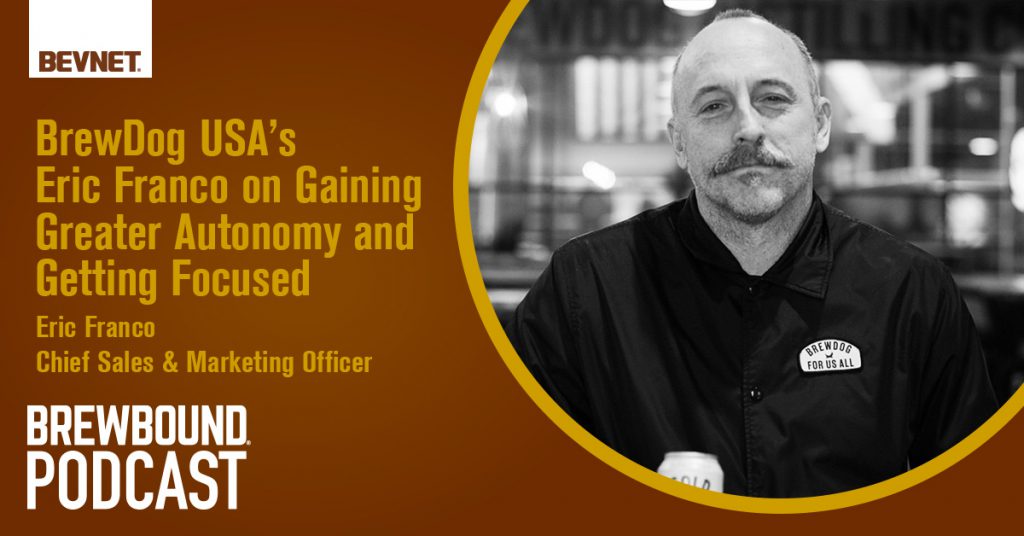
[00:25:47] Brewbound Podcast: Our guest this week is Eric Teodoro, Chief Sales and Marketing Officer of BrewDog USA, the stateside operations of the Scottish Craft Brewery. Eric, it's so good to have you here with us this week. How are you doing?
[00:25:59] Eric Teodoro: I'm doing well, Jess. How are you?
[00:26:00] Brewbound Podcast: I'm pretty good, thanks. You know, September is a weird month because it's like it almost feels like January all over again, you know?
[00:26:07] Eric Teodoro: It's kind of crazy. Apparently it was snowing in northern Michigan. So it's apparently here.
[00:26:13] Brewbound Podcast: I just meant like mentally in terms of like a reset, but I didn't need to know that. That's scary.
[00:26:19] Eric Teodoro: I'm prepping for stout season already. I'm into stouts already.
[00:26:23] Brewbound Podcast: And so let's just jump in and talk about it. The BrewDog global brand has been in the news a little bit lately. A couple of weeks ago, we reported that co-founder Martin Dickie has stepped away after James left a couple of years ago. That means they're both kind of out of the day-to-day operations of the brewery, which I think probably comes with some interesting opportunities. It's like a fresh page, just like the beginning of a new school year, as we just talked about. With that, there's sometimes, you know, a decent amount of controversy has come out from Scotland here and there over a couple of different things. How does that affect U.S. operations?
[00:26:58] Eric Teodoro: That's a great question. You know, I actually spoke to Martin very recently, as well as I was texting over the weekend. We had our annual AGM in Columbus this weekend. So it was great to have over 300 people on site, kind of our equity punks. talking and really enjoying the brand. You know, look, I think with change comes opportunity. And both James Taylor and Lauren Carroll were over last week here in Ohio with myself and Anne Wiseman. And we feel really strongly that, you know, we have the opportunity to lead the business. Not that we're not held to a standard or not that we're not aligned to the global strategy, but as part of that global strategy, we do really have the ability to run the business and make decisions which are best for the business here, which in years past, we were more tied, I think, to maybe a specific directive or narrative. We are now aligned, but we're able to make better decisions and decisions based on the trends here and based on the needs, both from a retailer, wholesaler, and consumer perspective.
[00:27:58] Justin Kendall: That's really interesting to hear because you, I mean, as an outsider, you wonder how much input the mothership sort of has into the U.S. operations.
[00:28:09] Eric Teodoro: Yeah I think in the past there was more involvement direct involvement even from a brand perspective from a range plan perspective you know really more now it's it's more support mechanisms right. We're on the financial side. You know we do have an in-house studio as an example when we talk about designing brands and that architecture and voice. So we're very much aligned but they're more really more supportive and a supportive mechanism than they are directive on the business and what we should or shouldn't do.
[00:28:37] Brewbound Podcast: It has felt to me, especially in the past couple of years, that USA BrewDog Operations has largely been pretty independent. It seems to me like they let you guys kind of do your own thing, which I'm sure good. You know, it's like much easier to run a business without, you know, somebody telling you what to do all the time, especially recognizing how different the industry is in the US versus pretty much anywhere else in the world.
[00:29:02] Eric Teodoro: Well, just that that's exactly it. Right. I mean, we don't own route to market. Right. The brands and the trends, the styles are all different. Right. And so we're really, really happy in particular with the quality of our beer. I think the beer right now that we're bringing in Canal Winchester for the U.S. market's probably never been as good as it is today. And so that really is, again, our formulation, our team really working through R&D and working through quality. giving our brew team here kind of the green light to run the business that way. Operations is the same way. On a sales and marketing perspective, we've designed the range plan, we've designed those brands with support from the UK. But really, we're running things the way we need to run them. The same on the food side and on the retail side of our business. For many years, we were kind of very much driven by what the UK or international bars looked like, and we would apply that narrative, if you will, or business plan to the US bars. That's gone away as well. And so, Anne Wiseman, my counterpart, she's running the retail side. We have a new head of food, Fay Foote, and she's fantastic, comes with a lot of experience on the food side. So, yeah, we're excited about the direction. We're excited about having earned the opportunity and the trust of the global leadership. And I think, and I know in our weekly conversations that they feel very much engaged, they feel very much communicated to, but they're leaving it to us to run the business.
[00:30:25] Brewbound Podcast: That's great. Preparing for our conversation, I was taking a peek at some of the Brewer'Brewers Association volume data and BrewDog's volume last year increased 26% to almost 90,000 barrels. That's incredible, especially when you put it in context of what the rest of the industry is doing. What do you think is driving those volume gains?
[00:30:43] Eric Teodoro: Well it's kind of what I call the quiet games just right. We've kind of been you know that in that 30 range in terms of ranking and we very quietly kind of done the work. I think a few things we've we've done fewer things better. And I think really our commitment to to really focusing on the core our headliner brands. You know, we were very, very famous and very willing to be famous for throwing a lot against the wall and see what would stick for many, many years. Right. And we can do that in the UK where you have a 50 plus share and you can develop a lot of things and trial and try new things in this market. We did that and it didn't work. And so we've really taken our range plan. We've taken our focus down to really doing fewer, better things. We've improved our wholesaler partnership. I'm actually sitting at one of our largest wholesalers in the country today. We've improved how we are partnering with those groups, how we communicate with those groups. And then we've redeployed our teams where we know that our core markets need people in market. We've restructured our sales and marketing organization to be more proactive and less reactive. And then ultimately, look, we feel like our brands are really, really well positioned. We've done some really strong work on Elvis Juice, which had gone seven years without really any investment or really attention. We've done the same with Hazy Jane, and we've introduced the right brands and the right styles, like a lager, like additional AFs, which we believe are the right things to do for the business.
[00:32:06] Justin Kendall: Well, and you just launched BrewDog IPA, 6.3% ABV, featuring Chinook and Citra hops. It's in six and 12-pack cans. You just launched this in August. I know it's a little early to ask how it's doing so far, but Tell me a little bit about bringing a new IPA to market at this time.
[00:32:30] Eric Teodoro: Yeah, Justin, that's fairly brew dog ask, right? You know, do it outside of the chain sets and then do it, you know, in kind of a time frame where maybe beer isn't getting the best news. We felt really strongly that one. We were trying to engage with the consumer with a citrus IPA and with hazy IPAs when they were looking for an American style IPA. We didn't have that style and that subsegment in the portfolio. So we felt it really important to actually brew what we believe is one of the better beers we've brewed. And I shouldn't release it. The feedback from the retailers has been fantastic. We were a little concerned obviously that you don't know if you go against the grain if that's going to hit during a downtime or during market conditions like we're seeing. But we've already gained nearly half the points distribution that we have with hazy Jane across the country with Bruton IPA and that's in less than six weeks. So the consumers reacted really well. The retailers are really excited about new news in IPA. And the fact that we brewed a really high quality IPA that kind of harkens back to old style, very classic, simple IPAs without any kind of noise around it is really, really simple and really, really fun. We're marketing that too, Justin, with kind of a campaign that talks about the celebration of IPAs. It's called How Do You IPA? And so we're telling the consumer and we're telling everyone, hey, we're an IPA brewery. Historically and now, we love IPAs, and how do you IPA? And we're then saying, hey, no matter how you IPA, BrewDog IPA is the best way to IPA.
[00:33:54] Brewbound Podcast: So within the three in the portfolio, which is kind of what I'm hearing, there's IPA, Hazy Jane, and Elvis Shoes. How do you prioritize and how do you ask wholesalers to prioritize them?
[00:34:04] Eric Teodoro: Yeah, it's really, it's a great question. Just, you know, Elvis is, I know the word flagship is often used, but it is our flagship brand. It's our largest brand. It's our heritage brand. So that's number one focus still. BrewDog IP will be our second focus as kind of a 1A, 1B on the range and in the range. And then Hazy very quietly, you know, looking at the latest four weeks in IRI, that's up, you know, almost 7% year over year. So we think that that nice trifecta and then, Working with the wholesalers to understand we've done a lot of segmentation work as well. Not every account should be or is all three. Not every account is an Elvis juice account. So we've done a lot of work with our wholesalers across the country to really segment and understand the did by universe and then understanding what that looks like and where we really should be placing those brands and skews.
[00:34:54] Justin Kendall: just mentioned your volume trends at the top of the show, but BrewDog has retrenched its footprint lately. How did you make those decisions? And one, how did you pull off volume growth when you're pulling back from markets?
[00:35:09] Eric Teodoro: Well, you know, and this goes back to how we were founded and really how we came to the United States from a strategy perspective. We felt probably early on that we were slightly boisterous and said, you know, if we build a brewery, they will come. If we launch it in New Mexico, as an example, they will buy it. And, you know, we underinvested probably in the markets that we went too wide, too quickly, didn't do a lot of investigation. and didn't do a lot of investment, quite frankly, with people in particular and not having people in those types of markets. And so it wasn't the greatest thing to do from a brand equity perspective. We weren't great partners to those wholesalers in particular and retailers in those states that we didn't necessarily invest in the right way. So it was a very difficult decision to make when we pulled out of those states. And it wasn't really pulling out of the states. The partnerships are still very much live. We've just paused distribution in those states. until we can better understand what the cadence needs to be what the brands need to be and what those partnerships look like. But it goes back to part of the strategy of pulling that back was doing things just better more simple making better investments. We redeployed people. We didn't cut any people at the time. And haven't since we made those decisions, we just redeployed them into, for example, into Ohio, where we actually have a now a channel strategy team where we actually have people just channel centric and specific. So we have off premise teams and on premise teams, both in in Columbus and Cleveland. And so we're now really making better financial decisions around commercially viable brands that were in the past. We might release something that wasn't super commercially viable didn't have anyone in that particular market. And then we would assume that the wholesaler could and would place that brand and that the quite frankly the consumer would pick the brand. Right. So there's a lot of variables there. We would prefer to control the variables like we're doing today.
[00:36:59] Brewbound Podcast: You would absolutely be forgiven for assuming that just, hey, let's get our beer out to as many states as possible, because that was, you know, the prevailing wisdom for a while.
[00:37:07] Eric Teodoro: It was. Yeah. Not unlike a lot of brands. Right. We were taking advantage of the trends and we were taking advantage of what was happening in craft. Those days have slightly changed, as I think we all know, listening to and then hosting the podcast. So we have to be smarter about our business. And again, that does come with making maybe some hard decisions, but better decisions on behalf of the wholesalers, on behalf of the retailers. and on behalf of, obviously, our constituents.
[00:37:31] Brewbound Podcast: I feel like I should know this, but what is your primary wholesaler network like? Are you guys mostly Molson Coors aligned?
[00:37:37] Eric Teodoro: We're actually kind of a third, a third, a third, right? Wow. Yeah, we're kind of a third blue-silver, and then we are in red houses as well, primarily on the East Coast in PA, as an example, and then we have some big independents here in Ohio and Florida and places like that.
[00:37:56] Brewbound Podcast: I mean, when you're working with them, does your strategy or your talking points differ from what kind of house you're in?
[00:38:02] Eric Teodoro: They do. My background is with the larger breweries. I spent over a decade with Miller Brewery and then Molson Coors, Miller Coors and Molson Coors, and then obviously with Founders and some of the larger breweries. You know my narrative always to our team and the way we're approaching our wholesaler partnerships is look we want to be good partners. We want to be financially viable partners to you. So if we take in the approach that a lot of the big breweries do which is being consistent being high quality being action based you know we have weekly recaps that go out. We're very consistent with the quality of our communication and how we work with those teams. You know, the messaging at the end of the day is how do we work together to make you more money? They make more money, they order more, they place more orders, we ship more. So it really starts and ends with the wholesaler. It's our number one strategy for 2026, right, is continuing to have really, really great partnerships and steward the business with our wholesaler.
[00:38:55] Justin Kendall: Also, in recent years, you all have tightened up your taproom footprint. How do you decide where to stay and where to go in some of those? Because you have some very large places that are still open, like Las Vegas, you're doing franchise opportunities in Denver, but you've also pulled back in other markets.
[00:39:16] Eric Teodoro: It's a really good question Justin with the on premise and I'm that's how I got into the business 30 plus years ago. You know I was an owner operator of a bar in West Texas. So it's kind of still very much drives how I think and the love for the beer industry really is on premise for me as the baseline. You know, the on premises change forever. I'm not sure it'll ever come back to the levels. It was pre cobit, but similar to what we were talking about earlier, we went really wide and we made some probably decisions and we went too quickly in site selection and probably locations. We were a bit early. Some of those open, right? Kind of before cobit. And so they never really got any traction, right? And then the dynamic changed and they weren't able to really take advantage of either the location and or the traffic flow and the patterns, the consumers. We're being smarter about that as well, right? So obviously, we've got the Las Vegas site, which is one of two global icon sites doing very, very well. Obviously, Vegas trends are interesting, but within those trends, we're starting to see some improvements. It really is kind of core out now, you know, or how locations will be the primary focuses. We're going to pause on, you know, individual franchisees, if you will, for the moment, just to make sure that we're doing right by each individual location currently. Really focus on, you know, creating magical moments at our locations, making sure our staff is super educated around beer and food, that they're excited, that they're given really, really good service, that the food is fantastic, that the beer is fantastic. you know, our strategy around our pilot programs now kind of being revised for 26 going into that. So the consumers and the guests will start seeing kind of some of our pilot beer offerings come back. We're actually, believe it or not, we've never done this, which is kind of interesting, but we're actually utilizing, which makes sense, our bars as kind of our RRD platform for the future, like say Seasonal's an example. So right now we have a brand called Citrus Strike on, which is a rice yuzu lager. And that's going to be our seasonal for next year because it did so well in the bars and we were able to get a lot of kind of feedback from the consumer directly. So yeah a lot going on in the retail side as well. And you know travel entertainment we opened our first airport location here in Columbus. So if you're through Columbus Airport you can see one of our little outposts there and we are continuing to look at opportunities for the travel side of the business where maybe more people that travel and international travelers in particular will know our brand and we'll see our brand pretty strongly in those airports or locations.
[00:41:46] Brewbound Podcast: Awesome. I know the taproom on-premise component is so important to craft breweries, but you guys have even more than most. So that's got to be really interesting in terms of what kind of data it can provide. Do you see, because you're kind of all over heavily in Ohio, but also like you said, Vegas, Denver, Atlanta, how do trends vary in those different regions?
[00:42:08] Eric Teodoro: You know, it's really interesting. You say that we were just looking at and we've just upgraded some of our systems to be able to report and analyze the business. Cool. You know, one of the things we're seeing is loggers, no different than a lot of the data showing loggers and Pilsner's and just easier drinking styles across the board. And, you know, some of that is seasonal. Some of that, like you look at Vegas, we have a Mexican logger on there and we produce that on site. That's going to do well, just because it's hot and obviously that weather in the Southwest or the West kind of leans towards that style. But we're seeing loggers, we're seeing cold beer here. We have Ohio Pilsner, which is a Pilsner we make for the Ohio market. Really no difference. And we're starting to see a lot of similarities, whereas before there would have been unique, maybe variances. We're seeing a lot of people ask for a lot of similar things. You know our ciders are doing really really well, which you know we had seen a drop off on ciders. We've created some upgrades and we've created some really new ciders. We have a mango and a guava cider out right now, which is really really heavily pulped, which we're excited about. We're seeing more and more people gravitate towards lower ABV as well. And so we're really limiting our ABV selections, even at the bars, to eight and a half and then below. We're just not seeing a ton of people want anything above that on a regular basis. And then, you know, as it stands for, you know, responsibility, and then you want some both conversion and you want that second beer poured, you know, two, nine and a half or 10 percenters are maybe not the greatest look anymore.
[00:43:33] Justin Kendall: What's the vibe like right now in Vegas? Because I've heard a number of reports about how tourism is down there. So what's it like to operate in what has historically been a very trendy, upcoming city, but seems to be struggling at the moment with tourism?
[00:43:52] Eric Teodoro: I was out there three weeks ago. Ann Wiseman, my counterpart, she's out there today actually introducing the new menu. And we've shut the property down for the morning to actually introduce the staff to the new menu and educate and whatnot. It's really interesting. I was shocked at how slow really it was. And I was there for multiple days over a weekend and it was slow. You know, we're fortunate on a few kind of levels. One, that we are the only craft brewery, really the only brewery on the strip still. So, you know, when people are looking for a brewery and want kind of a non casino experience, or they just want to get out of the casino for a minute, or they're there for a convention and they just, they're tired of the meetings and they're looking for a great beer. Although there's really good breweries locally, we're close. We're right there on the strip. And so it gives people really an easy way to interact with beer. One of the things we did earlier this summer was we actually created kind of a second concept called underdog. So we have two levels. The top level has the patio that overlooks the strip. Downstairs is called underdog. And what we did was we started seeing that the consumer was really looking for more value. So we turn it into more of a sports bar. It's called Underdog Sports Hall. And we've got pizzas down there. We change the menu. We do $10 pizzas. We do $7 beers. We have guest beers on, which normally we wouldn't have a huge selection, but we worked with our wholesaler partner there. So we'll have Coors Light on as an example during a Raiders game, who are official sponsors of the Raiders, which is right down the street from us. So we're starting to see a lot of interaction around sports and events and hockey and the UFC, pre and post kind of events. So we're utilizing that and really framing up our marketing to align to when the consumer wants, kind of a really great beer experience when they want to kind of get away from the casinos a bit and they want to have a value play potentially, then BrewDog's a really good example for them or a good location for them to consider.
[00:45:49] Brewbound Podcast: Awesome. We stopped by during, I want to say it was Craft Brewers Conference in 24?
[00:45:54] Eric Teodoro: I was there.
[00:45:55] Brewbound Podcast: Yeah. That patio, the roof deck, so cool.
[00:45:58] Eric Teodoro: Yeah. We're excited. And obviously the big wholesaler conference is coming up in a few weeks. We'll be there. We'll be out there as well. So we call all the wholesalers looking for a place to escape a little bit and talk beer that we've got the rooftop open.
[00:46:13] Brewbound Podcast: So you just talked about ABVs and how the pubs are kind of eschewing the higher stuff, but NA is big for you guys too, your AF series. How big has that grown? Like what share does it have in terms of your portfolio?
[00:46:29] Eric Teodoro: Yeah, it's between 18 to 20% of our total depletions, right?
[00:46:33] Brewbound Podcast: That's amazing.
[00:46:34] Eric Teodoro: It's big. Yeah, we were early adopters, Jess, right? And I think, you know, we got into it really early on globally. Obviously, being a European-based organization, when you go to Spain and you go to different countries like that, they're well advanced in terms of the percentage of overall porridge. I mean, I think the last that I looked at, it's still 3 to 4% of the total US, right, in terms of beer. from a share perspective. So it's still fairly low whereas in Europe you know those shares are much much higher. But for us we believe in it. We like being a brewery that does regular strength and that has a portfolio to complement. We actually in next spring you'll see us re redesigned all of our packaging our vessels and packaging to align to our core brands. And right now they're kind of separate. They look different. They're named slightly different Elvis juice and then we have Elvis AF. But you're going to see a like almost like for like right. There's to be some small nuances in terms of how the packaging looks. But we're redesigning all the packaging and vessels really investing back into that as well. We've launched cold AF which is a Pilsner. that has quickly become our number two kind of self-standing AF brand in our portfolio. That'll soon, probably within the next poll, probably on our I have passed Hazy AF, which is our number two. So super excited. And then the RAF variety pack still the number one AF or NA variety pack in the country, even in the states that we're in, and when you consider the entirety of the country. So the retailer loves that SKU. It's a big SKU for us, and we'll be able to have some fun with that as well as we refresh.
[00:48:07] Justin Kendall: As you're looking ahead to 2026, you talk about the refresh of the branding for the AF line. What else is sort of on the docket that we should be watching out for from BrewDog next year?
[00:48:20] Eric Teodoro: Yeah, Justin, so you've seen the Elvis twos work that we did. And so, you know, we've seen a massive, massive swing, almost a 10 point swing and the results there. So that's worked. You're going to see hazy Jane packaging upgrade and refresh as well. That'll actually align to the UK. So globally, hazy Jane will now look the same everywhere, which makes sense. because it is a global brand for us. You'll see some fun new items around Imperial. We're not going to get too too big in terms of new SKUs. You know like for like we'll have three new brands but nothing that is going to go overtly kind of different. So we'll have a new Imperial which aligns to BrewDog IPA. So in that family of a family of brands. which we're excited about. We're revamping our seasonal lineup and kind of architecture and voice. I think what we've tried to do in the past, and I'm sure you all look at the data and see that the other seasonals are kind of a mixed bag of success and have been for maybe some time. you know, for many years, we tried to develop an individual brand each season, right? It's just so difficult to market, so difficult to gain traction. So we've really kind of, and you'll see in 26, you'll see a scale back to BrewDog and then that particular type of seasonal, very similar to what Boston has done for many, many years, right? Where instead of it being its individual brand, it's the seasonal from BrewDog. So you'll see that starting in the spring, We've got a spring Bach that's coming out, which is fantastic. That's been a really, really strong success at the bars. We've just launched Oktoberfest. It's our first Oktoberfest in many years. That's wildly successful early on. That'll come back. And then we're actually playing with a low ABV or a lower ABV product as well. So we're really, really excited about what that potential has to kind of go along with our strategy. You know, one of our strategies that we believe strongly in is that we have that, as you mentioned, the AF side of our business. We have the regular strength, but there's this in-between sector that I think the consumer and we see the consumer playing on really, really strongly. So we're going to develop that sector and that section of the business with another brand that we think will be really, really strong. Interesting. What's the ABV range there? It'll be less than three and a half. Cool.
[00:50:32] Justin Kendall: Always game for that.
[00:50:33] Eric Teodoro: Yeah, Justin, you know what? And we sampled it. It's at the it's at the dog tap there in in the canal. So it's on and it's getting rave reviews. So we're now testing things. We're not just kind of launching things because we think it's the right thing to do. The branding is going to be great. The brand is going to be slightly different than the balance of our portfolio. And now we're going to be able to talk about our brand slightly different. Right. We have 95, which is a 95 calorie hazy IPA. If you haven't had that, that is really, really special. We're seeing that with strong double digit growth this year. And so We're going to really start positioning our brands a little bit differently and then let them do the work versus us trying to push them into places that the work won't get done.
[00:51:12] Brewbound Podcast: One last question that I've been thinking about a lot as we've been talking and as I was getting ready for this is that BrewDog is a Scottish brand, that's where it comes from, but you've always been so vocal about Columbus being the hometown of the brand. Is that needle difficult to thread? Is it difficult to be imported but local at the same time? How do you have those conversations with partners? Because to me it's working, but how does that work? How does it happen?
[00:51:35] Eric Teodoro: Yeah, I think the choice to come to the U.S. to open a brewery was an homage from James and from Martin, because when you think about the work they did and their journey over 18 years now, and we're the 20th largest brewery in the world, if you think about that, and if you've ever been to Fraserhead or Ellum, you'd be shocked at the story of two guys and a dog literally creating this brewery and having the success globally. They love American craft. They know that this is where craft beer was really kind of originated, right? I've been selling crafts since 93. I hate to say that out loud, but, you know, the Pete's Wicked Ale days and, you know, a long, long time ago with brands, they loved it and they fell in love with that. And they modeled their and started their business on the premise that craft was different and craft was better in their mind. And so they always believed that having a brewery here representing that love of the American craft scene was something really important to them. They looked at a lot of different sites across the country and James and Martin showed up in Ohio and they saw the site and they felt really strongly about the community and speaking to the community and being in the Midwest, which has for a long been a stalwart of having great brands, craft brands in particular. There's a lot of heritage in Ohio around, you know, just traditionally brewing. Right. You think about Cincinnati and Cleveland and places like that. So, yeah, I think it was always in the plan and it was always kind of a love story to craft in general. And it's not that difficult. You know, I think most people don't consider us Scottish. necessarily because we have so many locations too. I think people do understand that every ounce brewed and produced for the U.S. market is brewed in Ohio and people love that fact and then people can kind of travel. We think it's an advantage to actually be a global craft brewer because I was just emailing with EFPs today who had been down at the AGM over the weekend. And one of the guys says, hey, my wife and I are going to Dublin in two weeks. And then we're going to Bangkok. We're going to Thailand. I said, well, let me make you a reservation. And I made him a reservation with the GM in Dublin. And then I made him a reservation with the GM in Bangkok. So the scale and the ability for us to showcase the brands globally really, I think, helps us kind of be local in a way, but also part of a global community, which is really fun. That sounds like quite a journey, Dublin, then Bangkok. I was like, not that I asked to go, but I'm like, I want to go on that trip. I can do a lot of market survey and study that way.
[00:54:12] Brewbound Podcast: Oh, you could definitely do some work on that adventure.
[00:54:15] Eric Teodoro: 100%.
[00:54:17] Brewbound Podcast: Eric, this has been so great. It's always good to chat with you. And I think you'll probably see us in Vegas very soon.
[00:54:24] Eric Teodoro: Yeah, look, anytime we can have and share a beer and talk business or not talk business. Not talk business. It's about the celebration of the industry. It's still a great industry to be in. And we all should raise a glass or a can or a bottle to it all the time. Perfect.
[00:54:40] Brewbound Podcast: Well, thank you for joining us. That is our show for this week. Thank you to everybody for listening. If you enjoyed the Brewbound Podcast, please feel free to like, rate and review and give us a five-star rating on the podcast platform of your choice so that more people can find the show. Thank you as always to Justin and Zoe for being amazing co-hosts and to the whole Brewbound BevNET technical team that puts this together week after week. We will see you next week with a fresh episode.