[00:00:00] Justin Kendall: Next on The Brewbound Podcast, we celebrate three decades of Allagash White Rob Tod. Hello and welcome to The Brewbound Podcast. I'm Justin Kendall.
[00:00:20] Jessica Infante: I'm Jessica Infante. And I'm Zoe Licata.
[00:00:23] Justin Kendall: And this week we're gonna bring you an interview with Rob Tod. I believe you did this interview, Jess.
[00:00:29] Zoe Licata: I did. Always a great time to talk to Rob Tod. And I forget what you guys were doing, but it was just me and Rob. Great time.
[00:00:36] Justin Kendall: And so it's a two-person celebration, but...
[00:00:39] Zoe Licata: a two-person celebration, but sometimes those are the best celebrations.
[00:00:43] Justin Kendall: Yeah. So we've got that going on and we've got some housekeeping to take care of too. We have Brewbound Live coming up December 10th and 11th in Marina del Rey, California. Speaker announcements to come in the weeks and months ahead, but plan ahead already. I can't believe we're talking about this, but it's just a nice little reminder that it's on the calendar. And also on our calendars, we're headed to CBC. We're going to be there in booth 512. We'll be recording podcasts throughout the event. You can find us on the trade show floor, obviously. And we look forward to seeing people there. Reach out ahead of time. We'd like to hear from you.
[00:01:22] Zoe Licata: Yeah, shoot a note to podcast at Brewbound.com if you want to get in touch before then.
[00:01:28] Jessica Infante: Yeah, we'd love to get some of these scheduled ahead of time because everyone knows CBC is a big to-do, but we have three days on the floor in total, so we've got some time to chat with everybody.
[00:01:41] Justin Kendall: Very much looking forward to going to Indianapolis. I already have three recommendations for coffee shops from my local coffee shop, so I'm excited to have some new coffee to try.
[00:01:53] Jessica Infante: I may or may not be flying in earlier and going to the Motor Speedway Museum when I first get there. I'll let you know how it goes.
[00:02:00] Justin Kendall: We all have our priorities. Zoe and I will also be on the road. We're going to be in Michigan next week. By the time you're listening to this, we'll be probably in the air. We'll be headed to Oberon Day at Bell's Brewery. So looking forward to that and some conversations that we'll be bringing you on, I think, next week's podcast.
[00:02:21] Jessica Infante: Yeah. Very exciting.
[00:02:22] Justin Kendall: And always, if you like this podcast, please like, rate, review, and subscribe. Let's get into the news of the week. And I think this is kind of a sleeper story that we just posted on Tuesday on brewband.com, and that's Katie Marisik is leaving the Brewers Association and joining Diageo. And why I think this is a sleeper story is, everything that's going on with federal affairs at the moment. And the B.A. loses its main federal affairs person, who had been one of the top lobbyists, according to The Hill, since 2019.
[00:02:55] Zoe Licata: Yeah, we are going to miss Katie. Katie Marisik was the senior director of federal affairs for the B.A. She'd been there 10 years, a full decade. Started as the federal affairs manager in 2015. and was really instrumental in achieving a lot of the BA's federal success stories like excise tax reform, the Craft Beverage Modernization Tax Reform Act. I had forgot about that acronym until writing this story this morning. Katie was hugely instrumental in really getting that done. It really made a big difference in the lives and bank accounts of craft brewers. So I'm excited for Katie. I think she's probably ready for a new challenge. And I assume this is a step up for her in a couple of different ways, but I'm going to miss Katie.
[00:03:45] Jessica Infante: Yeah. Katie also is just a really great resource for just knowing what the heck is going on in DC. She always is presenting during CBC and other events and she's been on the podcast a couple of times where we've talked to her in some sort of format at Brewbound several times. She's really great at just distilling what's happening and it can be kind of a headache sometimes and she is great at doing that. So that's definitely a little heartbreaking that we don't have that resource anymore.
[00:04:13] Zoe Licata: No, she's not going far. I'm sure we'll see Katie all the time. She's moving to a similar role for Diageo, which is new challenges for her. Spirits are probably going to be somewhat related to what she does and obviously Guinness. Her first day was St. Patrick's Day. How appropriate. So congratulations to Katie, but if you have experience in managing federal affairs and relationships and know a thing or two about highly regulated small businesses, the BA probably wants to see your resume.
[00:04:47] Justin Kendall: They absolutely would. We saw that Bart Watson was going to speak to the administration and sort of get a lay of the land about a week ago, I think it was. And I'm looking forward to seeing some updates there on how those efforts are going because There's a lot going on, as we've seen in the news in the last few weeks with tariffs and now the threat of 200% tariffs on the EU. That brings us to another story that was an insider story in our newsletter, and that's the maker of delirium tremens is trying to get ahead of these tariffs by shipping 20 containers of delirium tremens to the U.S. And that's about a six-month supply. And they've said that, you know, it's already an expensive beer. If they have to triple the price, it's just not going to be marketable in the U.S. going forward. And I think this is just kind of one of those wild fallouts from what's going on out there.
[00:05:46] Zoe Licata: Yeah, well, and hopefully they have a fast boat.
[00:05:49] Justin Kendall: this thing could change on a dime as we've seen in the last few months or weeks.
[00:05:55] Zoe Licata: That's the thing, the whole tariff situation changes hour to hour. And it's, like, I find it exasperating for the three of us. I can't imagine if my business were affected how stressful and maddening this whole situation must be. Like, you don't know what's really going to happen here or there or really at any point in time.
[00:06:15] Justin Kendall: Yeah, it's the unpredictability of all of this that's falling at the feet of these brewers, and you can't make strategic business decisions on a dime like this. Some people are like, well, why don't they just bottle instead of can when we're talking about aluminum and steel tariffs? Oh, come on, like the market has moved to cans for the most part. I think it's like 75% of volume this year is in cans for craft. I think that's what the Brewers Association has said. And a lot of these companies have already sold off bottling lines. They've decommissioned them. Like it'll take a year to like get up to speed if that were the case. And you don't know if things are gonna change in the interim.
[00:07:00] Zoe Licata: No, plus glass is heavier to ship. It's like a hole. Chit chat.
[00:07:04] Justin Kendall: Yeah. You cussing on this podcast is not anything new or anything you need to apologize for.
[00:07:10] Zoe Licata: Also the least of everybody's worries. Yeah.
[00:07:13] Justin Kendall: Yeah. Let's talk about the PepsiCo poppy deal. So prebiotic soda Brandt Gehrs acquired for nearly $2 billion. Remember the days when craft breweries were going for a billion dollars? What a time it was. This is where the market is now, though, because we've seen Alani New, another billion plus dollar deal not long ago with Celsius. We saw the Spindrift deal. All the deal activity seems to be in this sort of, would you call it like healthy beverage space at the moment?
[00:07:54] Jessica Infante: Yeah, it's like this better for you adjacent beverages. I mean, a lot of them are energy drinks. but they're like beverages that have some sort of added quote unquote benefit for you, but they're seen as like better versions of what used to exist, I think is pretty accurate for most of those.
[00:08:14] Zoe Licata: I think that's a great way to put it. I mean, all three of the ones that you just mentioned are all very different. You know, like poppy is a functional soda. Spindrift is a better for you fruit forward flavored seltzer, right? And Alani Nu is an energy drink that I think has some functional benefits, but also has been targeted at women. So three very different things, but they all kind of are singing the same song.
[00:08:42] Justin Kendall: And there's Ghost too, which was another major deal last year. I know very little about this space, but do you turn your eyes to, is it Olipop?
[00:08:53] Jessica Infante: Olipop. Yeah.
[00:08:55] Justin Kendall: I've tried to drink these. I can't do it. Are these things that you all drink?
[00:09:01] Zoe Licata: Me, no. But my brother is a big fan of Ollipop because we both have some underlying health issues and he swears it helps him. So maybe I should start.
[00:09:12] Jessica Infante: I've not really been a big soda person in general, so I'm not a huge drinker of these, but I have friends who do all the time. I mean, our fridge has lollipop in it right now because my roommate drinks it all the time. I'll occasionally grab one at like Target if maybe I want some sweet sparkly beverage, but you feel less guilty I think about grabbing a poppy or an lollipop than a Diet Coke maybe, though I love a Diet Coke still.
[00:09:38] Zoe Licata: I am like 60% Diet Coke.
[00:09:40] Jessica Infante: I definitely drink more Diet Coke than lollipop or poppy, but it has definitely, they both have huge followings and they also have been able to capture The aspect of being a part of culture too, especially Poppy, really latched on to being more than a beverage brand. They also have merch that is really popular. They have done tons of influencer partnerships for better or for worse. There's been a little controversy with those too, but they have found a way to really be more than just the product itself. So it's become like a social thing to have one in your hand.
[00:10:16] Justin Kendall: I've tried. I don't know if my palate's just wrecked from soda. I just, the taste just doesn't appeal to me.
[00:10:24] Jessica Infante: Anything that's boasting these benefits, I'm always a little skeptical of, but people really love them.
[00:10:32] Justin Kendall: I think that we should move into another round of tabbing out and we're getting another round of Minute Maid spiked items and they are jumping into the vodka pink lemonade space and vodka lemonade in general with some new RTDs, 5% ABV. They claim this is the first nationally distributed pink lemonade out there with vodka pink lemonade. I'm not opposed. I feel like we've talked about Minute Maid on this podcast not long ago when we were going over some of these brands that, you know, have tapped into this. We just saw Crystal Light. Do you see this as something that's going to appeal to drinkers out there? Do you think this is gonna break through?
[00:11:19] Zoe Licata: I don't know how important lemonade being pink is to people who are of legal drinking age. I have a small human in my home. She's never had lemonade, but she loves the color pink. So I could see that being a point of differentiation for Cora, but Cora is not drinking Minute Maid Spiked. But when you said that, I did a quick run through of everything I could think of in my head and they must be right. I can't think of any other pink lemonade RTDs, but I don't know that that matters, especially because if you're drinking it out of the can, as most people do, you have no idea what color the liquid is. So yeah, good luck and Godspeed to them, I guess.
[00:12:00] Jessica Infante: The first thing that I thought of was Pink Whitney vodka, which is pink lemonade vodka. So it's not like a vodka based RTD. It's just, it's pink lemonade flavored vodka. And they also have some like F&B versions of little nips. And those are wildly popular with at least like folks around my age, I think is more, I don't know about like younger legal drinking age Gen Z. Part of that is because of like the social aspect of these are like hockey players and it's related to podcasts and all that fun stuff. But the flavor itself was like, I remember when it came out, like people were so excited about it's pink lemonade and it tastes really good. I think there must have been something like, I remember when we were kids, pink lemonade was so cool. Like you only drink pink lemonade. I guess it kind of translates as adults because Pink Whitney has been able to do well too. I feel like this is the same conversation we have a lot with all of these is like, if you are a dedicated Minute Maid drinker, maybe you're totally all about this. But like the broader demographic, I don't think folks are going to be like super stoked. But now we can finally have pink lemonade Minute Maid with vodka in it in a can.
[00:13:14] Justin Kendall: Let's talk about this demographic, though, because this comes with a motto, and that motto is no fuss, no muss, no duh. I haven't heard the phrase no duh since I was in junior high, which was a long time ago. Who is this drinker?
[00:13:33] Zoe Licata: I will tell you, my mother-in-law says no fuss, no muss quite a bit. One of her faves. But she is north of 60 for sure. Would she like this? Maybe. I don't know. She likes high noons a lot.
[00:13:47] Justin Kendall: Is that an 80s phrase? No fuss, no muss? I don't think it's got to be older than that. I don't know. Best of luck to Redtree Beverages, Coca-Cola's firewall Bev-Alk subsidiary with this product.
[00:14:00] Zoe Licata: Yeah, this isn't the first thing from Minute Maid. They have those ready-to-serve large format bottles. And I've seen the numbers from NIQ that those do particularly well with boomers.
[00:14:12] Justin Kendall: They also have mini cans of those flavors, and they just added a blue Hawaiian, which not a part of my original flavor palette.
[00:14:21] Zoe Licata: I mean, maybe you're just not here for the fun colored beverages. I could be.
[00:14:27] Jessica Infante: Whenever I think of these drinks, I'm like, who is drinking those? This is going to sound terrible for Minute Maid, but my grandfather's cooler whenever he comes to a barbecue is filled with Seagram's Escapes and bright, colorful, fruity beverages. So there are definitely folks who are really into it.
[00:14:44] Zoe Licata: Whenever my mom's like widow's social club comes to her house, that's what is left in the fridge. Sometimes escapes that are like bright blue and pink. So yeah, there's definitely an audience for those people. You would think that like, there's like something Instagrammable almost about these fun colors, but that's not really that crew.
[00:15:06] Justin Kendall: With that, let's get to our featured interview with Rob Tod.
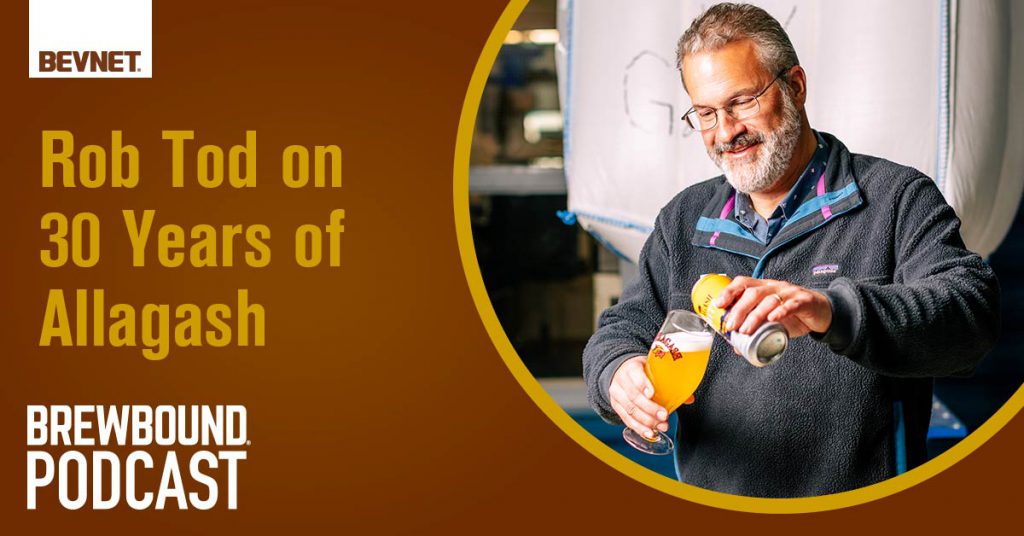
[00:15:12] Zoe Licata: I am so excited that this guest has been able to make time to join us for this conversation because it is always a delight to talk with him. We are going to be sitting down with Rob Tod, founder of Allagash Brewing, based out of Portland, Maine, right up the road from me, which shockingly somehow turns 30 years old this year. Rob, congrats on making it to 30.
[00:15:32] Speaker 1: I know, I can't believe it. You know, it's funny, that picture right behind me there, I was just realizing that I'm blocking with my head, was taken about 30 years ago, right when I finished building the brewery. And I remember that a buddy of mine, Jack, took the picture. It feels like it was yesterday that he was here taking the picture of us opening up. And yeah, I can't believe it's been 30 years.
[00:15:51] Zoe Licata: Which, not to make this about me, but I just turned 40. And in having a conversation with my mom somewhat recently, she was like, I can't believe that I have a 40-year-old. And I was like, I can't believe I am a 40-year-old. So here we are.
[00:16:04] Speaker 1: Well, we're hiring people now that were not born when the brewery started.
[00:16:09] Zoe Licata: That's crazy.
[00:16:11] Speaker 1: Yeah, it really is. I look at them and I feel like I'm their age, but then I look in the mirror and it's like, guess what? I'm a little older than they are.
[00:16:22] Zoe Licata: Well, the thing about working like in and around alcohol is that birthdays are really important. You've got to be checking IDs. And that never failed to shock me when the calendar year return or the next year that you had to be like the birth date year you were looking for on IDs just kept, you know, it would be like, wow, like these kids were born when I was fill in the blanks, high school, this, that, whatever. But it's kind of humbling.
[00:16:42] Speaker 1: Well, it's weird. You've had this experience, probably you go to a bar and you see that date on the wall and it'll say February 28th, 2004. And my first reaction is, oh, they didn't update the date. And I'm like, whoa, that's 21 years ago. But it seems like yesterday I was writing 2004 when I was dating something. Just the years start to go fast.
[00:17:06] Zoe Licata: Nicole Nugent 1 Oh, they really do. Well, so we don't need to get into all of the nitty gritty details of Alligash's story, but there's a lot there that's really interesting. And one thing that I've been thinking about a lot lately, and I'm sure you are not alone in that, a lot of your first brewing equipment was repurposed dairy equipment, right?
[00:17:23] Speaker 1: Oh yeah, it was.
[00:17:24] Zoe Licata: That's super common. So something that I just keep getting stuck in my craw is that one of the earliest, most important craft breweries anchor that everybody took their inspiration from is now owned by a dairy magnate.
[00:17:38] Speaker 1: Chobani, right, that bought it?
[00:17:40] Zoe Licata: Chobani, yeah. What a strange full circle moment.
[00:17:43] Speaker 1: It is. It is.
[00:17:44] Zoe Licata: So anyway, in terms of alligash, one thing I've always heard you say with a little bit of pride was in the early days of the brewery, you couldn't give Allagash White away for free because people were so confused by it. Obviously, that's not the case now. You are probably at or over 120,000 barrels of production every year. But what was the turning point where getting yeses from retailers became easier?
[00:18:09] Speaker 1: It was easily 10 years into it. It was a grind those first few years. And I've got a can here. I should have brought a glass too. And I could have poured a sample. But you obviously know what the beer looks like. But I'd go into accounts with samples. And the first thing I did was pouring a sample in a glass. And the first response I got was, what's wrong with it? Why does it look like that? Because back in 1995, really all through the 90s, very few people had seen cloudy beer. I mean, for the previous 70, 80, 90 years, most of what people were drinking was crystal clear, and that's what brewers strived for. So it really looked completely different, and then they would check out the aroma of the beer, the taste of the beer, which of course was completely different from anything they'd tried before. And if I was lucky, the response would be, you know what? All right, since you're right down the road, I'll put you on tap since you're trying to get going, but I'm going to tell you right now, it's not going to sell. And they were like almost without fail, right? It just didn't sell. I mean, if I was lucky enough to get a line, and I certainly didn't have many in the early days, it generally was the worst selling beer. I'd go into accounts a few months after we got a line and maybe they'd have 12 lines, I'd be like, hey, how's it going? And they'd say, well, you're the second worst selling beer. But I think I kept a lot of those lines in the early days because I was just in those accounts constantly. I mean, I'd come into work at five in the morning and wash kegs till 11 and change out of my boots, drive into town, see two or three accounts, come back to the brewery, wash more kegs, finish at the end of the day and go back and see accounts in town. And I knew we were a target and the other brewers, other distributors would be targeting us because they knew it didn't sell. They'd walk in and say, hey, how's the Allagash White doing? And the bartender would say, you know, it's not doing great at all, but the guy's always in here, so I'm not going to take his beer off. I kept a lot of lines in the early days by creating my own depletions.
[00:20:13] Zoe Licata: Polite persistence pays off.
[00:20:15] Speaker 1: Whatever you got to do.
[00:20:16] Zoe Licata: Right? Well, I assume you were talking to drinkers a lot on those visits and pouring samples. What were those conversations like? Was the idea of beer from Belgium remotely resonating with anybody?
[00:20:28] Speaker 1: No, no, they were just tough conversations. And really I was under the impression for some reason that I'd start the brewery, start selling beer, and then I'd just be coming into the brewery every day and brewing beer and kegging and fixing pumps on the weekend. And I never really considered the fact that I might have to go out and sell it. And I learned pretty quickly that it wasn't going to sell itself and I was going to have to go out and sell. So I just started carving out a ton of time to do ride with with our distributor partners, beer dinners, tasting events, general sales meetings for our distributors. So I just spent a ton of time explaining the beer and explaining things like why it was cloudy, why it looked like it did, and what that contributed to the experience of drinking the beer. and explaining the component of complexity that the spices added and why that yeast strain, which is a traditionally Belgian yeast strain, is so important to making a traditional Belgian-style wheat beer. But it was just literally years, probably a decade, about being out in the trade with customers, talking about the beer, educating I mean, just kind of selling it a pint at a time. You hear that expression sometimes, you sell beer a pint at a time. Well, I lived it. I sold beer a pint at a time for a good decade. And we still do. I was out with a couple of our reps last night in an account and someone at the bar, I saw him order like two or three Allagash White and I still get excited because I don't take it for granted now if people want an order and enjoy the beer. So I still get excited. So of course I bought him his beer. But yeah, it still gets exciting to see people order it, because we went so long without getting the orders.
[00:22:07] Zoe Licata: That is so nice of you to do. How many years in were you before you hired a dedicated sales rep?
[00:22:13] Speaker 1: 2009. So I did it from 95 to 09. We did have some brokerages in the country, some great partnerships with brokerages, but the brokerages, they had a family of brands, a number of beers, including ours, but we didn't have a dedicated rep until 2009.
[00:22:30] Zoe Licata: Which was Naomi?
[00:22:31] Speaker 1: Naomi, exactly. Yep, and she was with us for quite a while.
[00:22:36] Zoe Licata: Naomi's interview on the podcast last year, we had a chat with her as she was leaving just to be like, tell us about your experience. It was our best performing episode of the whole year.
[00:22:45] Speaker 1: Oh, that's awesome. It doesn't surprise me. She's great.
[00:22:48] Zoe Licata: No, the people love Naomi Neville.
[00:22:50] Speaker 1: Absolutely.
[00:22:51] Zoe Licata: And me included.
[00:22:52] Speaker 1: Yeah, she was a big part of growing the brand to what it is today.
[00:22:55] Zoe Licata: A gem of a person. Well, speaking of growing the brand, something that I refer to all the time when we're either writing about Allagash or thinking about craft brand expansion, it's an image that I have in a story that I wrote about a keynote address you gave at the New England Craft Brew Summit in 2020, which was like probably the last beer event I went to before the world shut down, which is honestly, Rob, I think it was five years ago today.
[00:23:19] Speaker 1: It wouldn't surprise me, and it was literally days before COVID hit, because I did that conference, then we went on a family vacation, and when we came back, everything was in full lockdown. I mean, it happened that quickly.
[00:23:31] Zoe Licata: It was so quick. I have an app that reminds you, like, here's what you did or posted or photos you took on this day of X year, and it popped up this morning as I was looking through it. Yeah, so appropriate. But you showed two maps and one was Allagash's distribution footprint in 2005, 26 states, you sold 5,000 barrels. The other was the current map at the time from 2020, 15 states, 100,000 barrels. And that I think there's a lot that younger craft brewers can take away from that. But what lessons do you think are the most obvious from looking at numbers and maps like that?
[00:24:09] Speaker 1: I mean, it basically comes down to what we were just talking about. I couldn't give the beer away in the early days and the solution for right or for wrong and Some good came of it, but some not so good came of it. We've learned from those lessons back then. You know, I sold enough beer to survive just by opening up as many states as I could open up. Anyone who wanted to buy the beer, I'd sell them the beer. And that map isn't even completely accurate, because those are the states that we're direct shipping. But some of those states were actually subbing out to additional states. So you could buy Allagash Brewing well over 30 states. But at the time, we were only making about 5,000 barrels a year, at least at the time we decided to pivot from that model. We were doing about 5,000 barrels of beer a year. We did not have a sales force. To say we weren't doing a good job is an understatement with things like making sure our beer was rotated. stored cold. Collections were tough back then. All the beer was shipping LTL, less than truckloads. So it was a very inefficient way to deliver beer to market. I mean, there were a lot of things that were broken with it. And really it was the definition of a mile wide and an inch deep. And when the brand finally did get some traction, probably starting around 2005, 10 or so years into it, I just kind of looked at myself in the mirror and said, this is not how I want to do business. If we're going to do business, I want to do business well. I want to be excelling versus all the breweries that we were competing with in terms of how we were supporting distributors, getting fresh beer to market. I mean, all of those things that I was just talking about that we were struggling with, I wasn't okay with those things. So we decided over a number of years It to some degree was painful because we walked away from volume. Luckily, the volume we were adding was compensating for some of that volume loss. But I look back and I'm glad we had the discipline at the time to just kind of gradually, one market after the next, pull out of a number of markets. And we went from a strategy of just selling beer wherever we could and really being spread very thin, a mile wide, an inch deep. to really drilling down in markets that, for whatever reason, the brand seemed to really have some traction. And you fast forward to five years ago today, when I was talking at the New England Brewing Summit, we were at that time doing about 100,000 barrels a year and doing it, and I think 18 So, we literally were 20 times deeper, maybe even arguably 30 or 40 times deeper, because we were doing 20 times the volume in many fewer states. And of course, by that period, we had a very robust sales force, much more sophisticated planning and data analysis, and we were just able to do a much better job delivering, I felt like, on all fronts. That's honestly one of the reasons we're beginning to open some new markets. We've had a number of states over the last 15 or 20 years, distributors in a number of states, coming to us, some on a monthly basis, year over year over year. When are you coming back? When are you coming back? And I just keep saying, well, we'll come back when we feel like we've got the capacity and we feel like we can adequately support the market to our standards, which were a lot higher now than they used to be. And so we finally feel like we're at that point, you know, very thoughtfully, incrementally, methodically open up a couple of new markets. But of course, the way we support a market today has literally nothing in common to how we supported it in the old days.
[00:27:38] Zoe Licata: I mean, I assume in the old days you hopped on a plane, went out, met up with the wholesaler, hit a few accounts and kind of did what you could do and then you were back out. But obviously that's not what happens now because you do have the team to support it. You know, when you and when Allagash announced it was returning to Colorado, it was December. It was during our Brewbound Live business conference. The night before the press release hit, I had dinner with your sales director, Josh Fruckman, and we were buddies. Like we had a nice time. He didn't say anything. And then the next morning it lands in my inbox and I text him. I was like, you are a very good secret keeper. He was probably sitting right next to Terry Sokola, who owns Elite Brands, who is your distributor out there. And it was like, all of my friends are keeping secrets from me. But you know, I wrote the story really quick. I mean, Colorado is a state you'd been in the first time, but you've added some states that you weren't in 20 years ago, like Minnesota, brand new market. What metrics gave you the confidence to enter markets like that?
[00:28:36] Speaker 1: Well, a lot of the things I mentioned, I mean, we've got 40 people now on our sales team. Obviously, not all of them are out on the street, but from street level reps that are going from account to account in the market to a sophisticated chain, key accounts, team leadership, data analysis and administration. So very robust team, 40 full time people on the team from data analysis to leadership, to street level reps, key accounts. So, you know, we've obviously got a very strong team from that perspective. Our logistics team is very, very sophisticated. I could tell you at any time exactly how many 5-gallon kegs, 15-gallon kegs we've got on the floor at every single one of our distributors. business units. So we've really optimized how we can support a market, whether it's a very close local market like Boston or Minnesota, Colorado, or even Los Angeles. So we really do feel like we've got a strong, competitive go-to-market plan and that we can do a very, very solid, optimized job supporting our distributor partners.
[00:29:44] Zoe Licata: Awesome. One thing that has kind of stuck out to me is that California has always been a part of the equation. So what's the secret that makes that such a strong market for you guys so far away?
[00:29:53] Speaker 1: Back in 2005, when we started to gradually pull out of some markets, we stayed in the markets where for whatever reason, we didn't do a lot of complex analysis back then. that the brand was really relevant, where we were hitting a certain threshold of sales. And that was the case in California. And it's always been the case. And I think it's a number of factors. Number one, we've always supported that market. I've got a lot of ties to that market. My mom grew up in California, so I've been visiting there all my life. I love going out there. I think even to this day, there really isn't another beer in that market quite like Allagash White. It works perfectly with the climate out there. We've always had great distributor partners in California. So I think it's just a really nice mix of a bunch of elements that have delivered a ton of success for us and continue to deliver success.
[00:30:46] Zoe Licata: Awesome. Well, when you're talking to new distributors, what are you looking for? What's the best indicator to you that they're going to be the right steward for Alligash?
[00:30:54] Speaker 1: So we're looking for a lot. Number one, just engagement and excitement with the brand. As I mentioned, for the past 15 or 20 years, there have been a number of distributors that have regularly reached out at a regular cadence. And, you know, if someone's been reaching out for 10, 12, 15 years, I know they're excited about the brand and they're engaged in the brand. We have a much, much more sophisticated way of engaging with distributors and evaluating them prior to going into a market than we used to have. I was actually just reviewing that template with Josh earlier today, but it's probably a 10-tab spreadsheet that Prospective Distributor has to populate, and it covers everything from the size of their sales force, service levels, how often they're delivering, if it's legal to have a merchandising team, how many merchandisers they have, the cadence of the merchandising, their technology and reporting capabilities, their willingness to work with us doing a regular general sales meeting cadence. We, of course, do monthly business reviews right now. So we want to make sure that they've got the technology and the capacity to sit down and do those with us. And of course, we look at things, logistical components like are they able to be moving enough product for us to be shipping efficiently to them and for them to store our beer refrigerated. So we look at a ton of factors and weigh those. I wouldn't say there's one, because if you look at, say, three or four potential distributor partners, they've all got their pros and cons, pluses and minus in terms of capabilities. So we just try to look at all of those as a mix and evaluate our options and then make a decision. We certainly haven't gone into that many states over the last few years, even though we feel like we do have enough capacity to service a couple states. And additionally, there's just more predictability in the trajectory of the market right now. It's not growing 10%, 15%, 20% a year anymore. So we feel with that predictability, we can methodically open up a couple of states. And I could see maybe one more coming down the pike over the next couple of years. But that's probably going to be it for a little while.
[00:33:06] Zoe Licata: I would be a very bad teammate if I did not lobby to you to open Iowa for my buddy Justin, who I know misses having Allie Allagash White on the regular, but...
[00:33:17] Speaker 1: I'll take that into consideration.
[00:33:20] Zoe Licata: I'm sure he would thank you very much. Well, let's get into products. So something that I've always found really impressive is that Allagash never seems to chase fads with products that might feel inauthentic to the brand. We've seen a lot of that lately throughout the industry from breweries of brands of all sizes, people chasing either FMBs and it doesn't feel right to them or hard seltzers or who knows what. And it's tough out there and I understand the temptation to do things like that. but you guys have always exercised such restraint in that area. What are those internal conversations like and when do you know what's right and what's wrong?
[00:33:56] Speaker 1: Dr. Kahneman Well, we of course have them a lot. And I mean, we open the doors as a Belgian-inspired brewery. The only beer I brewed really for the first year was Allagash White. And then probably the next six or seven styles we came out with were Belgian styles. So we kind of have our roots in that tradition, but I've never felt like we're limited just to that traditional Belgian tradition. And for years, we've played around with styles like IPAs, some traditional lagers. And in fact, we've got a really cool program here at the brewery If anyone, regardless of what they do at the brewery, whether they're accounting sales, in production, in our logistics building, if they have an idea for a beer, they can go to our pilot brewing team and propose an idea and brew it on a little 10-gallon system. And we're literally running that system 100 times a year. And we've been doing that for a number of years. So we probably have 500, 600, 700 unique recipes. I mean, obviously, some of them have some things in common with that many beers. who we just have this massive quiver of beers. And really, it's approach that's really, really important to us, not necessarily a specific style. So for me, it's things like balance and drinkability and complexity and authenticity. So as long as it's checking those boxes and as long as that's something that we're inspired by, I mean, if we can match that up with something our consumers are asking for, then we're absolutely going to do it. I mean, we have been asked for years, you know, when are you guys going to do a logger? There are a lot of breweries doing Great Lost. When are you guys going to do a hazy? And we're excited about it. We just released a hazy. I had a couple at home last night. It's delicious. I'm very proud of it. I'm excited. I'm excited for it. So if we can kind of create that moment where what our distributors are asking for, what customers are asking for, retailers and bars are asking for, if we can get that to dovetail with something that we feel is as like a lot of cultural integrity and authenticity, we will absolutely go to market with it. And I think there's plenty more opportunity for us to explore new styles. We just came out with a variety package. very excited about.
[00:36:17] Zoe Licata: I am very excited about that.
[00:36:19] Speaker 1: I don't know if it's shipped yet. We're retooling our packaging line to make assembling variety packs much more efficient, but the work's not done yet, so it's kind of all hands on deck with the first run, and I was down there last week helping out. It was fun. I'm excited. It's like the true variety pack. It's got our triple in it, which has never been in a can, so 9% triple. Of course, it's got to have Allagash White in it, 5.2% Belgian-style Whitbeer. It's got our new lager release, which is a little under 5%. Just classic Euro-style pills, lagers, very drinkable and approachable. And then a hazy, I think it's about 6.7%. Three different yeast strains, different fermentation profiles, completely different hop profiles. So there's something for everyone in that pack.
[00:37:05] Zoe Licata: literally something for everybody. I have to tell you, the past two years, my very large, loud Italian-American, New Jersey-based family does the Feast of the Seven Fishes every Christmas Eve, and I have been doing mussels in alligash triple, which is not Italian at all, but I don't want to brag, but I think it seals the show.
[00:37:24] Speaker 1: The triple with shellfish is so good. With oysters, it's unbelievable. And I could see it working real well with something like steamed clams or steamed mussels.
[00:37:32] Zoe Licata: Oh, for sure.
[00:37:33] Speaker 1: Got that flavor, but not a lot of bitterness.
[00:37:35] Zoe Licata: Most recipes and like fancy cookbook writers don't always think about beer. You know, like I feel like whenever beer is being used in a recipe, it's usually an afterthought. So in the New York Times recipe that I use, it just says like, any beer will do, but that's not true. Like it is this beer and only this beer for me. So thank you.
[00:37:53] Speaker 1: Thanks for including it in the ingredients list.
[00:37:56] Zoe Licata: Anytime. So looking back, what retired beer in Allagash's 30-year history would you love to see make a comeback?
[00:38:04] Speaker 1: We're doing a lot of just walks down memory lane with our 30th anniversary this year. We were just talking about that yesterday, like maybe we could do like a new beer each day, which we can only do in the local market, like bring back some of these really cool beers. And one of them, which you I just loved was the double. It was the second beer that we did. It was 7%, like very traditional Belgian style. You know, maybe a little bit drier than your typical doubles, but really unique, like rummy, raisiny, like plummy character. I loved it. For some reason, that style just wasn't doing the volume to justify keeping it. So we walked away from it. We now actually released that as a seasonal. It's called Foliage Report. It does great. That one I'd love to see come back. We had a great beer for years called the Grand Cru, which was, I don't know if you remember that one, it was a 7% kind of a strong golden ale, you could call it. And it was spiced with anise, so it had like a nice kind of licorice-y background. That was a fun one.
[00:39:05] Zoe Licata: That sounds delicious, but I assume perhaps underappreciated in its time, as many great beers are.
[00:39:11] Speaker 1: There are like dozens and dozens of beers that we love that I wish we could do. But, you know, we were all well aware in this world right now. I mean, what we ask our distributors to partner with us and sell, we got to be very, very thoughtful about. And we need to make sure everything that we're getting behind it, we're asking them to get behind it. We're asking our retailer partners to get behind. It needs to deliver value for them on some front.
[00:39:41] Zoe Licata: Yeah, 5,000%.
[00:39:43] Speaker 1: And if it doesn't, yet if it's tough to walk away from, we still got to walk away from it.
[00:39:46] Zoe Licata: A lot of hard decisions being made out there for sure. So to get ready for our chat, I read your profile in the Boston Globe, which came out I think this week, last week. And I love how you guys talked about the Great Lost Bear, which is your first account at all, right? I assume you were there on tap before you ever had a packaged beer in a market. And you go back every July 1st to celebrate the first day they put it on. What can we expect this coming July 1st?
[00:40:13] Speaker 1: You can expect me to be sitting in that same seat drinking an Allie Allagash White. Yeah, I do it every year. And I'm almost always around because I do not like leaving Maine in the summer. This time of year, I'm happy to leave Maine, January, February, March, you know, during snow season, mud season. But the middle of July, it's beautiful. So I'm usually sticking around. I mean, I remember like it was yesterday, that was our very first draft line. I shipped eight kegs of Allagash White to Nappy Distributors on June 29th and July 1st. I worked at the brewery all day and my plan was to head down to the bear where I knew it was going on tap at five o'clock and just hang out for a few hours and having a bunch of beers. And I kind of thought, my work's going to be done. Spent a year building the brewery. I've written this recipe. I've brewed the beer. I'm kind of all done. I'm there. So I went down there and Mike Dixon and Dave and Chip, the owners, they were right there. We poured a beer. I had a pint and I was very happy with it. And I had another pint and then I was like, I got to get back to work. I got in my car and I drove right back to the brewery and kept working on whatever I was working on at the time, probably just continuing to build and piece the brewery together. But yeah, I've always felt like just the work isn't done.
[00:41:30] Zoe Licata: Yeah. Well, and keeping that connection with your longest serving account, so, so important. You and I have talked about this. I used to work at Boston Beer. I worked on the Sam Adams brand. My introduction to both that company and this whole industry was giving tours at the brewery in Jamaica Plain, right down the road from Jim's first account, which was Doyle's, which is no longer among us, but...
[00:41:48] Speaker 1: I remember Doyle's. That was our first account in Boston in probably 1996, 1997.
[00:41:54] Zoe Licata: Wow. I feel like they were so welcoming of new craft brands. I want to say it's one of Harpoon's first accounts too.
[00:42:04] Speaker 1: It was a great bar.
[00:42:05] Zoe Licata: Yeah, I mean, I want to say they said goodbye before COVID. Something got built on that spot now, but you know, you always remember who said yes to you in the early days, and it's really nice to keep those ties.
[00:42:19] Speaker 1: I certainly do. I mean, I still absolutely know who the first six lines that we have, and I know who the decision makers were in all of those six places, and I will be forever thankful.
[00:42:31] Zoe Licata: So hear me out. I feel like those first six bars, July 1st, would be a perfect bar crawl.
[00:42:37] Speaker 1: There's a few of them that are still around. One of them, interestingly enough, is another brewery, Grady McDuff's. And, you know, Richard and Ned are really good friends. And when we opened the door, they literally were one of our first six lines. And they had it on for six or so months. And then I believe they had to take it off because Their cooler was a bonded area and they couldn't mix something they were buying from a distributor with their beers that were in a bonded area. So they had to take it off. And they just put it back on tap about a year ago. So I love popping by there and they're real good friends of ours.
[00:43:10] Zoe Licata: What a great full circle story. So something that I think everybody in Kraft and also beyond that admires about Allagash White the culture that you guys have built. and you routinely rank among the best places to work in Maine. What do you think has helped foster a culture that people really seem to enjoy working in?
[00:43:29] Speaker 1: It's always been important to me. And I think that's why I got into the beer business in the first place. I mean, I love everything about this business, whether it's, I love working with my hands, whether it's coming in and washing kegs, even if it's a tough job, working on the packaging line, you know, fixing something, welding, going out in the market and selling. I just, I love every facet of this business. It's one of the reasons I'm in it and I just couldn't imagine a world where I'm not going to work every day, like from the moment I wake up, like excited about being here and passionate about what I'm doing. I mean, of course there are going to be tough days. I have tough days like everyone, but I'm just so passionate about this. And it's just really, really important to me that to the extent that's possible, everyone here at the company feels like that. So leadership spends a lot of time engaging with employees really on all levels. I don't just come up here, show up in the morning at eight in the morning and pop in my office and close the door and then leave at six at night. I'm probably out on the floor more often than I'm sitting in the office. And I'm out engaging with people. And, you know, leadership here at this company, they genuinely care how everyone at the company feels, how everyone's doing. And I love just being out on the floor, sharing their passion in whatever they're doing. Every year we do a best places to work survey that's like very, very comprehensive. And we absolutely don't do that for our score at the end of the year. The reason we do it is it is one more way for us to get the pulse with how people are feeling, like how's their work environment, you know, how are they feeling about how they're engaging with leadership? Do they have the tools at their disposal to do their job? Do they understand what they're being asked to do and what the mission and the purpose are? So we want to ask those questions because we're genuinely interested in how we can do better on that front. And of course, there are always going to be things that we can work on. And none of that work is easy work, but it's work that we take really, really seriously. And it's work that it's like inspiring for me to do, because if we're improving from the perspective of our employees, that's a win I feel really, really good about. For me, it's not coming in and getting to 10,000 barrels a year or 50,000 barrels a year or 100,000 barrels a year. But if we're winning on a front satisfaction, if people have been feeling better with each passing year about coming into work every day and spending their day here and hopefully feeling like they're contributing, that's the kind of win that really means a lot to me. It's something that's inspiring for me.
[00:46:18] Zoe Licata: amazing. I mean, it pays off too because to be kind of like racked my brain thinking of all the Alligashians I've met over the years, every single one of them is so kind and just a delight to be around. Another thing that's super important to your culture and like the people of your culture is the ties to Belgian beer. And you guys do employee trips to Belgium. Why is it so important to keep that tie going?
[00:46:44] Speaker 1: It's kind of our roots. I started making, as we just talked about, the first six or seven, eight beers we made were really traditional Belgian styles. It's been a brewing tradition that's always fascinated me, not strictly from the perspective of these specific styles I'm going to limit myself to and ourselves to, more from an approach perspective. I mean, the Belgian brewing tradition is open to brewing with. many, many different approaches from a brewing technique perspective, many approaches with ingredients, with unmalted grains, with spices, with fruits, approaches to different kinds of aging, like barrel aging, the presentation of the beer, the glassware. I've just been intrigued by really an approach of curiosity and an approach of like balance and complexity. So I think it's important for us to continue to like recognize that that in a lot of ways kind of was the fuel for our approach to making beers and should continue to be the fuel to our approach to making beers. Even if it's a beer style that you wouldn't usually think of as traditionally Belgian, that approach is important. And yes, we do. Jason, the brewmaster, and I bring employees who've been at the company for five years to Belgium every single year. And I'm already looking forward to it, just talking about it now. I can't wait. It's a blast. From the moment we get to the airport, and, you know, hang out on our inevitable layover on the way there and then fly over there and get there in the morning and head right to a brewery, amazing dinners together at really cool places. And Jason and I have a lot of relationships with breweries over there, and it's always fun to see them. They're always really, really welcoming. And we, of course, have always had a ton of respect for the brewers that we know over there and their tradition.
[00:48:38] Zoe Licata: I started my honeymoon in Brussels.
[00:48:39] Speaker 1: Me too. Betsy and I went right to Brussels, yeah. Oh, look at that. Yep. She was very tolerant on her honeymoon going to basically visit breweries. At least you're doing it in a beautiful place, right?
[00:48:50] Zoe Licata: I mean, really, you can't beat it. A lot of people kept asking, and why are you doing this? And I was like, to drink beer. So awesome. Well, Rob, I think that's a great place to leave it. You've been so generous with your time and I really appreciate it. It is always a joy to speak with you and the whole team and congratulations on three decades. It's so, so impressive.
[00:49:10] Speaker 1: Well, thank you very much. And it was a pleasure and I love doing these. It's a nice way to kind of mix up the day a little bit. And I get to drink a beer at two o'clock.
[00:49:20] Zoe Licata: Anyway, to drink a beer, as soon as we hang up, I'm going to text my husband to ask him to stop to pick some up on his way home from work and picking up our daughter at daycare, because now I would really like one. And that is our show for this week. Always such a pleasure to speak with Rob and hear all about Alligash. Thank you so much to him for joining. Thank you to Justin and Zoe for being impeccable co-hosts all the time and to the whole Brewbound BevNET audio visual crew that makes all of this possible. If you enjoyed this podcast, please give our show a rating, a review on your platform of choice. It will really help make sure the show gets pushed out to other beer lovers who can discover it. And if you have any feedback, we are all ears podcast at Brewbound.com. We'll be back with a fresh episode next week. Thank you so much.